

234
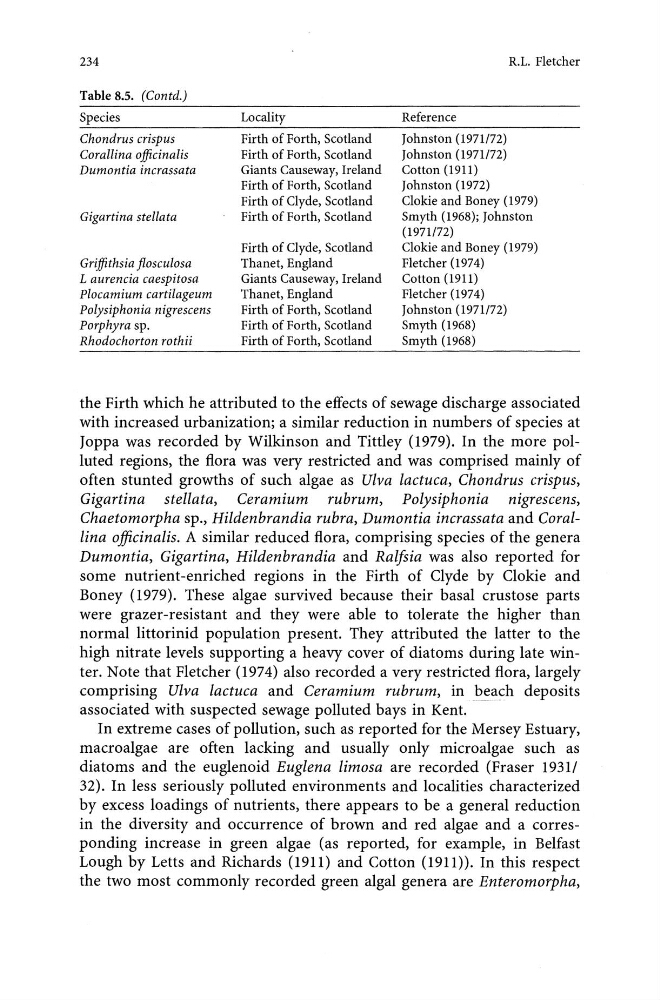
Table 8.5. (Contd.)
Species
Chondrus crisp us
Corallina officinalis
Dumontia incrassata
Gigartina stellata
Griffithsia flosculosa
L aurencia caespitosa
Plocamium cartilageum
Polysiphonia nigrescens
Porphyra sp.
Rhodochorton rothii
Locality
Firth of Forth, Scotland
Firth of Forth, Scotland
Giants Causeway, Ireland
Firth of Forth, Scotland
Firth of Clyde, Scotland
Firth of Forth, Scotland
Firth of Clyde, Scotland
Thanet, England
Giants Causeway, Ireland
Thanet, England
Firth of Forth, Scotland
Firth of Forth, Scotland
Firth of Forth, Scotland
Reference
Johnston (1971/72)
Johnston (1971/72)
Cotton (1911)
Johnston (1972)
R.L. Fletcher
Clokie and Boney (1979)
Smyth (1968); Johnston
(1971/72)
Clokie and Boney (1979)
Fletcher (1974)
Cotton (1911)
Fletcher (1974)
Johnston (1971/72)
Smyth (1968)
Smyth (1968)
the Firth which he attributed to the effects of sewage discharge associated
with increased urbanization; a similar reduction in numbers of species at
Joppa was recorded by Wilkinson and Tittley (1979). In the more polluted regions, the flora was very restricted and was comprised mainly of
often stunted growths of such algae as Ulva lactuca, Chondrus crisp us,
Gigartina stellata, Ceramium rubrum, Polysiphonia nigrescens,
Chaetomorpha sp., Hildenbrandia rubra, Dumontia incrassata and Corallin a officinal is. A similar reduced flora, comprising species of the genera
Dumontia, Gigartina, Hildenbrandia and Ralfsia was also reported for
some nutrient -enriched regions in the Firth of Clyde by Clokie and
Boney (1979). These algae survived because their basal crustose parts
were grazer-resistant and they were able to tolerate the higher than
normal littorinid population present. They attributed the latter to the
high nitrate levels supporting a heavy cover of diatoms during late winter. Note that Fletcher (1974) also recorded a very restricted flora, largely
comprising Ulva lactuca and Ceramium rubrum, in beach deposits
associated with suspected sewage polluted bays in Kent. ~-~In extreme cases of pollution, such as reported for the Mersey Estuary,
macro algae are often lacking and usually only micro algae such as
diatoms and the euglenoid Euglena limosa are recorded (Fraser 1931/
32). In less seriously polluted environments and localities characterized
by excess loadings of nutrients, there appears to be a general reduction
in the diversity and occurrence of brown and red algae and a corresponding increase in green algae (as reported, for example, in Belfast
Lough by Letts and Richards (1911) and Cotton (1911». In this respect
the two most commonly recorded green algal genera are Enteromorpha,
Table 8.5. (Contd.)
Species
Chondrus crisp us
Corallina officinalis
Dumontia incrassata
Gigartina stellata
Griffithsia flosculosa
L aurencia caespitosa
Plocamium cartilageum
Polysiphonia nigrescens
Porphyra sp.
Rhodochorton rothii
Locality
Firth of Forth, Scotland
Firth of Forth, Scotland
Giants Causeway, Ireland
Firth of Forth, Scotland
Firth of Clyde, Scotland
Firth of Forth, Scotland
Firth of Clyde, Scotland
Thanet, England
Giants Causeway, Ireland
Thanet, England
Firth of Forth, Scotland
Firth of Forth, Scotland
Firth of Forth, Scotland
Reference
Johnston (1971/72)
Johnston (1971/72)
Cotton (1911)
Johnston (1972)
R.L. Fletcher
Clokie and Boney (1979)
Smyth (1968); Johnston
(1971/72)
Clokie and Boney (1979)
Fletcher (1974)
Cotton (1911)
Fletcher (1974)
Johnston (1971/72)
Smyth (1968)
Smyth (1968)
the Firth which he attributed to the effects of sewage discharge associated
with increased urbanization; a similar reduction in numbers of species at
Joppa was recorded by Wilkinson and Tittley (1979). In the more polluted regions, the flora was very restricted and was comprised mainly of
often stunted growths of such algae as Ulva lactuca, Chondrus crisp us,
Gigartina stellata, Ceramium rubrum, Polysiphonia nigrescens,
Chaetomorpha sp., Hildenbrandia rubra, Dumontia incrassata and Corallin a officinal is. A similar reduced flora, comprising species of the genera
Dumontia, Gigartina, Hildenbrandia and Ralfsia was also reported for
some nutrient -enriched regions in the Firth of Clyde by Clokie and
Boney (1979). These algae survived because their basal crustose parts
were grazer-resistant and they were able to tolerate the higher than
normal littorinid population present. They attributed the latter to the
high nitrate levels supporting a heavy cover of diatoms during late winter. Note that Fletcher (1974) also recorded a very restricted flora, largely
comprising Ulva lactuca and Ceramium rubrum, in beach deposits
associated with suspected sewage polluted bays in Kent. ~-~In extreme cases of pollution, such as reported for the Mersey Estuary,
macro algae are often lacking and usually only micro algae such as
diatoms and the euglenoid Euglena limosa are recorded (Fraser 1931/
32). In less seriously polluted environments and localities characterized
by excess loadings of nutrients, there appears to be a general reduction
in the diversity and occurrence of brown and red algae and a corresponding increase in green algae (as reported, for example, in Belfast
Lough by Letts and Richards (1911) and Cotton (1911». In this respect
the two most commonly recorded green algal genera are Enteromorpha,