

The British Isles
225
Table 8.2. Sources of pollution load discharged in Southampton
Water (expressed as kg day-I). (After Wright 1980)
AmmoniumN Nitrate N
Streams
198
8445
Industrial
2675
645
Sewage
1803
542
Table 8.3. Sources of input of nitrogen in
Dublin Bay, Ireland. (After Wilson et al. 1990)
River Input
71.6%
Domestic Sewage
24.4%
Atmosphere
4.1 %
Natural Nitrogen Fixation
0.2%
Phosphate P
300
82.4
517
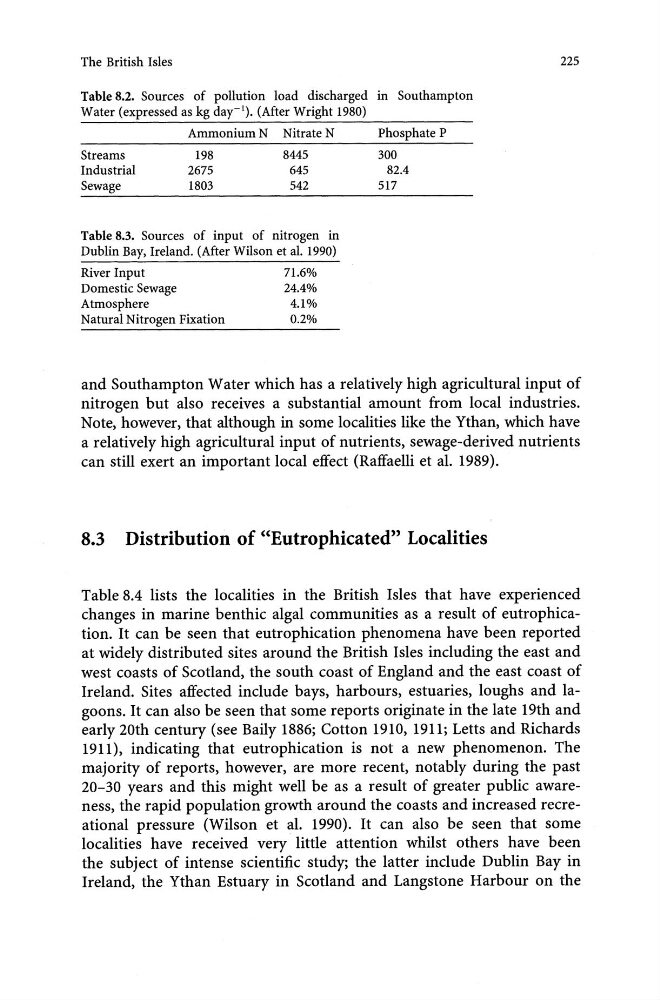
and Southampton Water which has a relatively high agricultural input of
nitrogen but also receives a substantial amount from local industries.
Note, however, that although in some localities like the ythan, which have
a relatively high agricultural input of nutrients, sewage-derived nutrients
can still exert an important local effect (Raffaelli et al. 1989).
8.3 Distribution of "Eutrophicated" Localities
Table 8.4 lists the localities in the British Isles that have experienced
changes in marine benthic algal communities as a result of eutrophication. It can be seen that eutrophication phenomena have been reported
at widely distributed sites around the British Isles including the east and
west coasts of Scotland, the south coast of England and the east coast of
Ireland. Sites affected include bays, harbours, estuaries, loughs and lagoons. It can also be seen that some reports originate in the late 19th and
early 20th century (see Baily 1886; Cotton 1910, 1911; Letts and Richards
1911), indicating that eutrophication is not a new phenomenon. The
majority of reports, however, are more recent, notably during the past
20-30 years and this might well be as a result of greater public awareness, the rapid population growth around the coasts and increased recreational pressure (Wilson et al. 1990). It can also be seen that some
localities have received very little attention whilst others have been
the subject of intense scientific study; the latter include Dublin Bay in
Ireland, the Ythan Estuary in Scotland and Langstone Harbour on the
225
Table 8.2. Sources of pollution load discharged in Southampton
Water (expressed as kg day-I). (After Wright 1980)
AmmoniumN Nitrate N
Streams
198
8445
Industrial
2675
645
Sewage
1803
542
Table 8.3. Sources of input of nitrogen in
Dublin Bay, Ireland. (After Wilson et al. 1990)
River Input
71.6%
Domestic Sewage
24.4%
Atmosphere
4.1 %
Natural Nitrogen Fixation
0.2%
Phosphate P
300
82.4
517
and Southampton Water which has a relatively high agricultural input of
nitrogen but also receives a substantial amount from local industries.
Note, however, that although in some localities like the ythan, which have
a relatively high agricultural input of nutrients, sewage-derived nutrients
can still exert an important local effect (Raffaelli et al. 1989).
8.3 Distribution of "Eutrophicated" Localities
Table 8.4 lists the localities in the British Isles that have experienced
changes in marine benthic algal communities as a result of eutrophication. It can be seen that eutrophication phenomena have been reported
at widely distributed sites around the British Isles including the east and
west coasts of Scotland, the south coast of England and the east coast of
Ireland. Sites affected include bays, harbours, estuaries, loughs and lagoons. It can also be seen that some reports originate in the late 19th and
early 20th century (see Baily 1886; Cotton 1910, 1911; Letts and Richards
1911), indicating that eutrophication is not a new phenomenon. The
majority of reports, however, are more recent, notably during the past
20-30 years and this might well be as a result of greater public awareness, the rapid population growth around the coasts and increased recreational pressure (Wilson et al. 1990). It can also be seen that some
localities have received very little attention whilst others have been
the subject of intense scientific study; the latter include Dublin Bay in
Ireland, the Ythan Estuary in Scotland and Langstone Harbour on the