

224
R.L. Fletcher
The present paper examines the phenomenon and environmental impact
of eutrophication on benthic algal communities around the British Isles.
8.2 Sources of Nutrients
In general, primary producers rely on the natural annual cycle of nutrients to complete their biological processes. This primarily revolves
around the pelagic activities associated with the spring bloom of phytoplankton. Locally it can involve the decay of accumulations of rotting
seaweed (Thrush 1986). Anthropogenic sources of nutrients can, however, be important and have been found to exert a major influence on
both pelagic and benthic communities. Around the British Isles, the
three main sources of these nutrients are industrial wastes, sewage
discharges and agricultural runoff.
The relative proportions of these sources entering the marine environment will vary for different localities. Not surprisingly, estuaries that
are heavily industrialized, such as the Tyne on the NE coast of England,
will be a source of both domestic and trade waste nutrient discharges,
whilst those which are less populated and support only light industries,
for example the Wear, also in NE England, and the Ythan in NE
Scotland, are more likely to receive a higher proportion of nutrients
derived from agriculture and sewage. The source will also determine the
chemical form of the nutrients, for example a large amount of ammoniacal nitrogen was reported to be released into Southampton Water from
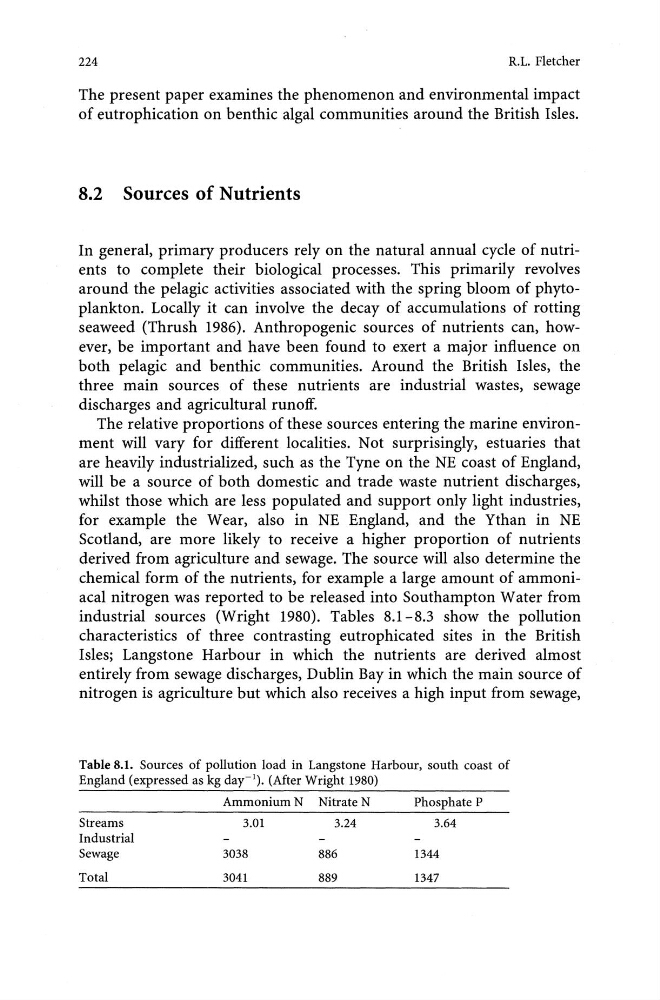
industrial sources (Wright 1980). Tables 8.1-8.3 show the pollution
characteristics of three contrasting eutrophicated sites in the British
Isles; Langstone Harbour in which the nutrients are derived almost
entirely from sewage discharges, Dublin Bay in which the main source of
nitrogen is agriculture but which also receives a high input from sewage,
Table 8.1. Sources of pollution load in Langstone Harbour, south coast of
England (expressed as kg day-I). (After Wright 1980)
AmmoniumN Nitrate N
Phosphate P
Streams
3.01
3.24
3.64
Industrial
Sewage
3038
886
1344
Total
3041
889
1347
R.L. Fletcher
The present paper examines the phenomenon and environmental impact
of eutrophication on benthic algal communities around the British Isles.
8.2 Sources of Nutrients
In general, primary producers rely on the natural annual cycle of nutrients to complete their biological processes. This primarily revolves
around the pelagic activities associated with the spring bloom of phytoplankton. Locally it can involve the decay of accumulations of rotting
seaweed (Thrush 1986). Anthropogenic sources of nutrients can, however, be important and have been found to exert a major influence on
both pelagic and benthic communities. Around the British Isles, the
three main sources of these nutrients are industrial wastes, sewage
discharges and agricultural runoff.
The relative proportions of these sources entering the marine environment will vary for different localities. Not surprisingly, estuaries that
are heavily industrialized, such as the Tyne on the NE coast of England,
will be a source of both domestic and trade waste nutrient discharges,
whilst those which are less populated and support only light industries,
for example the Wear, also in NE England, and the Ythan in NE
Scotland, are more likely to receive a higher proportion of nutrients
derived from agriculture and sewage. The source will also determine the
chemical form of the nutrients, for example a large amount of ammoniacal nitrogen was reported to be released into Southampton Water from
industrial sources (Wright 1980). Tables 8.1-8.3 show the pollution
characteristics of three contrasting eutrophicated sites in the British
Isles; Langstone Harbour in which the nutrients are derived almost
entirely from sewage discharges, Dublin Bay in which the main source of
nitrogen is agriculture but which also receives a high input from sewage,
Table 8.1. Sources of pollution load in Langstone Harbour, south coast of
England (expressed as kg day-I). (After Wright 1980)
AmmoniumN Nitrate N
Phosphate P
Streams
3.01
3.24
3.64
Industrial
Sewage
3038
886
1344
Total
3041
889
1347