

192
P.R. Nienhuis
combination with a relatively low water exchange in these vertically
stratified and almost non-tidal waters, local and regional effects of
increased macroalgal biomass, and decreased oxygen concentrations in
bottom water leading to mortalities of benthic animals and decreased
fish catches have at times been observed. The effects were first noted in
the Baltic proper, but are now obvious also in Swedish and Danish
coastal areas in the Kattegat and the Belt Sea (Rosenberg 1985).
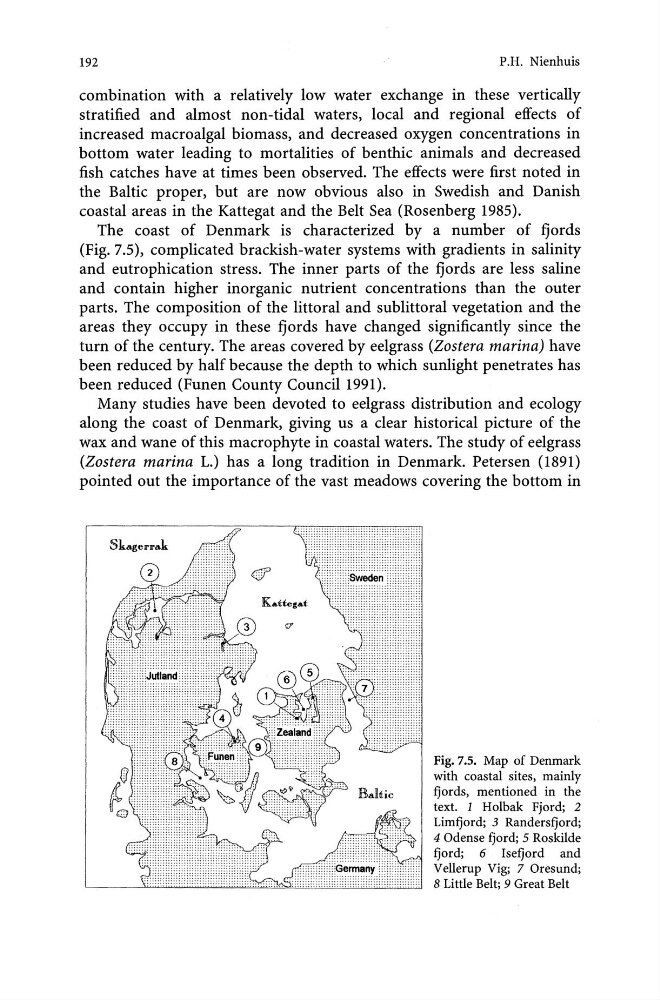
The coast of Denmark is characterized by a number of fjords
(Fig. 7.5), complicated brackish-water systems with gradients in salinity
and eutrophication stress. The inner parts of the fjords are less saline
and contain higher inorganic nutrient concentrations than the outer
parts. The composition of the littoral and sublittoral vegetation and the
areas they occupy in these fjords have changed significantly since the
turn of the century. The areas covered by eelgrass (Zostera marina) have
been reduced by half because the depth to which sunlight penetrates has
been reduced (Funen County Council 1991).
Many studies have been devoted to eelgrass distribution and ecology
along the coast of Denmark, giving us a clear historical picture of the
wax and wane of this macrophyte in coastal waters. The study of eelgrass
(Zostera marina 1.) has a long tradition in Denmark. Petersen (1891)
pointed out the importance of the vast meadows covering the bottom in
Skagerr...k
Fig.7.S. Map of Denmark
with coastal sites, mainly
fjords, mentioned in the
text. 1 Holbak Fjord; 2
Limfjord; 3 Randersfjord;
4 Odense fjord; 5 Roskilde
fjord; 6 Isefjord and
Vellerup Vig; 7 Oresund;
8 Little Belt; 9 Great Belt
P.R. Nienhuis
combination with a relatively low water exchange in these vertically
stratified and almost non-tidal waters, local and regional effects of
increased macroalgal biomass, and decreased oxygen concentrations in
bottom water leading to mortalities of benthic animals and decreased
fish catches have at times been observed. The effects were first noted in
the Baltic proper, but are now obvious also in Swedish and Danish
coastal areas in the Kattegat and the Belt Sea (Rosenberg 1985).
The coast of Denmark is characterized by a number of fjords
(Fig. 7.5), complicated brackish-water systems with gradients in salinity
and eutrophication stress. The inner parts of the fjords are less saline
and contain higher inorganic nutrient concentrations than the outer
parts. The composition of the littoral and sublittoral vegetation and the
areas they occupy in these fjords have changed significantly since the
turn of the century. The areas covered by eelgrass (Zostera marina) have
been reduced by half because the depth to which sunlight penetrates has
been reduced (Funen County Council 1991).
Many studies have been devoted to eelgrass distribution and ecology
along the coast of Denmark, giving us a clear historical picture of the
wax and wane of this macrophyte in coastal waters. The study of eelgrass
(Zostera marina 1.) has a long tradition in Denmark. Petersen (1891)
pointed out the importance of the vast meadows covering the bottom in
Skagerr...k
Fig.7.S. Map of Denmark
with coastal sites, mainly
fjords, mentioned in the
text. 1 Holbak Fjord; 2
Limfjord; 3 Randersfjord;
4 Odense fjord; 5 Roskilde
fjord; 6 Isefjord and
Vellerup Vig; 7 Oresund;
8 Little Belt; 9 Great Belt