

The Baltic Sea and Its Transition Zones
147
5
9
i
10
o
-
-
-
59 -
-
-
-
-
-
a
c
- ~
1-:' ;' ;' ;' ;' ;)
......
~ -".rI'-"~
c:::I
PLANTS
Bluegreen
Green
Brown
(F=Fucus)
Red
o Animals
b
Furholrrten 1974
5F g dryweight 1D-2
i : ' \ . ~ ~ : : : : : : : ' : : : l ' : " : : : : : : : : : : : : : : . : : : : : : ' : : ; : : : : : ~ : : : : : : ' : ~ : : ::ft::;iiJ:::::::::::::::::::::::.:::t:::::::::::::::.;:::::::;:' ::: ::::t::I~~6:",2
. :, .,'.
:: ~ ~ ::
:::::' . ~
: .
. "
:: :
d
Furholrrten 1990
ANIMALS
sInaU groups
snails
Inussels
(M=Mytilus)
Insects
PhanerogaInS
Crustacea
Others
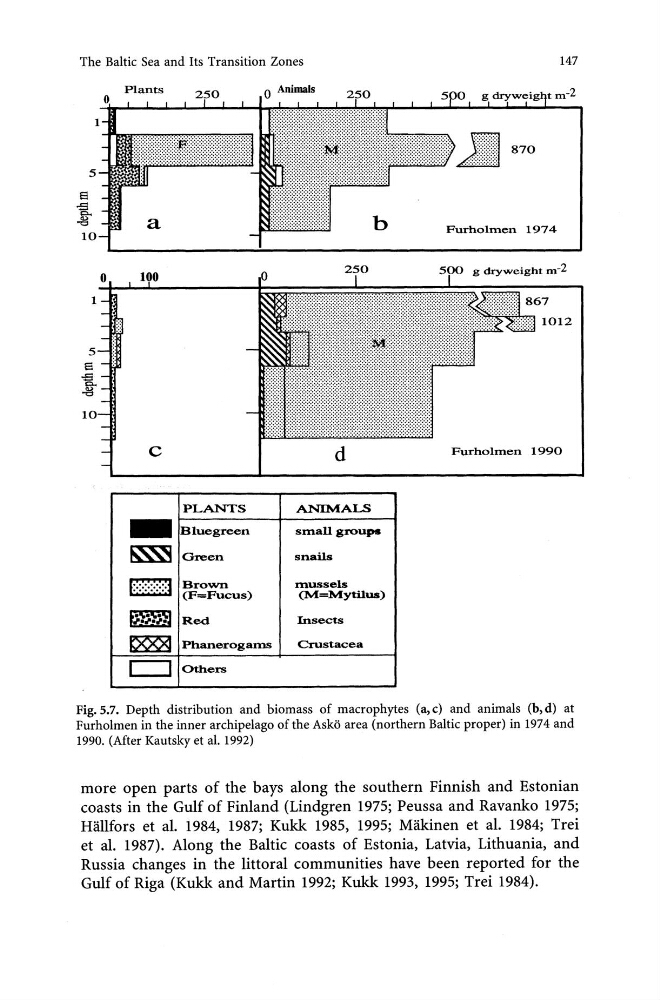
Fig.S.7. Depth distribution and biomass of macrophytes (a, c) and animals (b, d) at
Furholmen in the inner archipelago of the Asko area (northern Baltic proper) in 1974 and
1990. (After Kautsky et al. 1992)
more open parts of the bays along the southern Finnish and Estonian
coasts in the Gulf of Finland (Lindgren 1975; Peussa and Ravanko 1975;
Hallfors et al. 1984, 1987; Kukk 1985, 1995; Miikinen et al. 1984; Trei
et al. 1987). Along the Baltic coasts of Estonia, Latvia, Lithuania, and
Russia changes in the littoral communities have been reported for the
Gulf of Riga (Kukk and Martin 1992; Kukk 1993, 1995; Trei 1984).
147
5
9
i
10
o
-
-
-
59 -
-
-
-
-
-
a
c
- ~
1-:' ;' ;' ;' ;' ;)
......
~ -".rI'-"~
c:::I
PLANTS
Bluegreen
Green
Brown
(F=Fucus)
Red
o Animals
b
Furholrrten 1974
5F g dryweight 1D-2
i : ' \ . ~ ~ : : : : : : : ' : : : l ' : " : : : : : : : : : : : : : : . : : : : : : ' : : ; : : : : : ~ : : : : : : ' : ~ : : ::ft::;iiJ:::::::::::::::::::::::.:::t:::::::::::::::.;:::::::;:' ::: ::::t::I~~6:",2
. :, .,'.
:: ~ ~ ::
:::::' . ~
: .
. "
:: :
d
Furholrrten 1990
ANIMALS
sInaU groups
snails
Inussels
(M=Mytilus)
Insects
PhanerogaInS
Crustacea
Others
Fig.S.7. Depth distribution and biomass of macrophytes (a, c) and animals (b, d) at
Furholmen in the inner archipelago of the Asko area (northern Baltic proper) in 1974 and
1990. (After Kautsky et al. 1992)
more open parts of the bays along the southern Finnish and Estonian
coasts in the Gulf of Finland (Lindgren 1975; Peussa and Ravanko 1975;
Hallfors et al. 1984, 1987; Kukk 1985, 1995; Miikinen et al. 1984; Trei
et al. 1987). Along the Baltic coasts of Estonia, Latvia, Lithuania, and
Russia changes in the littoral communities have been reported for the
Gulf of Riga (Kukk and Martin 1992; Kukk 1993, 1995; Trei 1984).