

Aquaculture Methods for Use in Managing Eutrophicated Waters
119
tural production. While these categories provide a convenient framework
into which to categorize raw material sources, they might justifiably be
considered to be just the two extremes in a continuum spanning a wide
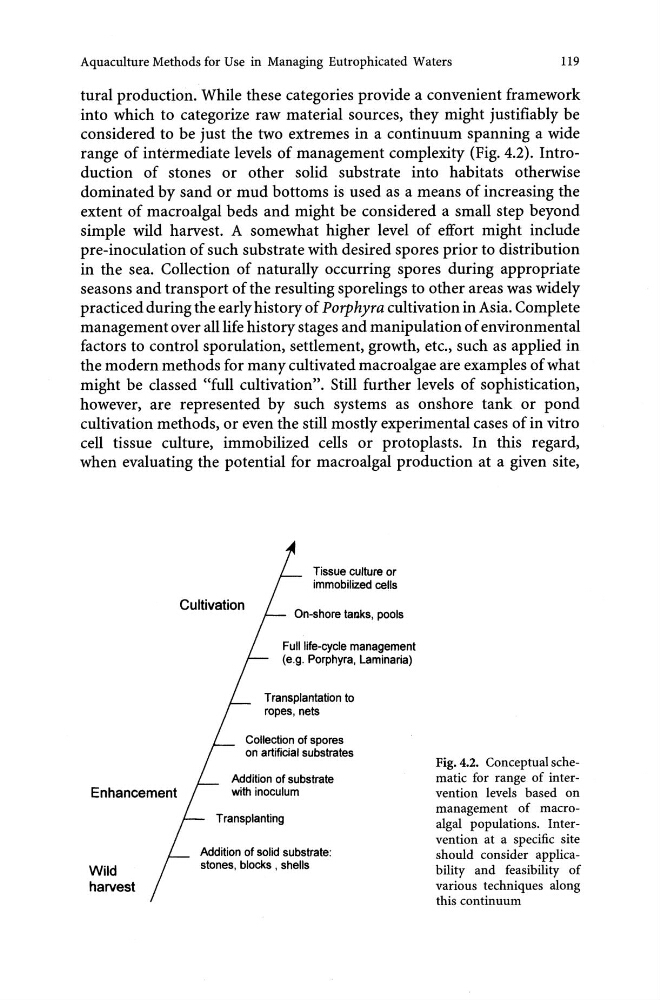
range of intermediate levels of management complexity (Fig. 4.2). Introduction of stones or other solid substrate into habitats otherwise
dominated by sand or mud bottoms is used as a means of increasing the
extent of macro algal beds and might be considered a small step beyond
simple wild harvest. A somewhat higher level of effort might include
pre-inoculation of such substrate with desired spores prior to distribution
in the sea. Collection of naturally occurring spores during appropriate
seasons and transport of the resulting sporelings to other areas was widely
practiced during the early history of Porphyra cultivation in Asia. Complete
management over all life history stages and manipulation of environmental
factors to control sporulation, settlement, growth, etc., such as applied in
the modern methods for many cultivated macro algae are examples of what
might be classed "full cultivation". Still further levels of sophistication,
however, are represented by such systems as onshore tank or pond
cultivation methods, or even the still mostly experimental cases of in vitro
cell tissue culture, immobilized cells or protoplasts. In this regard,
when evaluating the potential for macro algal production at a given site,
Enhancement
Wild
harvest
Cultivation
Tissue culture or
immobilized cells
On-shore taaks, pools
Full life-cycle management
(e.g. Porphyra, Laminaria)
Transplantation to
ropes, nets
Collection of spores
on artificial substrates
Addition of substrate
with inoculum
Transplanting
Addition of solid SUbstrate:
stones, blocks, shells
Fig. 4.2. Conceptual schematic for range of intervention levels based on
management of macroalgal populations. Intervention at a specific site
should consider applicability and feasibility of
various techniques along
this continuum
119
tural production. While these categories provide a convenient framework
into which to categorize raw material sources, they might justifiably be
considered to be just the two extremes in a continuum spanning a wide
range of intermediate levels of management complexity (Fig. 4.2). Introduction of stones or other solid substrate into habitats otherwise
dominated by sand or mud bottoms is used as a means of increasing the
extent of macro algal beds and might be considered a small step beyond
simple wild harvest. A somewhat higher level of effort might include
pre-inoculation of such substrate with desired spores prior to distribution
in the sea. Collection of naturally occurring spores during appropriate
seasons and transport of the resulting sporelings to other areas was widely
practiced during the early history of Porphyra cultivation in Asia. Complete
management over all life history stages and manipulation of environmental
factors to control sporulation, settlement, growth, etc., such as applied in
the modern methods for many cultivated macro algae are examples of what
might be classed "full cultivation". Still further levels of sophistication,
however, are represented by such systems as onshore tank or pond
cultivation methods, or even the still mostly experimental cases of in vitro
cell tissue culture, immobilized cells or protoplasts. In this regard,
when evaluating the potential for macro algal production at a given site,
Enhancement
Wild
harvest
Cultivation
Tissue culture or
immobilized cells
On-shore taaks, pools
Full life-cycle management
(e.g. Porphyra, Laminaria)
Transplantation to
ropes, nets
Collection of spores
on artificial substrates
Addition of substrate
with inoculum
Transplanting
Addition of solid SUbstrate:
stones, blocks, shells
Fig. 4.2. Conceptual schematic for range of intervention levels based on
management of macroalgal populations. Intervention at a specific site
should consider applicability and feasibility of
various techniques along
this continuum