

118
J.E. Merrill
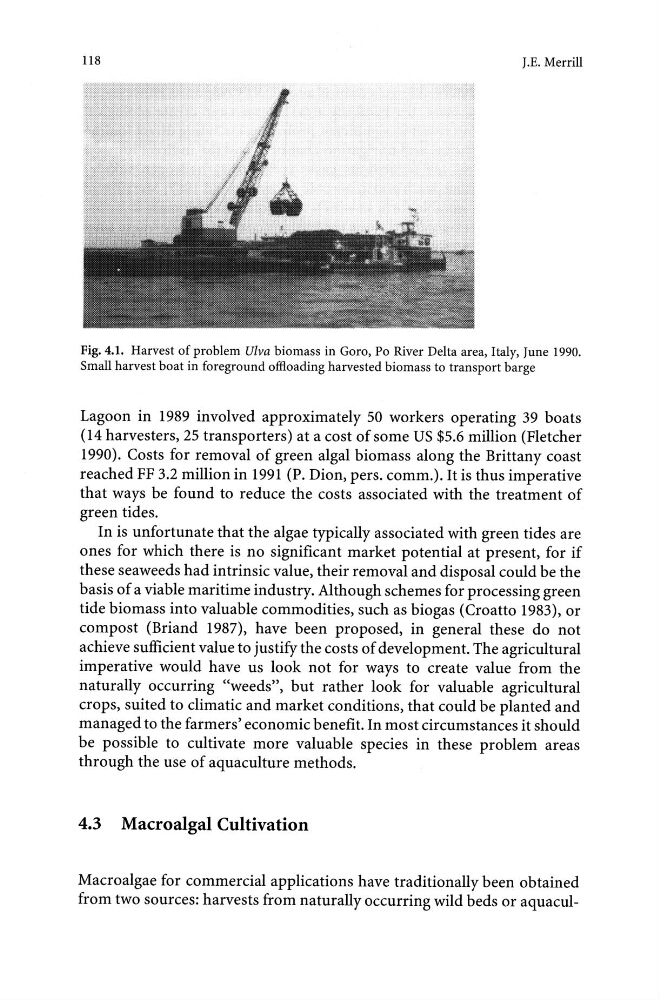
Fig.4.1. Harvest of problem Ulva biomass in Goro, Po River Delta area, Italy, June 1990.
Small harvest boat in foreground offloading harvested biomass to transport barge
Lagoon in 1989 involved approximately 50 workers operating 39 boats
(14 harvesters, 25 transporters) at a cost of some US $5.6 million (Fletcher
1990). Costs for removal of green algal biomass along the Brittany coast
reached FF 3.2 million in 1991 (P. Dion, pers. comm.). It is thus imperative
that ways be found to reduce the costs associated with the treatment of
green tides.
In is unfortunate that the algae typically associated with green tides are
ones for which there is no significant market potential at present, for if
these seaweeds had intrinsic value, their removal and disposal could be the
basis of a viable maritime industry. Although schemes for processing green
tide biomass into valuable commodities, such as biogas (Croatto 1983), or
compost (Briand 1987), have been proposed, in general these do not
achieve sufficient value to justify the costs of development. The agricultural
imperative would have us look not for ways to create value from the
naturally occurring "weeds", but rather look for valuable agricultural
crops, suited to climatic and market conditions, that could be planted and
managed to the farmers' economic benefit. In most circumstances it should
be possible to cultivate more valuable species in these problem areas
through the use of aquaculture methods.
4.3 Macroalgal Cultivation
Macroalgae for commercial applications have traditionally been obtained
from two sources: harvests from naturally occurring wild beds or aquacul-
J.E. Merrill
Fig.4.1. Harvest of problem Ulva biomass in Goro, Po River Delta area, Italy, June 1990.
Small harvest boat in foreground offloading harvested biomass to transport barge
Lagoon in 1989 involved approximately 50 workers operating 39 boats
(14 harvesters, 25 transporters) at a cost of some US $5.6 million (Fletcher
1990). Costs for removal of green algal biomass along the Brittany coast
reached FF 3.2 million in 1991 (P. Dion, pers. comm.). It is thus imperative
that ways be found to reduce the costs associated with the treatment of
green tides.
In is unfortunate that the algae typically associated with green tides are
ones for which there is no significant market potential at present, for if
these seaweeds had intrinsic value, their removal and disposal could be the
basis of a viable maritime industry. Although schemes for processing green
tide biomass into valuable commodities, such as biogas (Croatto 1983), or
compost (Briand 1987), have been proposed, in general these do not
achieve sufficient value to justify the costs of development. The agricultural
imperative would have us look not for ways to create value from the
naturally occurring "weeds", but rather look for valuable agricultural
crops, suited to climatic and market conditions, that could be planted and
managed to the farmers' economic benefit. In most circumstances it should
be possible to cultivate more valuable species in these problem areas
through the use of aquaculture methods.
4.3 Macroalgal Cultivation
Macroalgae for commercial applications have traditionally been obtained
from two sources: harvests from naturally occurring wild beds or aquacul-