

94
I. De Vries et al.
LAKE GREVELINGEN
LAKE VEERE
VENICE LAGOON
a
50
10
50
170
_
phytoplankton
EJ microphytobenthos _ eelgrass (Zostera) D macroalgae (Ulva)
b
80
D consumer respiration _ suspended mineralisation _ benthiC mineralisation D refractory detritus
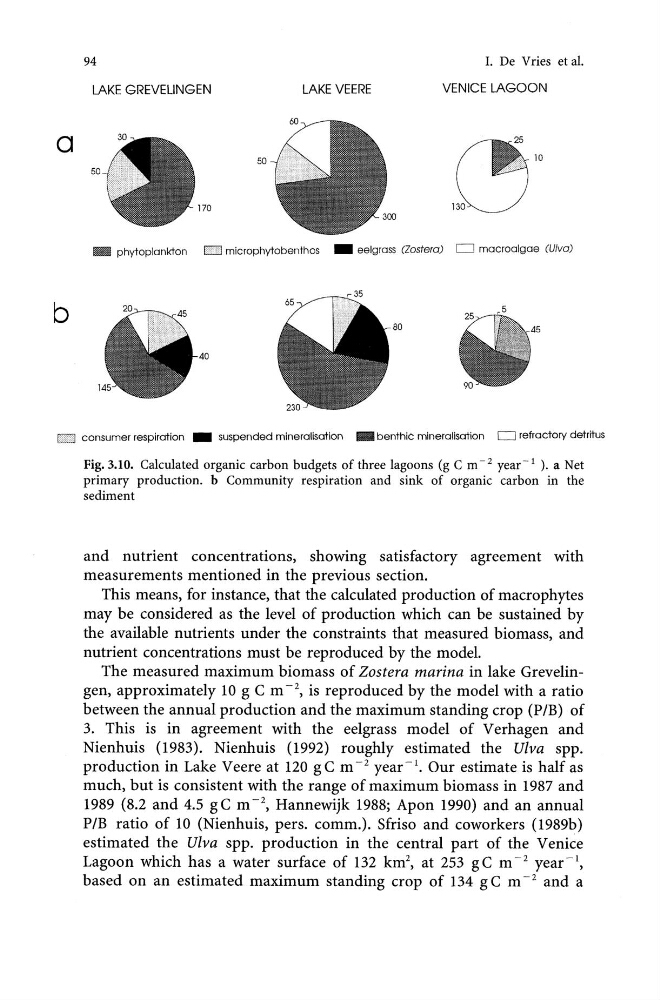
Fig.3.10. Calculated organic carbon budgets of three lagoons (g C m - 2 year- 1 ). a Net
primary production. b Community respiration and sink of organic carbon in the
sediment
and nutrient concentrations, showing satisfactory agreement with
measurements mentioned in the previous section.
This means, for instance, that the calculated production of macrophytes
may be considered as the level of production which can be sustained by
the available nutrients under the constraints that measured biomass, and
nutrient concentrations must be reproduced by the model.
The measured maximum biomass of Zostera marina in lake Grevelingen, approximately 10 gem -2, is reproduced by the model with a ratio
between the annual production and the maximum standing crop (P/B) of
3. This is in agreement with the eelgrass model of Verhagen and
Nienhuis (1983). Nienhuis (1992) roughly estimated the Ulva spp.
production in Lake Veere at 120 gem - 2 year -1. Our estimate is half as
much, but is consistent with the range of maximum biomass in 1987 and
1989 (8.2 and 4.5 gem -2, Hannewijk 1988; Apon 1990) and an annual
P/B ratio of 10 (Nienhuis, pers. comm.), Sfriso and coworkers (I989b)
estimated the Ulva spp. production in the central part of the Venice
Lagoon which has a water surface of 132 km 2 , at 253 gem - 2 year - I,
based on an estimated maximum standing crop of 134 gem -2 and a
I. De Vries et al.
LAKE GREVELINGEN
LAKE VEERE
VENICE LAGOON
a
50
10
50
170
_
phytoplankton
EJ microphytobenthos _ eelgrass (Zostera) D macroalgae (Ulva)
b
80
D consumer respiration _ suspended mineralisation _ benthiC mineralisation D refractory detritus
Fig.3.10. Calculated organic carbon budgets of three lagoons (g C m - 2 year- 1 ). a Net
primary production. b Community respiration and sink of organic carbon in the
sediment
and nutrient concentrations, showing satisfactory agreement with
measurements mentioned in the previous section.
This means, for instance, that the calculated production of macrophytes
may be considered as the level of production which can be sustained by
the available nutrients under the constraints that measured biomass, and
nutrient concentrations must be reproduced by the model.
The measured maximum biomass of Zostera marina in lake Grevelingen, approximately 10 gem -2, is reproduced by the model with a ratio
between the annual production and the maximum standing crop (P/B) of
3. This is in agreement with the eelgrass model of Verhagen and
Nienhuis (1983). Nienhuis (1992) roughly estimated the Ulva spp.
production in Lake Veere at 120 gem - 2 year -1. Our estimate is half as
much, but is consistent with the range of maximum biomass in 1987 and
1989 (8.2 and 4.5 gem -2, Hannewijk 1988; Apon 1990) and an annual
P/B ratio of 10 (Nienhuis, pers. comm.), Sfriso and coworkers (I989b)
estimated the Ulva spp. production in the central part of the Venice
Lagoon which has a water surface of 132 km 2 , at 253 gem - 2 year - I,
based on an estimated maximum standing crop of 134 gem -2 and a