

Coastal Eutrophication and Marine Benthic Vegetation
83
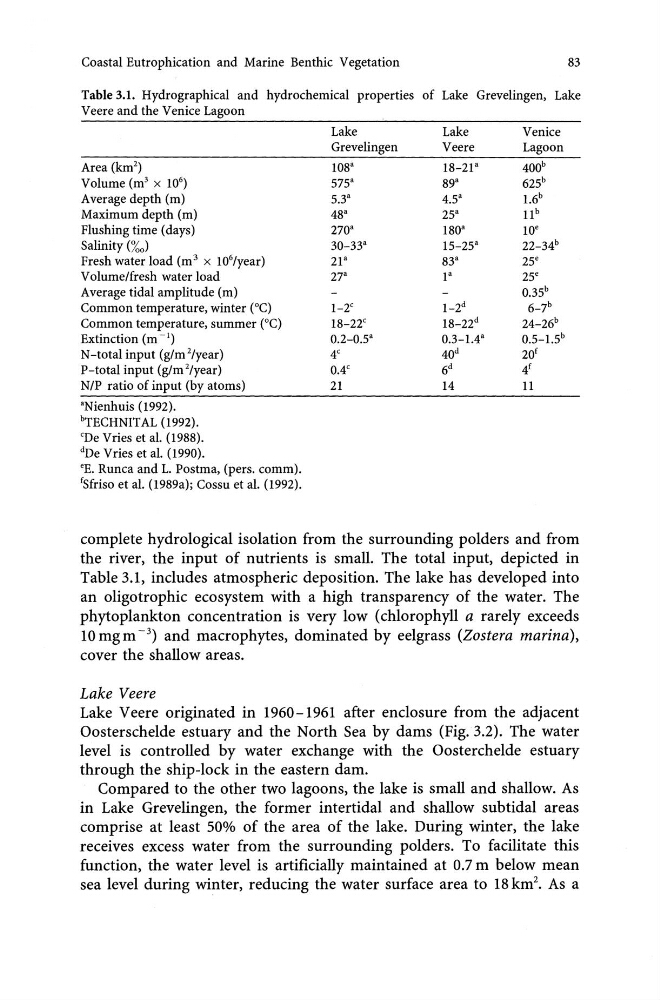
Table 3.1. Hydrographical and hydrochemical properties of Lake Grevelingen, Lake
Veere and the Venice Lagoon
Lake
Lake
Venice
Grevelingen
Veere
Lagoon
Area (km 2 )
10818-21 _
400 b
Volume (m 3 x 10 6 )
89625 b
Average depth (m)
5.34S
1.61>
Maximum depth (m)
48'
25lIb
Flushing time (days)
18010 e
Salinity (%0)
30-33'
15-2522-34b
Fresh water load (m 3 x 10 6 /year)
8325 e
V olume/fresh water load
27'
1 _
25 e
Average tidal amplitude (m)
0.35 b
Common temperature, winter (DC)
1_2C
1-2d
6-7 b
Common temperature, summer (DC)
18-22C
18-22d
24-26 b
Extinction (m - 1)
0.2-0S
0.3-1.40.5-1.5 b
N-total input (g/m 2/year)
4 C
40 d
20f
P-total input (g/m 2/year)
O.4 C
6 d
4f
NIP ratio of input (by atoms)
21
14
11
-Nienhuis (1992).
~ECHNITAL (1992).
cDe Vries et al. (1988).
dDe Vries et al. (1990).
eE. Runca and L. Postma, (pers. comm).
fSfriso et al. (1989a); Cossu et al. (1992).
complete hydrological isolation from the surrounding polders and from
the river, the input of nutrients is small. The total input, depicted in
Table 3.1, includes atmospheric deposition. The lake has developed into
an oligotrophic ecosystem with a high transparency of the water. The
phytoplankton concentration is very low (chlorophyll a rarely exceeds
10 mg m - 3) and macrophytes, dominated by eelgrass (Zostera marina),
cover the shallow areas.
Lake Veere
Lake Veere originated in 1960-1961 after enclosure from the adjacent
Oosterschelde estuary and the North Sea by dams (Fig. 3.2). The water
level is controlled by water exchange with the Oosterchelde estuary
through the ship-lock in the eastern dam.
Compared to the other two lagoons, the lake is small and shallow. As
in Lake Grevelingen, the former intertidal and shallow subtidal areas
comprise at least 50% of the area of the lake. During winter, the lake
receives excess water from the surrounding polders. To facilitate this
function, the water level is artificially maintained at 0.7 m below mean
sea level during winter, reducing the water surface area to 18km 2 • As a
83
Table 3.1. Hydrographical and hydrochemical properties of Lake Grevelingen, Lake
Veere and the Venice Lagoon
Lake
Lake
Venice
Grevelingen
Veere
Lagoon
Area (km 2 )
10818-21 _
400 b
Volume (m 3 x 10 6 )
89625 b
Average depth (m)
5.34S
1.61>
Maximum depth (m)
48'
25lIb
Flushing time (days)
18010 e
Salinity (%0)
30-33'
15-2522-34b
Fresh water load (m 3 x 10 6 /year)
8325 e
V olume/fresh water load
27'
1 _
25 e
Average tidal amplitude (m)
0.35 b
Common temperature, winter (DC)
1_2C
1-2d
6-7 b
Common temperature, summer (DC)
18-22C
18-22d
24-26 b
Extinction (m - 1)
0.2-0S
0.3-1.40.5-1.5 b
N-total input (g/m 2/year)
4 C
40 d
20f
P-total input (g/m 2/year)
O.4 C
6 d
4f
NIP ratio of input (by atoms)
21
14
11
-Nienhuis (1992).
~ECHNITAL (1992).
cDe Vries et al. (1988).
dDe Vries et al. (1990).
eE. Runca and L. Postma, (pers. comm).
fSfriso et al. (1989a); Cossu et al. (1992).
complete hydrological isolation from the surrounding polders and from
the river, the input of nutrients is small. The total input, depicted in
Table 3.1, includes atmospheric deposition. The lake has developed into
an oligotrophic ecosystem with a high transparency of the water. The
phytoplankton concentration is very low (chlorophyll a rarely exceeds
10 mg m - 3) and macrophytes, dominated by eelgrass (Zostera marina),
cover the shallow areas.
Lake Veere
Lake Veere originated in 1960-1961 after enclosure from the adjacent
Oosterschelde estuary and the North Sea by dams (Fig. 3.2). The water
level is controlled by water exchange with the Oosterchelde estuary
through the ship-lock in the eastern dam.
Compared to the other two lagoons, the lake is small and shallow. As
in Lake Grevelingen, the former intertidal and shallow subtidal areas
comprise at least 50% of the area of the lake. During winter, the lake
receives excess water from the surrounding polders. To facilitate this
function, the water level is artificially maintained at 0.7 m below mean
sea level during winter, reducing the water surface area to 18km 2 • As a