

corrosion of such magnitude, possibly because most
continental surfaces were under water. The atmospheric
CO 2 content was therefore probably lower and the ocean
temperature lower than the higher estimates (Kasting and
Howard 2006).
4.1.3 How to Describe LUCA?
The description of LUCA, a now defunct organism, may
seem, a priori, a utopian enterprise. However, comparative
studies based on the study of living organisms allow the
formulation of a number of hypotheses. As some of them
are very speculative, any dogmatic position should be
avoided.
The starting point of these studies is based on the fact that
the current members of the three domains of life have a
number of common traits, such as a DNA genome, the
same genetic code, a complex ribosome and a cytoplasmic
membrane. The most parsimonious explanation for the presence of features common to all organisms is to consider that
they were inherited from their last common ancestor, that is
to say, LUCA. The development of techniques for largescale DNA sequencing resulted in the determination of a
large number of complete genome sequences. It has
extended the study of the traits shared by the three domains
of life to the information contained in the genome (e.g.
genes). Such genes are called universal markers.
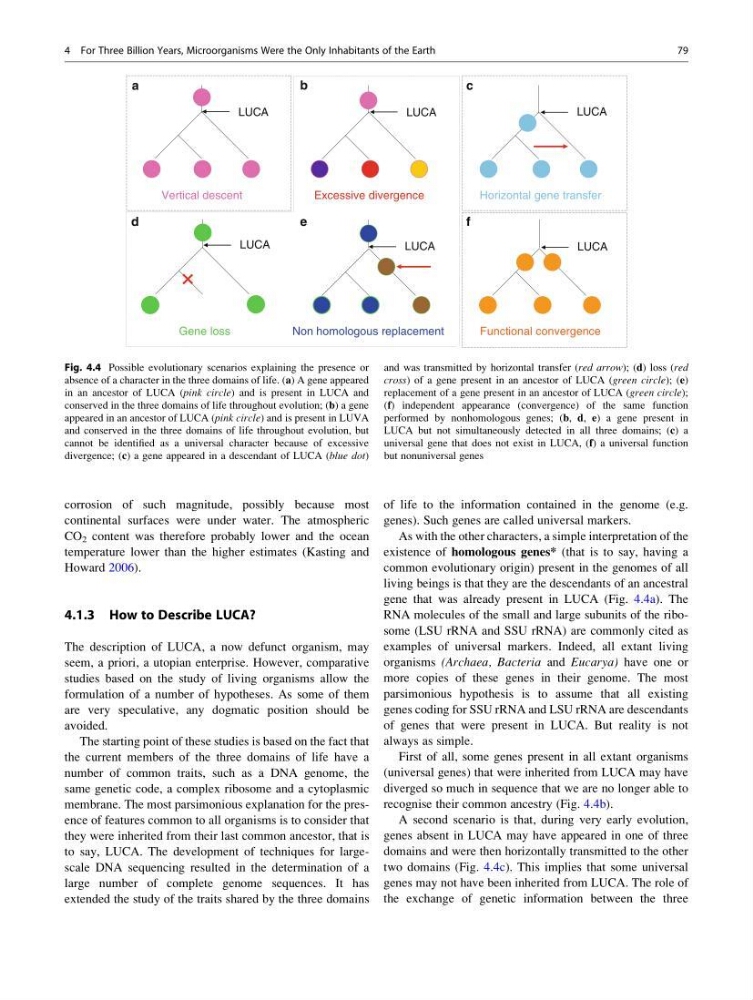
As with the other characters, a simple interpretation of the
existence of homologous genes* (that is to say, having a
common evolutionary origin) present in the genomes of all
living beings is that they are the descendants of an ancestral
gene that was already present in LUCA (Fig. 4.4a). The
RNA molecules of the small and large subunits of the ribosome (LSU rRNA and SSU rRNA) are commonly cited as
examples of universal markers. Indeed, all extant living
organisms (Archaea, Bacteria and Eucarya) have one or
more copies of these genes in their genome. The most
parsimonious hypothesis is to assume that all existing
genes coding for SSU rRNA and LSU rRNA are descendants
of genes that were present in LUCA. But reality is not
always as simple.
First of all, some genes present in all extant organisms
(universal genes) that were inherited from LUCA may have
diverged so much in sequence that we are no longer able to
recognise their common ancestry (Fig. 4.4b).
A second scenario is that, during very early evolution,
genes absent in LUCA may have appeared in one of three
domains and were then horizontally transmitted to the other
two domains (Fig. 4.4c). This implies that some universal
genes may not have been inherited from LUCA. The role of
the exchange of genetic information between the three
Vertical descent
Excessive divergence
Functional convergence
LUCA
Horizontal gene transfer
LUCA
LUCA
Non homologous replacement
a
c
b
d
f
e
LUCA
LUCA
Gene loss
LUCA
Fig. 4.4 Possible evolutionary scenarios explaining the presence or
absence of a character in the three domains of life. (a) A gene appeared
in an ancestor of LUCA (pink circle) and is present in LUCA and
conserved in the three domains of life throughout evolution; (b) a gene
appeared in an ancestor of LUCA (pink circle) and is present in LUVA
and conserved in the three domains of life throughout evolution, but
cannot be identified as a universal character because of excessive
divergence; (c) a gene appeared in a descendant of LUCA (blue dot)
and was transmitted by horizontal transfer (red arrow); (d) loss (red
cross) of a gene present in an ancestor of LUCA (green circle); (e)
replacement of a gene present in an ancestor of LUCA (green circle);
(f) independent appearance (convergence) of the same function
performed by nonhomologous genes; (b, d, e) a gene present in
LUCA but not simultaneously detected in all three domains; (c) a
universal gene that does not exist in LUCA, (f) a universal function
but nonuniversal genes
4 For Three Billion Years, Microorganisms Were the Only Inhabitants of the Earth
79
continental surfaces were under water. The atmospheric
CO 2 content was therefore probably lower and the ocean
temperature lower than the higher estimates (Kasting and
Howard 2006).
4.1.3 How to Describe LUCA?
The description of LUCA, a now defunct organism, may
seem, a priori, a utopian enterprise. However, comparative
studies based on the study of living organisms allow the
formulation of a number of hypotheses. As some of them
are very speculative, any dogmatic position should be
avoided.
The starting point of these studies is based on the fact that
the current members of the three domains of life have a
number of common traits, such as a DNA genome, the
same genetic code, a complex ribosome and a cytoplasmic
membrane. The most parsimonious explanation for the presence of features common to all organisms is to consider that
they were inherited from their last common ancestor, that is
to say, LUCA. The development of techniques for largescale DNA sequencing resulted in the determination of a
large number of complete genome sequences. It has
extended the study of the traits shared by the three domains
of life to the information contained in the genome (e.g.
genes). Such genes are called universal markers.
As with the other characters, a simple interpretation of the
existence of homologous genes* (that is to say, having a
common evolutionary origin) present in the genomes of all
living beings is that they are the descendants of an ancestral
gene that was already present in LUCA (Fig. 4.4a). The
RNA molecules of the small and large subunits of the ribosome (LSU rRNA and SSU rRNA) are commonly cited as
examples of universal markers. Indeed, all extant living
organisms (Archaea, Bacteria and Eucarya) have one or
more copies of these genes in their genome. The most
parsimonious hypothesis is to assume that all existing
genes coding for SSU rRNA and LSU rRNA are descendants
of genes that were present in LUCA. But reality is not
always as simple.
First of all, some genes present in all extant organisms
(universal genes) that were inherited from LUCA may have
diverged so much in sequence that we are no longer able to
recognise their common ancestry (Fig. 4.4b).
A second scenario is that, during very early evolution,
genes absent in LUCA may have appeared in one of three
domains and were then horizontally transmitted to the other
two domains (Fig. 4.4c). This implies that some universal
genes may not have been inherited from LUCA. The role of
the exchange of genetic information between the three
Vertical descent
Excessive divergence
Functional convergence
LUCA
Horizontal gene transfer
LUCA
LUCA
Non homologous replacement
a
c
b
d
f
e
LUCA
LUCA
Gene loss
LUCA
Fig. 4.4 Possible evolutionary scenarios explaining the presence or
absence of a character in the three domains of life. (a) A gene appeared
in an ancestor of LUCA (pink circle) and is present in LUCA and
conserved in the three domains of life throughout evolution; (b) a gene
appeared in an ancestor of LUCA (pink circle) and is present in LUVA
and conserved in the three domains of life throughout evolution, but
cannot be identified as a universal character because of excessive
divergence; (c) a gene appeared in a descendant of LUCA (blue dot)
and was transmitted by horizontal transfer (red arrow); (d) loss (red
cross) of a gene present in an ancestor of LUCA (green circle); (e)
replacement of a gene present in an ancestor of LUCA (green circle);
(f) independent appearance (convergence) of the same function
performed by nonhomologous genes; (b, d, e) a gene present in
LUCA but not simultaneously detected in all three domains; (c) a
universal gene that does not exist in LUCA, (f) a universal function
but nonuniversal genes
4 For Three Billion Years, Microorganisms Were the Only Inhabitants of the Earth
79