

isoleucine, methionine, lysine, leucine, valine, serine, glycine, cysteine, phenylalanine, tyrosine). The synthesis of
aspartate by transfer of amino group of glutamate to
oxaloacetic acid catalyzed by glutamate oxaloacetate transaminase is an example of transamination (cf. Sect. 14.3.3,
Fig. 14.29):
Oxaloacetate þ L‐glutamate ! α‐ketoglutarate
þ L‐aspartate
Some transamidations (transfer of the amide group of
glutamine) are involved in the synthesis of some amino
acids (tryptophan, arginine).
The nitrogen of purines and pyrimidines, other important
cellular nitrogen compounds, is derived from transamination and transamidation reactions and transfers of
carbamyl group (NH 2 –CO–) of carbamyl phosphate
(NH 2 –CO–O–PO 3
2À ) whose synthesis is shown in the following equation:
Glutamine þ CO 2 þ 2 ATP ! glutamate þ carbamyl
phosphate þ 2 ADP þ 2 Pi Carbamyl phosphate synthase
The synthesis of arginine also implies a carbamyl group.
That of histidine is a complex metabolic pathway where the
nitrogen has several origins (purine, transamination, and
transamidation reactions).
3.4.4.2 Assimilation of Sulfur Compounds
The most abundant form of sulfur in the biosphere is sulfate
which is the most oxidized sulfur state (oxidation state + VI)
(cf. Sect. 14.4.1, Fig. 14.34). Sulfate is the sulfur source used
by most microorganisms; animal cells require sulfur in
organic form.
In organic matter, sulfur is reduced, mainly in the
form of sulfhydryl groups (oxidation state À II). Sulfate
represents a too oxidized sulfur source to be included in
organic compounds. To be assimilated, it must be reduced
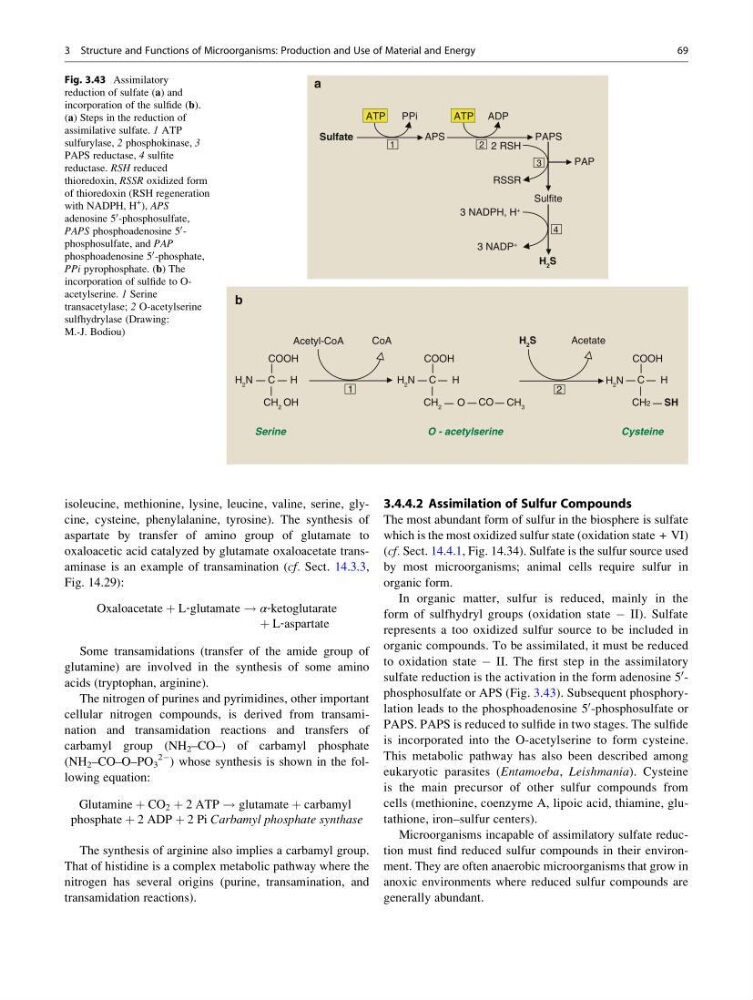
to oxidation state À II. The first step in the assimilatory
sulfate reduction is the activation in the form adenosine 5
0 -
phosphosulfate or APS (Fig. 3.43). Subsequent phosphorylation leads to the phosphoadenosine 5
0 -phosphosulfate or
PAPS. PAPS is reduced to sulfide in two stages. The sulfide
is incorporated into the O-acetylserine to form cysteine.
This metabolic pathway has also been described among
eukaryotic parasites (Entamoeba, Leishmania). Cysteine
is the main precursor of other sulfur compounds from
cells (methionine, coenzyme A, lipoic acid, thiamine, glutathione, iron–sulfur centers).
Microorganisms incapable of assimilatory sulfate reduction must find reduced sulfur compounds in their environment. They are often anaerobic microorganisms that grow in
anoxic environments where reduced sulfur compounds are
generally abundant.
a
1
Sulfate
H 2 S
ATP
ATP
PPi
ADP
PAPS
APS
2 RSH
RSSR
3 NADPH, H
+
3 NADP
+
PAP
Sulfite
2
3
4
O CO
Acetyl-CoA
CoA
Acetate
H 2 S
COOH
C
C
CH 2 OH
CH 2
CH 3
H 2 N
H 2 N
H 2 N
H
COOH
H
C
CH2
COOH
H
1
2
SH
Serine
O - acetylserine
Cysteine
b
Fig. 3.43 Assimilatory
reduction of sulfate (a) and
incorporation of the sulfide (b).
(a) Steps in the reduction of
assimilative sulfate. 1 ATP
sulfurylase, 2 phosphokinase, 3
PAPS reductase, 4 sulfite
reductase. RSH reduced
thioredoxin, RSSR oxidized form
of thioredoxin (RSH regeneration
with NADPH, H
+ ), APS
adenosine 5
0 -phosphosulfate,
PAPS phosphoadenosine 5
0 -
phosphosulfate, and PAP
phosphoadenosine 5
0 -phosphate,
PPi pyrophosphate. (b) The
incorporation of sulfide to Oacetylserine. 1 Serine
transacetylase; 2 O-acetylserine
sulfhydrylase (Drawing:
M.-J. Bodiou)
3 Structure and Functions of Microorganisms: Production and Use of Material and Energy
69
aspartate by transfer of amino group of glutamate to
oxaloacetic acid catalyzed by glutamate oxaloacetate transaminase is an example of transamination (cf. Sect. 14.3.3,
Fig. 14.29):
Oxaloacetate þ L‐glutamate ! α‐ketoglutarate
þ L‐aspartate
Some transamidations (transfer of the amide group of
glutamine) are involved in the synthesis of some amino
acids (tryptophan, arginine).
The nitrogen of purines and pyrimidines, other important
cellular nitrogen compounds, is derived from transamination and transamidation reactions and transfers of
carbamyl group (NH 2 –CO–) of carbamyl phosphate
(NH 2 –CO–O–PO 3
2À ) whose synthesis is shown in the following equation:
Glutamine þ CO 2 þ 2 ATP ! glutamate þ carbamyl
phosphate þ 2 ADP þ 2 Pi Carbamyl phosphate synthase
The synthesis of arginine also implies a carbamyl group.
That of histidine is a complex metabolic pathway where the
nitrogen has several origins (purine, transamination, and
transamidation reactions).
3.4.4.2 Assimilation of Sulfur Compounds
The most abundant form of sulfur in the biosphere is sulfate
which is the most oxidized sulfur state (oxidation state + VI)
(cf. Sect. 14.4.1, Fig. 14.34). Sulfate is the sulfur source used
by most microorganisms; animal cells require sulfur in
organic form.
In organic matter, sulfur is reduced, mainly in the
form of sulfhydryl groups (oxidation state À II). Sulfate
represents a too oxidized sulfur source to be included in
organic compounds. To be assimilated, it must be reduced
to oxidation state À II. The first step in the assimilatory
sulfate reduction is the activation in the form adenosine 5
0 -
phosphosulfate or APS (Fig. 3.43). Subsequent phosphorylation leads to the phosphoadenosine 5
0 -phosphosulfate or
PAPS. PAPS is reduced to sulfide in two stages. The sulfide
is incorporated into the O-acetylserine to form cysteine.
This metabolic pathway has also been described among
eukaryotic parasites (Entamoeba, Leishmania). Cysteine
is the main precursor of other sulfur compounds from
cells (methionine, coenzyme A, lipoic acid, thiamine, glutathione, iron–sulfur centers).
Microorganisms incapable of assimilatory sulfate reduction must find reduced sulfur compounds in their environment. They are often anaerobic microorganisms that grow in
anoxic environments where reduced sulfur compounds are
generally abundant.
a
1
Sulfate
H 2 S
ATP
ATP
PPi
ADP
PAPS
APS
2 RSH
RSSR
3 NADPH, H
+
3 NADP
+
PAP
Sulfite
2
3
4
O CO
Acetyl-CoA
CoA
Acetate
H 2 S
COOH
C
C
CH 2 OH
CH 2
CH 3
H 2 N
H 2 N
H 2 N
H
COOH
H
C
CH2
COOH
H
1
2
SH
Serine
O - acetylserine
Cysteine
b
Fig. 3.43 Assimilatory
reduction of sulfate (a) and
incorporation of the sulfide (b).
(a) Steps in the reduction of
assimilative sulfate. 1 ATP
sulfurylase, 2 phosphokinase, 3
PAPS reductase, 4 sulfite
reductase. RSH reduced
thioredoxin, RSSR oxidized form
of thioredoxin (RSH regeneration
with NADPH, H
+ ), APS
adenosine 5
0 -phosphosulfate,
PAPS phosphoadenosine 5
0 -
phosphosulfate, and PAP
phosphoadenosine 5
0 -phosphate,
PPi pyrophosphate. (b) The
incorporation of sulfide to Oacetylserine. 1 Serine
transacetylase; 2 O-acetylserine
sulfhydrylase (Drawing:
M.-J. Bodiou)
3 Structure and Functions of Microorganisms: Production and Use of Material and Energy
69