

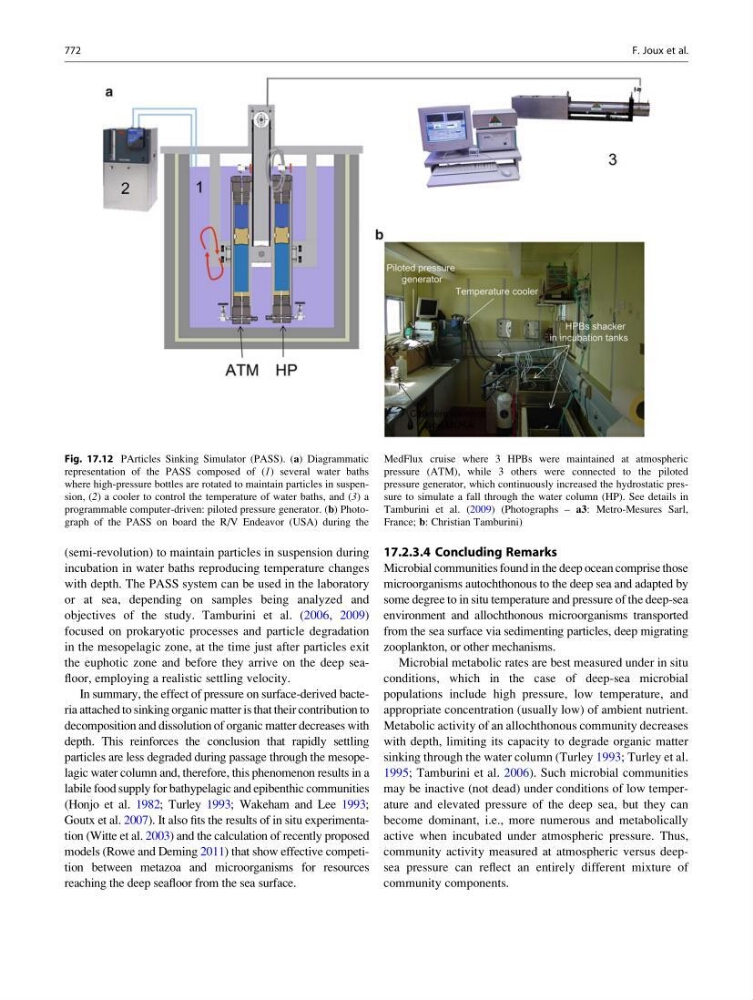
(semi-revolution) to maintain particles in suspension during
incubation in water baths reproducing temperature changes
with depth. The PASS system can be used in the laboratory
or at sea, depending on samples being analyzed and
objectives of the study. Tamburini et al. (2006, 2009)
focused on prokaryotic processes and particle degradation
in the mesopelagic zone, at the time just after particles exit
the euphotic zone and before they arrive on the deep seafloor, employing a realistic settling velocity.
In summary, the effect of pressure on surface-derived bacteria attached to sinking organic matter is that their contribution to
decomposition and dissolution of organic matter decreases with
depth. This reinforces the conclusion that rapidly settling
particles are less degraded during passage through the mesopelagic water column and, therefore, this phenomenon results in a
labile food supply for bathypelagic and epibenthic communities
(Honjo et al. 1982; Turley 1993; Wakeham and Lee 1993;
Goutx et al. 2007). It also fits the results of in situ experimentation (Witte et al. 2003) and the calculation of recently proposed
models (Rowe and Deming 2011) that show effective competition between metazoa and microorganisms for resources
reaching the deep seafloor from the sea surface.
17.2.3.4 Concluding Remarks
Microbial communities found in the deep ocean comprise those
microorganisms autochthonous to the deep sea and adapted by
some degree to in situ temperature and pressure of the deep-sea
environment and allochthonous microorganisms transported
from the sea surface via sedimenting particles, deep migrating
zooplankton, or other mechanisms.
Microbial metabolic rates are best measured under in situ
conditions, which in the case of deep-sea microbial
populations include high pressure, low temperature, and
appropriate concentration (usually low) of ambient nutrient.
Metabolic activity of an allochthonous community decreases
with depth, limiting its capacity to degrade organic matter
sinking through the water column (Turley 1993; Turley et al.
1995; Tamburini et al. 2006). Such microbial communities
may be inactive (not dead) under conditions of low temperature and elevated pressure of the deep sea, but they can
become dominant, i.e., more numerous and metabolically
active when incubated under atmospheric pressure. Thus,
community activity measured at atmospheric versus deepsea pressure can reflect an entirely different mixture of
community components.
Fig. 17.12 PArticles Sinking Simulator (PASS). (a) Diagrammatic
representation of the PASS composed of (1) several water baths
where high-pressure bottles are rotated to maintain particles in suspension, (2) a cooler to control the temperature of water baths, and (3) a
programmable computer-driven: piloted pressure generator. (b) Photograph of the PASS on board the R/V Endeavor (USA) during the
MedFlux cruise where 3 HPBs were maintained at atmospheric
pressure (ATM), while 3 others were connected to the piloted
pressure generator, which continuously increased the hydrostatic pressure to simulate a fall through the water column (HP). See details in
Tamburini et al. (2009) (Photographs – a3: Metro-Mesures Sarl,
France; b: Christian Tamburini)
772
F. Joux et al.