

on metabolic rate in deep-sea samples. A Pe ratio >1 indicates
the deep-sea prokaryotic assemblage is adapted to predominantly the in situ pressure, and prokaryotic activity will be
underestimated if the sample is decompressed and incubated at
atmospheric pressure. On the other hand, if the Pe < 1, inhibition by high pressure is indicated and metabolic activity will be
overestimated if the sample is decompressed (Tamburini et al.
2013). From deep-seawater collected during stratified conditions
(n ¼ 120), the mean Pe (n ¼ 120) was 4.01 (median 2.11), with
50 % of values between 1.50 and 2.82 and 90 % between 1.12
and 8.17. During stratified conditions, the prokaryotic assemblage was adapted to high pressure (Wilcoxon rank test Pe >1,
p < 2.2 Â 10
À16
) and the metabolic rate has to be determined
under in situ pressure conditions to avoid underestimating activity (Tamburini et al. 2013).
Hyperbaric System to Simulate Particles Sinking
Throughout the Water Column
Biogenic aggregates (>500 μm in diameter), including marine
snow and fast-sinking fecal pellets of large migrating
macrozooplankton, constitute the majority of vertical particle
flux to the deep ocean (Fowler and Knauer 1986; Bochdansky
et al. 2010). Enzymatic dissolution and mineralization of
particulate organic matter (POM) by attached prokaryotes
during descent can provide important carbon sources for
free-living prokaryotes, thereby playing important biogeochemical roles in mesopelagic and bathypelagic carbon
cycling (Cho and Azam 1988; Smith et al. 1992; Turley and
Mackie 1994, 1995). Attached prokaryotes, however, tend to
comprise a small fraction (5 %) of the total prokaryotic biomass (Cho and Azam 1988), reaching somewhat higher
proportions (10–34 %) only when the concentration of
aggregates is high (Turley and Mackie 1995). The extent to
which sinking particles contribute to microbial community
structure in the deep sea remains an open question.
To better understand the metabolic capacity of prokaryotes
of shallow-water origin, which are carried below the euphotic
zone on sinking particles, to degrade organic matter in the deep
sea, different approaches proved informative. For instance,
Turley (1993) applied increasing pressure to collections of
sinking particles, obtained by trapping for 48 h at 200 m depth
and containing microbial assemblages. These samples were
placed in sealed bags incubated in pressure vessels at 5
C.
Pressures of 0.1, 10, 20, 30, and 43 MPa were applied in step
function (within 30 min, then maintained constant for 4 h) to
simulate pressure at the deep water–sediment interface. In the
early work on heterotrophic microbial activity associated with
particulate matter in the deep sea, comparative responses to
moderate (surface water) versus extreme (abyssal) temperatures
and pressures were used to diagnose prokaryotic origin
(Deming 1985). Samples of sinking particulates, fecal pellets,
and deposited sediments were collected in bottom-moored sediment traps and boxcores at station depths of 1,850, 4,120, and
4,715 m in the North Atlantic and incubated for 2–7 days under
both surface water and simulated deep-sea conditions (the latter
in sterile syringes in pressure vessels at 3
C).
To simulate more accurately the increase in pressure (and
decrease in temperature) prokaryotes associated with
particles experience in sinking to depth, Tamburini et al.
(2009) created a PArticulate Sinking Simulator (PASS) system (Fig. 17.12). Same high-pressure bottles (HPBs), developed for the HPSS, were used to incubate samples while
pressure was increased continuously (linearly) by means
of a piloted pressure generator. The HPBs were rotated
High-pressure
bottles
Pressure sensors
CTD
Electro-mechanical
sea cable
NISKIN bottles
a
Pressure sensor
Check valve
Deck Unit
PC
On board
the ship
Pressure sensor
Nozzle (0.01")
Filling valve
(open)
"decompressed"
"high pressure"
Floating
piston
Distilled
water
Exhaust tank
Stainless wall
PEEK coating
to the CTD
CTD
Electro-mechanical
sea cable
Tracer
+
sample
No check valve
Distilled
water
b
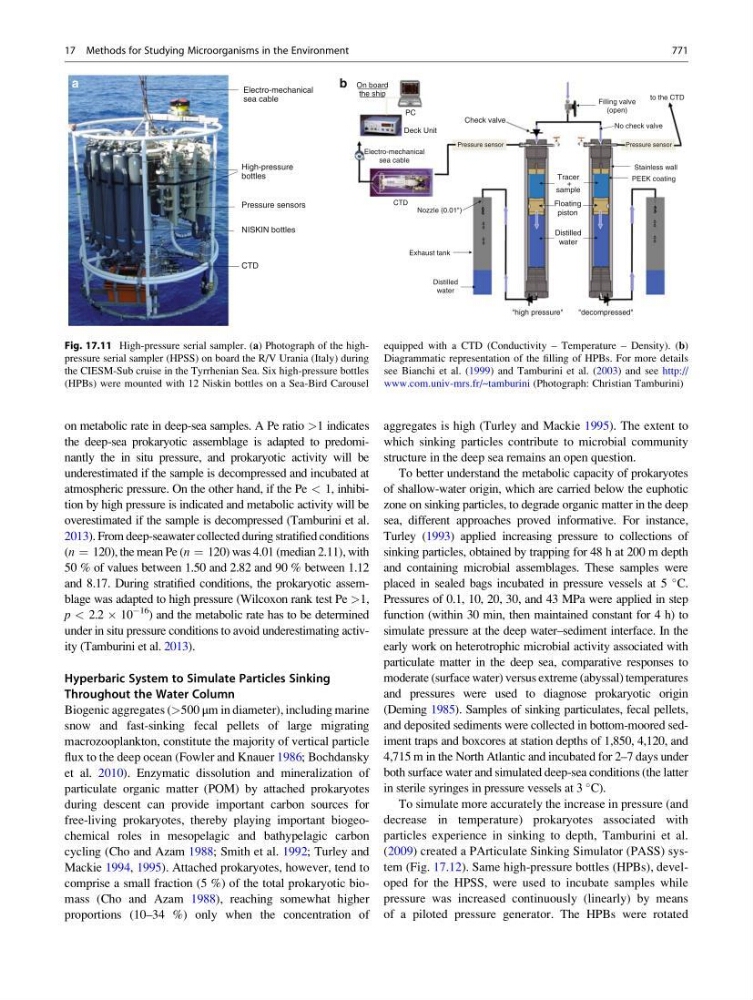
Fig. 17.11 High-pressure serial sampler. (a) Photograph of the highpressure serial sampler (HPSS) on board the R/V Urania (Italy) during
the CIESM-Sub cruise in the Tyrrhenian Sea. Six high-pressure bottles
(HPBs) were mounted with 12 Niskin bottles on a Sea-Bird Carousel
equipped with a CTD (Conductivity – Temperature – Density). (b)
Diagrammatic representation of the filling of HPBs. For more details
see Bianchi et al. (1999) and Tamburini et al. (2003) and see http://
www.com.univ-mrs.fr/~tamburini (Photograph: Christian Tamburini)
17 Methods for Studying Microorganisms in the Environment
771