

active in warm or temperate waters are different from
those active in cold waters.
(iii) To not produce toxic metabolites
(iv) To not be pathogens
(v) To not be eliminated by endogenous communities during the period of bioremediation.
Conversely, it is necessary that the massive input of
exogenous microorganisms does not affect on the long
term the equilibrium of the communities initially present in
the ecosystem.
The treatment efficiency by bioincrease was
demonstrated in laboratory; the situation is completely different for experiments conducted in natural environment
where very few studies were undertaken. None rigorously
demonstrated positive effects of such a treatment.
Attempts of in situ seeding were undertaken in Japan with
a mixture of cultured bacteria called “TerraZyme,” after the
Nakhodia tanker beaching on the Japan coasts (1997). The
only published data related to this operation are visual
observations or analyses of digitized images that only showed
the cleaning of polluted surfaces. A bioincrease action was
also undertaken in the USA after the Mega Borg beaching on
Texan coasts (June 1990), where a microorganism mixture
(called “Alpha BiopSea”) was applied on contaminated
surfaces. In the latter case, independent observers reported
that the contaminated zone look only changed after an emulsification assigned to the implementation of bacterial cultures.
Finally, chemical analyses of treated samples never rigorously
demonstrated the efficiency of this seeding. Indeed, whatever
the sample, the calculated ratio n-C 18 /phytane revealed no
hydrocarbon selective alteration which would have proved a
biodegradation beginning (Means 1991).
Biostimulation
Hydrocarbonoclastic microorganisms are ubiquitous in the
environment. This property is built on in biostimulation
techniques in order to stimulate hydrocarbon biodegradation
capacities of microorganisms already present in the site submitted to pollution. Indeed, it was observed that after a massive petroleum input, the biomass of hydrocarbonoclastic
microbial communities was extensively increased. To be efficient, an additive must display four major properties:
(i) To keep ratios C/N/P compatible with hydrocarbon biodegradation. The petroleum input on the site corresponds
to a massive carbon input. To achieve the largest biodegradation, it is necessary that the applied product
contains nitrogen and phosphorus amounts enabling the
establishment of ratios carbon-nitrogen-phosphorus
supporting the optimal microorganism growth; ratios
100:10:1 are usually considered as ideal.
(ii) To be oleophilic microemulsion so that the added
nutrients stay in contact with petroleum. Indeed, watersoluble products, easily washed away by waves and sea
sprays or lixiviated by rain falls, are very quickly
ineffective and require almost daily implementations.
(iii) To have surfactant properties that increase the hydrocarbon bioavailability which favors biodegradation
processes.
(iv) To be nontoxic.
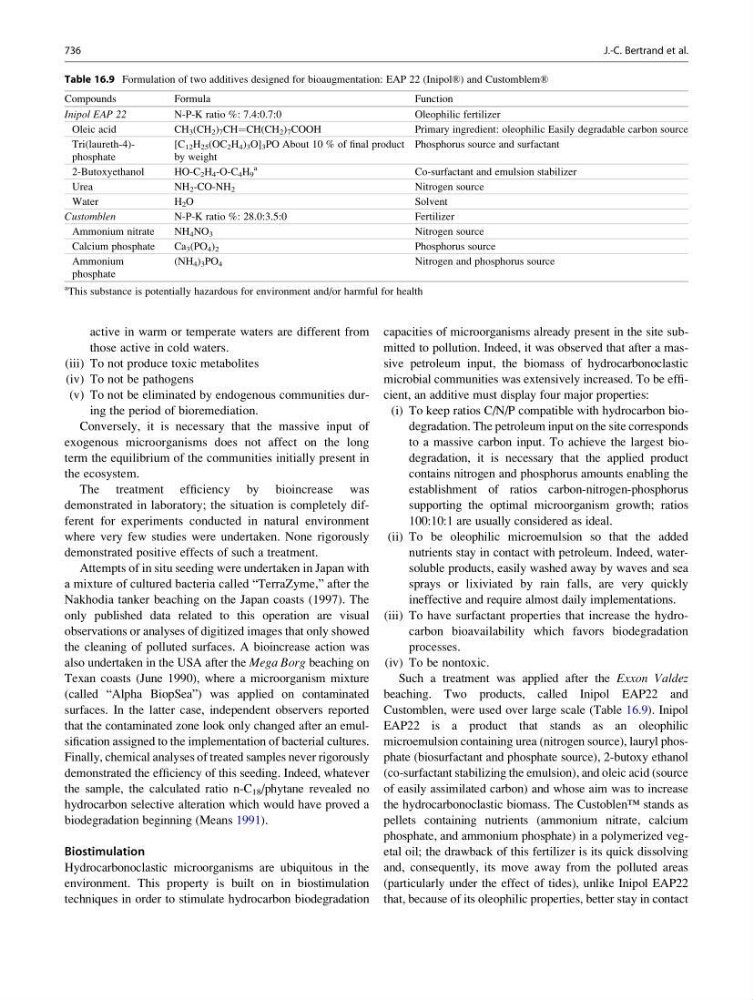
Such a treatment was applied after the Exxon Valdez
beaching. Two products, called Inipol EAP22 and
Customblen, were used over large scale (Table 16.9). Inipol
EAP22 is a product that stands as an oleophilic
microemulsion containing urea (nitrogen source), lauryl phosphate (biosurfactant and phosphate source), 2-butoxy ethanol
(co-surfactant stabilizing the emulsion), and oleic acid (source
of easily assimilated carbon) and whose aim was to increase
the hydrocarbonoclastic biomass. The Custoblen™ stands as
pellets containing nutrients (ammonium nitrate, calcium
phosphate, and ammonium phosphate) in a polymerized vegetal oil; the drawback of this fertilizer is its quick dissolving
and, consequently, its move away from the polluted areas
(particularly under the effect of tides), unlike Inipol EAP22
that, because of its oleophilic properties, better stay in contact
Table 16.9 Formulation of two additives designed for bioaugmentation: EAP 22 (Inipol®) and Customblem®
Compounds
Formula
Function
Inipol EAP 22
N-P-K ratio %: 7.4:0.7:0
Oleophilic fertilizer
Oleic acid
CH 3 (CH 2 ) 7 CH¼CH(CH 2 ) 7 COOH
Primary ingredient: oleophilic Easily degradable carbon source
Tri(laureth-4)phosphate
[C 12 H 25 (OC 2 H 4 ) 3 O] 3 PO About 10 % of final product
by weight
Phosphorus source and surfactant
2-Butoxyethanol
HO-C 2 H 4 -O-C 4 H 9
a
Co-surfactant and emulsion stabilizer
Urea
NH 2 -CO-NH 2
Nitrogen source
Water
H 2 O
Solvent
Customblen
N-P-K ratio %: 28.0:3.5:0
Fertilizer
Ammonium nitrate
NH 4 NO 3
Nitrogen source
Calcium phosphate
Ca 3 (PO 4 ) 2
Phosphorus source
Ammonium
phosphate
(NH 4 ) 3 PO 4
Nitrogen and phosphorus source
a
This substance is potentially hazardous for environment and/or harmful for health
736
J.-C. Bertrand et al.