

class of enzyme, they are highly specific for the halogenated
compounds. It has been shown that chlorocatechol
dioxygenases of the modified ortho-pathway (i.e., ccd or clc
genes for the degradation of chlorocatechol) are sharing relatively high level of similarities of amino-acid sequences
(i.e., up to 22 % of similarity) with catechol dioxygenases of
the ortho-pathway (i.e., β-ketoadipate pathway) such as catA
which are widely dispersed within soil microbiota (El Azhari
et al. 2010). The most well-known type II dioxygenases of the
modified ortho-pathway are those involved in the degradation
of 2,4-D, 3- and 4-chlorbenzoate and 1,2,4-trichlorobenze.
These enzymes are sharing between 50 and 60 % of
similarities at the amino-acid levels. Corresponding genes
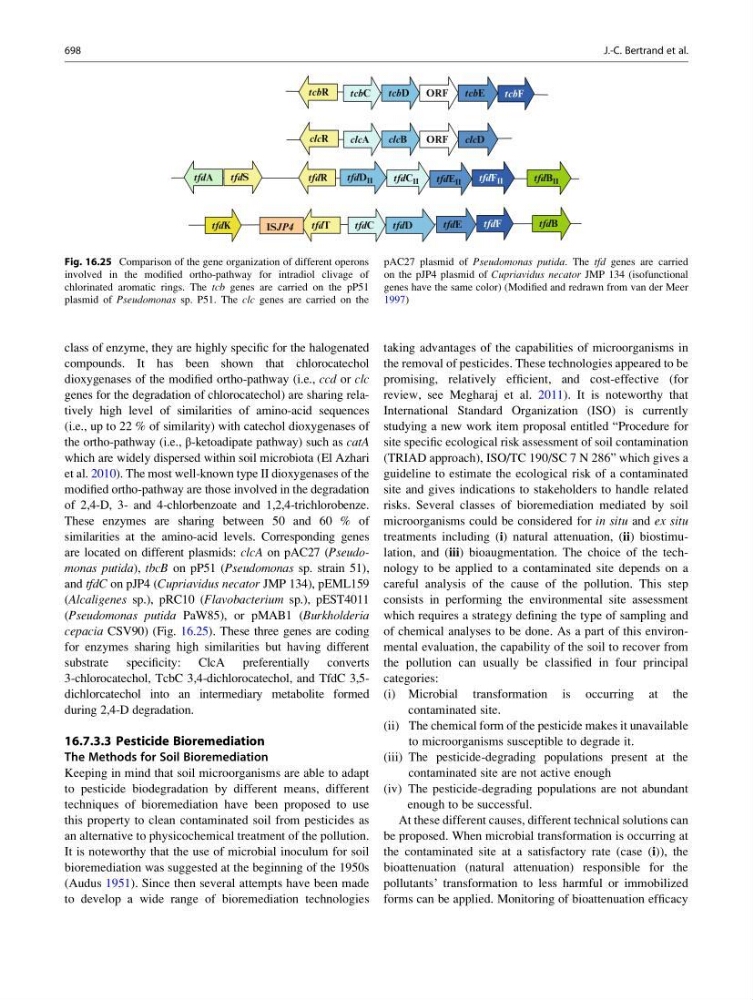
are located on different plasmids: clcA on pAC27 (Pseudomonas putida), tbcB on pP51 (Pseudomonas sp. strain 51),
and tfdC on pJP4 (Cupriavidus necator JMP 134), pEML159
(Alcaligenes sp.), pRC10 (Flavobacterium sp.), pEST4011
(Pseudomonas putida PaW85), or pMAB1 (Burkholderia
cepacia CSV90) (Fig. 16.25). These three genes are coding
for enzymes sharing high similarities but having different
substrate specificity: ClcA preferentially converts
3-chlorocatechol, TcbC 3,4-dichlorocatechol, and TfdC 3,5dichlorcatechol into an intermediary metabolite formed
during 2,4-D degradation.
16.7.3.3 Pesticide Bioremediation
The Methods for Soil Bioremediation
Keeping in mind that soil microorganisms are able to adapt
to pesticide biodegradation by different means, different
techniques of bioremediation have been proposed to use
this property to clean contaminated soil from pesticides as
an alternative to physicochemical treatment of the pollution.
It is noteworthy that the use of microbial inoculum for soil
bioremediation was suggested at the beginning of the 1950s
(Audus 1951). Since then several attempts have been made
to develop a wide range of bioremediation technologies
taking advantages of the capabilities of microorganisms in
the removal of pesticides. These technologies appeared to be
promising, relatively efficient, and cost-effective (for
review, see Megharaj et al. 2011). It is noteworthy that
International Standard Organization (ISO) is currently
studying a new work item proposal entitled “Procedure for
site specific ecological risk assessment of soil contamination
(TRIAD approach), ISO/TC 190/SC 7 N 286” which gives a
guideline to estimate the ecological risk of a contaminated
site and gives indications to stakeholders to handle related
risks. Several classes of bioremediation mediated by soil
microorganisms could be considered for in situ and ex situ
treatments including (i) natural attenuation, (ii) biostimulation, and (iii) bioaugmentation. The choice of the technology to be applied to a contaminated site depends on a
careful analysis of the cause of the pollution. This step
consists in performing the environmental site assessment
which requires a strategy defining the type of sampling and
of chemical analyses to be done. As a part of this environmental evaluation, the capability of the soil to recover from
the pollution can usually be classified in four principal
categories:
(i) Microbial transformation is occurring at the
contaminated site.
(ii) The chemical form of the pesticide makes it unavailable
to microorganisms susceptible to degrade it.
(iii) The pesticide-degrading populations present at the
contaminated site are not active enough
(iv) The pesticide-degrading populations are not abundant
enough to be successful.
At these different causes, different technical solutions can
be proposed. When microbial transformation is occurring at
the contaminated site at a satisfactory rate (case (i)), the
bioattenuation (natural attenuation) responsible for the
pollutants’ transformation to less harmful or immobilized
forms can be applied. Monitoring of bioattenuation efficacy
tcbR
tcbF
tcbE
ORF
tcbD
tcbC
clcR
clcD
ORF
clcB
clcA
tfdB II
tfdR
tfdA
tfdF II
tfdE II
tfdC II
tfdD II
tfdS
tfdK
tfdB
ISJP4
tfdT
tfdF
tfdE
tfdD
tfdC
Fig. 16.25 Comparison of the gene organization of different operons
involved in the modified ortho-pathway for intradiol clivage of
chlorinated aromatic rings. The tcb genes are carried on the pP51
plasmid of Pseudomonas sp. P51. The clc genes are carried on the
pAC27 plasmid of Pseudomonas putida. The tfd genes are carried
on the pJP4 plasmid of Cupriavidus necator JMP 134 (isofunctional
genes have the same color) (Modified and redrawn from van der Meer
1997)
698
J.-C. Bertrand et al.