

genetic plasticity giving genetic support with new properties.
They indicate that following pesticide exposure, soil microbial
communities are able to rapidly adapt to pesticide biodegradation by different mechanisms allowing the recruitment,
the establishment, and the dispersion of genes coding enymes
responsible for the pesticide-degrading pathway among the
community. From this point of view, one could consider that
the selection of efficient pesticide-degrading communities is
the result of an intense genetic patchwork leading to the
emergence of new catabolic pathways. Recent observation
done on emerging contaminants such as antibiotics suggests
that similar processes are ongoing among soil microflora for
other types of xenobiotics (Topp et al. 2013).
Genes coding for chlorocatechol dioxygenases are of
prime interest to understand how widespread catabolic
pathways have emerged from the β-ketoadiapate pathway,
the central bacterial metabolic pathway for the aerobic degradation of aromatic compounds (Harwood and Parales 1996).
Numerous lignin monomers, aromatic hydrocarbons, and
amino aromatics are degraded along protocatechuate and
catechol branches of the β-ketoadiapate pathway. This metabolism is relying on several classes of dioxygenases comprising those involved in the degradation of soil organic matter
(El Azhari et al. 2010). Interestingly, although chlorocatechol
dioxygenases from the ortho-modified pathway (i.e., type II
dioxygenase) part of the clc element are belonging to this
Box 16.2 (continued)
strain MCM B436. In addition, for Pseudomonas sp.
ADP, the involvement of IS in the duplication of the
gene atzB was shown to improve the rate of mineralization of atrazine giving a gain of fitness to the newly
evolved population under atrazine selection pressure
(Devers et al. 2008). Conversely, under cyanuric
acid selection pressure, homologous recombination
mediated by ISPps1 led to the selective loss of a 47-kb
fragment containing the atzABC genes (Changey et al.
2011). In addition, the full sequencing of the pTC1 plasmid of Arthrobacter aurescens TC1 showed the existence
of six copies of the gene trzN which are most likely
responsible for the high atrazine-degrading efficiency of
this strain. Beyond these transposition and recombination
events, the recent discovery of the trzN gene in phage
DNA suggests that transduction might as well play a role
in the dissemination of atrazine-degrading genes.
(continued)
Box 16.2 (continued)
Up to know, not much isknown regarding the regulation
of atrazine-degrading pathway. Thereby, the atzA, B,
and C genes are basally expressed in Pseudomonas sp.
ADP (Devers et al. 2004). On the contrary, the hypothesis
of the transcriptional regulation of the atzDEF operon
(Martinez et al. 2001) was validated by the identification
of the gene atzR, coding for a LysR-type transcription
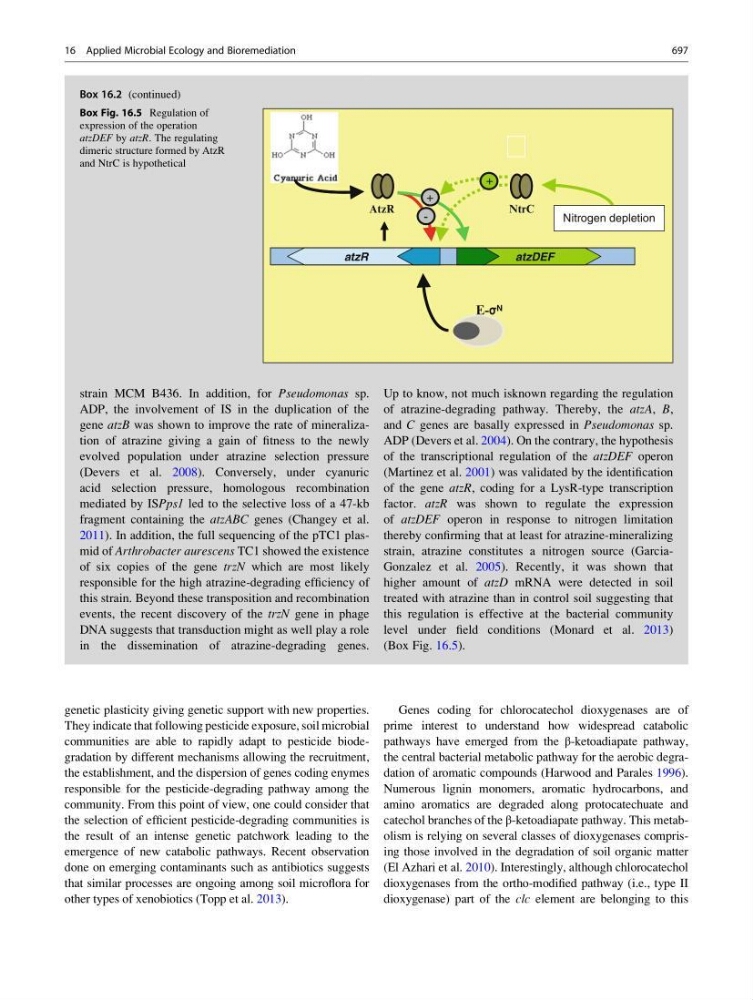
factor. atzR was shown to regulate the expression
of atzDEF operon in response to nitrogen limitation
thereby confirming that at least for atrazine-mineralizing
strain, atrazine constitutes a nitrogen source (GarciaGonzalez et al. 2005). Recently, it was shown that
higher amount of atzD mRNA were detected in soil
treated with atrazine than in control soil suggesting that
this regulation is effective at the bacterial community
level under field conditions (Monard et al. 2013)
(Box Fig. 16.5).
Carence en azote
+
-
+
atzDEF
atzR
Nitrogen depletion
Carence en azote
E-σ N
NtrC
AtzR
+
-
+
atzDEF
atzR
Nitrogen depletion
Box Fig. 16.5 Regulation of
expression of the operation
atzDEF by atzR. The regulating
dimeric structure formed by AtzR
and NtrC is hypothetical
16 Applied Microbial Ecology and Bioremediation
697