

Box 16.2 (continued)
genes involved in the control of plasmid replication, transfer, and maintenance and a region with accessory genes
that confer beneficial traits to the bacterial host such as the
ability to metabolize xenobiotic compounds. Accessory
genes are often associated with mobile genetic elements
such as transposons that facilitate their incorporation in or
expelling from the backbone. Plasmids with similar
backbones can have different accessory genes (Schlu ¨ter
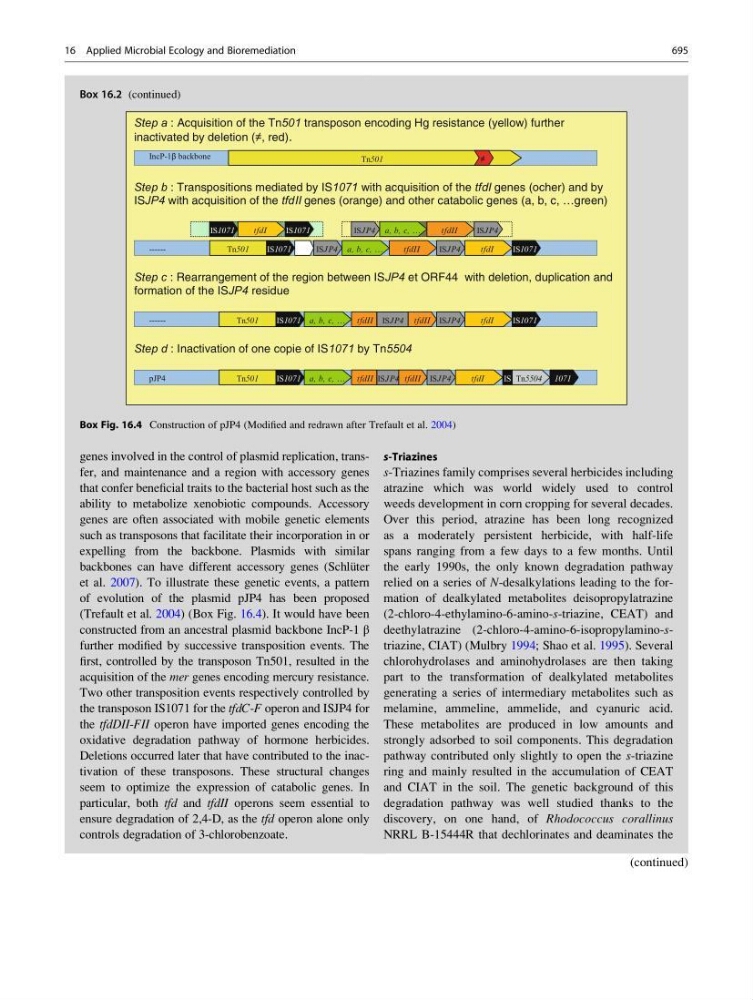
et al. 2007). To illustrate these genetic events, a pattern
of evolution of the plasmid pJP4 has been proposed
(Trefault et al. 2004) (Box Fig. 16.4). It would have been
constructed from an ancestral plasmid backbone IncP-1 β
further modified by successive transposition events. The
first, controlled by the transposon Tn501, resulted in the
acquisition of the mer genes encoding mercury resistance.
Two other transposition events respectively controlled by
the transposon IS1071 for the tfdC-F operon and ISJP4 for
the tfdDII-FII operon have imported genes encoding the
oxidative degradation pathway of hormone herbicides.
Deletions occurred later that have contributed to the inactivation of these transposons. These structural changes
seem to optimize the expression of catabolic genes. In
particular, both tfd and tfdII operons seem essential to
ensure degradation of 2,4-D, as the tfd operon alone only
controls degradation of 3-chlorobenzoate.
(continued)
Box 16.2 (continued)
s-Triazines
s-Triazines family comprises several herbicides including
atrazine which was world widely used to control
weeds development in corn cropping for several decades.
Over this period, atrazine has been long recognized
as a moderately persistent herbicide, with half-life
spans ranging from a few days to a few months. Until
the early 1990s, the only known degradation pathway
relied on a series of N-desalkylations leading to the formation of dealkylated metabolites deisopropylatrazine
(2-chloro-4-ethylamino-6-amino-s-triazine, CEAT) and
deethylatrazine (2-chloro-4-amino-6-isopropylamino-striazine, CIAT) (Mulbry 1994; Shao et al. 1995). Several
chlorohydrolases and aminohydrolases are then taking
part to the transformation of dealkylated metabolites
generating a series of intermediary metabolites such as
melamine, ammeline, ammelide, and cyanuric acid.
These metabolites are produced in low amounts and
strongly adsorbed to soil components. This degradation
pathway contributed only slightly to open the s-triazine
ring and mainly resulted in the accumulation of CEAT
and CIAT in the soil. The genetic background of this
degradation pathway was well studied thanks to the
discovery, on one hand, of Rhodococcus corallinus
NRRL B-15444R that dechlorinates and deaminates the
(continued)
Step a : Acquisition of the Tn501 transposon encoding Hg resistance (yellow) further
inactivated by deletion (≠, red).
IncP-1β backbone
Tn501
≠
Step b : Transpositions mediated by IS1071 with acquisition of the tfdI genes (ocher) and by
ISJP4 with acquisition of the tfdII genes (orange) and other catabolic genes (a, b, c, …green)
IS1071
IS1071
ISJP4
ISJP4
tfdII
tfdI
a, b, c, …
-----IS1071
IS1071
ISJP4
ISJP4
tfdII
tfdI
a, b, c, …
Tn501
Step c : Rearrangement of the region between ISJP4 et ORF44 with deletion, duplication and
formation of the ISJP4 residue
-----IS1071
IS1071
ISJP4
ISJP4
tfdII
tfdI
a, b, c, …
Tn501
tfdII
Step d : Inactivation of one copie of IS1071 by Tn5504
pJP4
Tn5504
IS1071
1071
ISJP4
ISJP4
tfdII
tfdI
a, b, c, …
Tn501
tfdII
IS
Box Fig. 16.4 Construction of pJP4 (Modified and redrawn after Trefault et al. 2004)
16 Applied Microbial Ecology and Bioremediation
695