

Box 16.2 (continued)
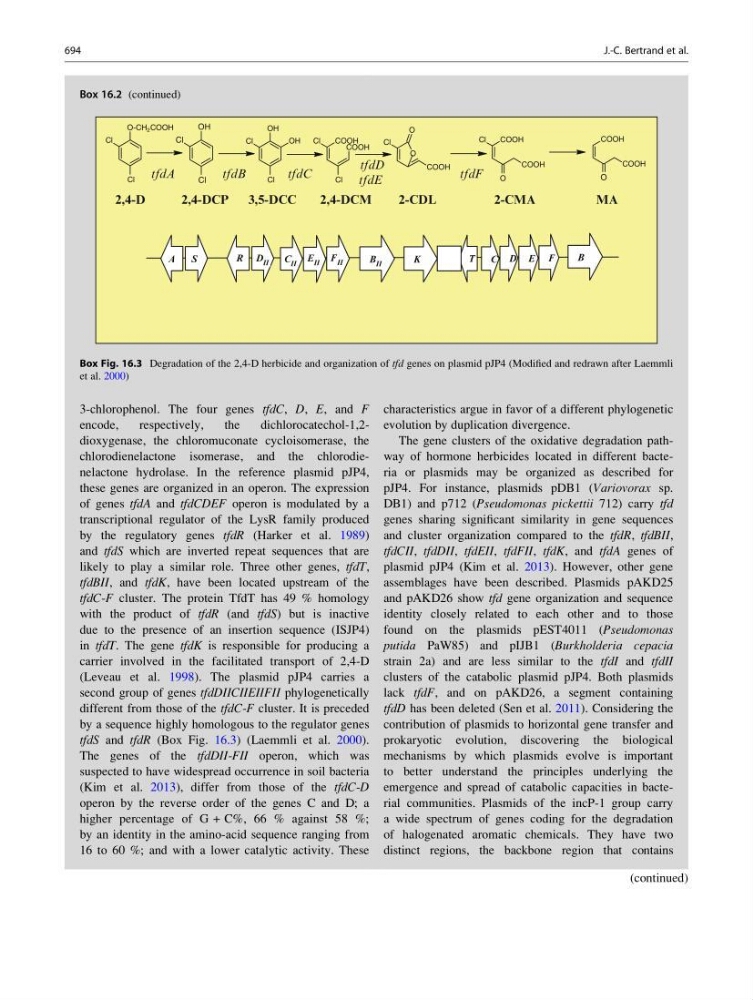
3-chlorophenol. The four genes tfdC, D, E, and F
encode,
respectively,
the
dichlorocatechol-1,2dioxygenase, the chloromuconate cycloisomerase, the
chlorodienelactone isomerase, and the chlorodienelactone hydrolase. In the reference plasmid pJP4,
these genes are organized in an operon. The expression
of genes tfdA and tfdCDEF operon is modulated by a
transcriptional regulator of the LysR family produced
by the regulatory genes tfdR (Harker et al. 1989)
and tfdS which are inverted repeat sequences that are
likely to play a similar role. Three other genes, tfdT,
tfdBII, and tfdK, have been located upstream of the
tfdC-F cluster. The protein TfdT has 49 % homology
with the product of tfdR (and tfdS) but is inactive
due to the presence of an insertion sequence (ISJP4)
in tfdT. The gene tfdK is responsible for producing a
carrier involved in the facilitated transport of 2,4-D
(Leveau et al. 1998). The plasmid pJP4 carries a
second group of genes tfdDIICIIEIIFII phylogenetically
different from those of the tfdC-F cluster. It is preceded
by a sequence highly homologous to the regulator genes
tfdS and tfdR (Box Fig. 16.3) (Laemmli et al. 2000).
The genes of the tfdDII-FII operon, which was
suspected to have widespread occurrence in soil bacteria
(Kim et al. 2013), differ from those of the tfdC-D
operon by the reverse order of the genes C and D; a
higher percentage of G + C%, 66 % against 58 %;
by an identity in the amino-acid sequence ranging from
16 to 60 %; and with a lower catalytic activity. These
(continued)
Box 16.2 (continued)
characteristics argue in favor of a different phylogenetic
evolution by duplication divergence.
The gene clusters of the oxidative degradation pathway of hormone herbicides located in different bacteria or plasmids may be organized as described for
pJP4. For instance, plasmids pDB1 (Variovorax sp.
DB1) and p712 (Pseudomonas pickettii 712) carry tfd
genes sharing significant similarity in gene sequences
and cluster organization compared to the tfdR, tfdBII,
tfdCII, tfdDII, tfdEII, tfdFII, tfdK, and tfdA genes of
plasmid pJP4 (Kim et al. 2013). However, other gene
assemblages have been described. Plasmids pAKD25
and pAKD26 show tfd gene organization and sequence
identity closely related to each other and to those
found on the plasmids pEST4011 (Pseudomonas
putida PaW85) and pIJB1 (Burkholderia cepacia
strain 2a) and are less similar to the tfdI and tfdII
clusters of the catabolic plasmid pJP4. Both plasmids
lack tfdF, and on pAKD26, a segment containing
tfdD has been deleted (Sen et al. 2011). Considering the
contribution of plasmids to horizontal gene transfer and
prokaryotic evolution, discovering the biological
mechanisms by which plasmids evolve is important
to better understand the principles underlying the
emergence and spread of catabolic capacities in bacterial communities. Plasmids of the incP-1 group carry
a wide spectrum of genes coding for the degradation
of halogenated aromatic chemicals. They have two
distinct regions, the backbone region that contains
(continued)
O-CH 2 COOH
Cl
Cl
Cl
Cl
OH
OH
OH
Cl
Cl
Cl
COOH
COOH
Cl
Cl
O
O
COOH
O
COOH
COOH
Cl
O
COOH
COOH
tfdA
tfdB
tfdD
tfdC
tfdE
tfdF
2,4-D
2,4-DCP
3,5-DCC
2,4-DCM
2-CDL
2-CMA
MA
K
C D E F
B
T
B II
C II
A
S
R D II
E II F II
Box Fig. 16.3 Degradation of the 2,4-D herbicide and organization of tfd genes on plasmid pJP4 (Modified and redrawn after Laemmli
et al. 2000)
694
J.-C. Bertrand et al.