

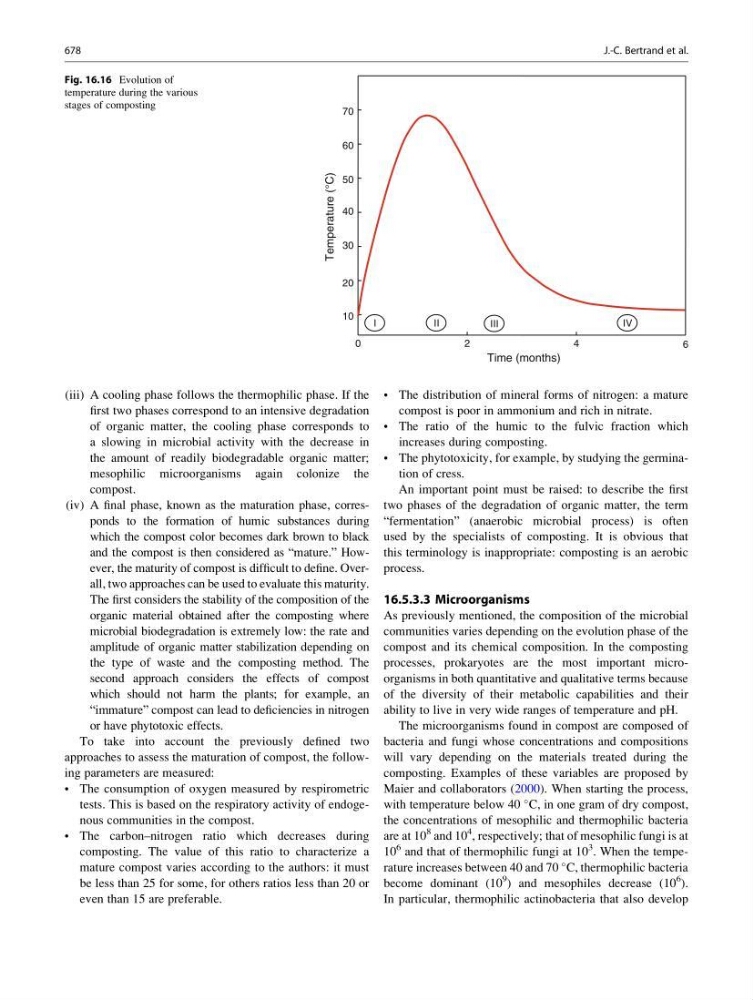
(iii) A cooling phase follows the thermophilic phase. If the
first two phases correspond to an intensive degradation
of organic matter, the cooling phase corresponds to
a slowing in microbial activity with the decrease in
the amount of readily biodegradable organic matter;
mesophilic microorganisms again colonize the
compost.
(iv) A final phase, known as the maturation phase, corresponds to the formation of humic substances during
which the compost color becomes dark brown to black
and the compost is then considered as “mature.” However, the maturity of compost is difficult to define. Overall, two approaches can be used to evaluate this maturity.
The first considers the stability of the composition of the
organic material obtained after the composting where
microbial biodegradation is extremely low: the rate and
amplitude of organic matter stabilization depending on
the type of waste and the composting method. The
second approach considers the effects of compost
which should not harm the plants; for example, an
“immature” compost can lead to deficiencies in nitrogen
or have phytotoxic effects.
To take into account the previously defined two
approaches to assess the maturation of compost, the following parameters are measured:
• The consumption of oxygen measured by respirometric
tests. This is based on the respiratory activity of endogenous communities in the compost.
• The carbon–nitrogen ratio which decreases during
composting. The value of this ratio to characterize a
mature compost varies according to the authors: it must
be less than 25 for some, for others ratios less than 20 or
even than 15 are preferable.
• The distribution of mineral forms of nitrogen: a mature
compost is poor in ammonium and rich in nitrate.
• The ratio of the humic to the fulvic fraction which
increases during composting.
• The phytotoxicity, for example, by studying the germination of cress.
An important point must be raised: to describe the first
two phases of the degradation of organic matter, the term
“fermentation” (anaerobic microbial process) is often
used by the specialists of composting. It is obvious that
this terminology is inappropriate: composting is an aerobic
process.
16.5.3.3 Microorganisms
As previously mentioned, the composition of the microbial
communities varies depending on the evolution phase of the
compost and its chemical composition. In the composting
processes, prokaryotes are the most important microorganisms in both quantitative and qualitative terms because
of the diversity of their metabolic capabilities and their
ability to live in very wide ranges of temperature and pH.
The microorganisms found in compost are composed of
bacteria and fungi whose concentrations and compositions
will vary depending on the materials treated during the
composting. Examples of these variables are proposed by
Maier and collaborators (2000). When starting the process,
with temperature below 40
C, in one gram of dry compost,
the concentrations of mesophilic and thermophilic bacteria
are at 10
8 and 10
4 , respectively; that of mesophilic fungi is at
10
6 and that of thermophilic fungi at 10
3 . When the temperature increases between 40 and 70
C, thermophilic bacteria
become dominant (10
9 ) and mesophiles decrease (10
6 ).
In particular, thermophilic actinobacteria that also develop
70
20
10
30
40
50
60
0
6
2
4
I
II
IV
III
Time (months)
Temperature (°C)
Fig. 16.16 Evolution of
temperature during the various
stages of composting
678
J.-C. Bertrand et al.