

Deposition over large areas (“landfarming”) consists of
spreading out the material (e.g., soil polluted by oil products)
with a thickness of a few ten centimeters. An alternative is to
use wetlands.
These techniques are easy to implement, do not require
heavy infrastructure, and are of low cost. However,
operations lasted a long time (year or decade) and are likely
to produce odors and visual nuisances. In addition, to avoid
any risk of infiltration, a waterproof cover must be in place
before the start of the treatment.
16.2.2.4 Bioventing and Air Sparging
The method consists of injecting flowing air through the
contaminated area. This artificial aeration is essential in the
case of a bioremediation by composting (cf. Sect. 16.5.3).
Applied to the in situ treatment of soil and groundwater, air
injection, whose the flow rate must be sufficient to enable
effective biodegradation, can be made in the following way:
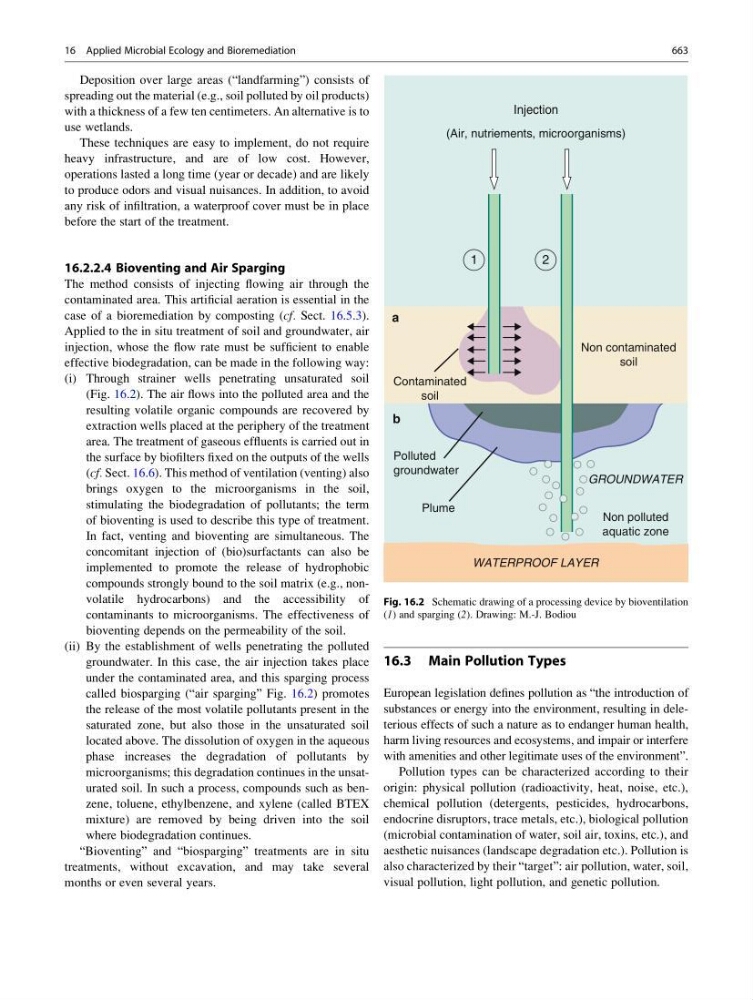
(i) Through strainer wells penetrating unsaturated soil
(Fig. 16.2). The air flows into the polluted area and the
resulting volatile organic compounds are recovered by
extraction wells placed at the periphery of the treatment
area. The treatment of gaseous effluents is carried out in
the surface by biofilters fixed on the outputs of the wells
(cf. Sect. 16.6). This method of ventilation (venting) also
brings oxygen to the microorganisms in the soil,
stimulating the biodegradation of pollutants; the term
of bioventing is used to describe this type of treatment.
In fact, venting and bioventing are simultaneous. The
concomitant injection of (bio)surfactants can also be
implemented to promote the release of hydrophobic
compounds strongly bound to the soil matrix (e.g., nonvolatile hydrocarbons) and the accessibility of
contaminants to microorganisms. The effectiveness of
bioventing depends on the permeability of the soil.
(ii) By the establishment of wells penetrating the polluted
groundwater. In this case, the air injection takes place
under the contaminated area, and this sparging process
called biosparging (“air sparging” Fig. 16.2) promotes
the release of the most volatile pollutants present in the
saturated zone, but also those in the unsaturated soil
located above. The dissolution of oxygen in the aqueous
phase increases the degradation of pollutants by
microorganisms; this degradation continues in the unsaturated soil. In such a process, compounds such as benzene, toluene, ethylbenzene, and xylene (called BTEX
mixture) are removed by being driven into the soil
where biodegradation continues.
“Bioventing” and “biosparging” treatments are in situ
treatments, without excavation, and may take several
months or even several years.
16.3 Main Pollution Types
European legislation defines pollution as “the introduction of
substances or energy into the environment, resulting in deleterious effects of such a nature as to endanger human health,
harm living resources and ecosystems, and impair or interfere
with amenities and other legitimate uses of the environment”.
Pollution types can be characterized according to their
origin: physical pollution (radioactivity, heat, noise, etc.),
chemical pollution (detergents, pesticides, hydrocarbons,
endocrine disruptors, trace metals, etc.), biological pollution
(microbial contamination of water, soil air, toxins, etc.), and
aesthetic nuisances (landscape degradation etc.). Pollution is
also characterized by their “target”: air pollution, water, soil,
visual pollution, light pollution, and genetic pollution.
1
2
a
b
Polluted
groundwater
Plume
Injection
(Air, nutriements, microorganisms)
GROUNDWATER
Non contaminated
soil
Non polluted
aquatic zone
Contaminated
soil
WATERPROOF LAYER
Fig. 16.2 Schematic drawing of a processing device by bioventilation
(1) and sparging (2). Drawing: M.-J. Bodiou
16 Applied Microbial Ecology and Bioremediation
663