

16.2.1.5 Bioimmobilization
Bioimmobilization is the ability of certain microorganisms
(prokaryotes and eukaryotes, primarily fungi) to immobilize
some inorganic (and radioactive mining waste) or organic
pollutants (hydrocarbons in the matrix of a microbial mat)
by precipitating or by trapping them in a mineral or organic
matrix.
16.2.2 The Main Methods for Microbial
Treatment of Pollution
16.2.2.1 Bioreactors
Biodegradation of a pollutant can be performed in a bioreactor operated in batch or continuous mode (cf. Sects. 17.8.3
and 19.3.4), the microorganisms being free or immobilized
on a support. This technique allows a good control of the
treatment (control of oxygen concentration, temperature,
nutrient intake, pH, etc.) and a maximal accessibility to
pollutants; it is particularly well suited for use in
bioaugmentation techniques. The design and dimensions of
the reactor are functions of the type of culture (aerobic or
anaerobic), the sample volume to be treated, and the nature
of the pollutant. For decontamination of solid samples (soil,
sediment), these may be in the form of more or less liquid
sludge held in suspension in an aqueous phase (“bioslurry”),
with a percentage of the solid fraction generally between 10
and 50 % (weight). It is possible to include the biological
processes in wastewater treatment plants, including membrane bioreactors, in this treatment category.
16.2.2.2 Treatment in Ponds and Wastewater
Plants
For example, aqueous effluents* produced by an oil refinery
are initially treated in an aerated pond where biodegradation
takes place; then, they pass through a settling basin and the
sludge formed is treated in another basin where the biodegradation of residual contaminants continues. If the wastewaters obtained meet the standard requirements, they are
rejected; otherwise, they undergo a new treatment cycle.
Another example is the biological ponds of wastewater
plants that allow the reduction of the concentration of organic
matter, but also a decrease in the concentrations of nitrates and
phosphates (cf. Sect. 16.4.3); indeed, treatment in ponds can
also use techniques to control the most important parameters
such as oxygen or organic matter load (cf. Sect. 16.4.3).
16.2.2.3 Biopiles, Windrows, and Landfarming
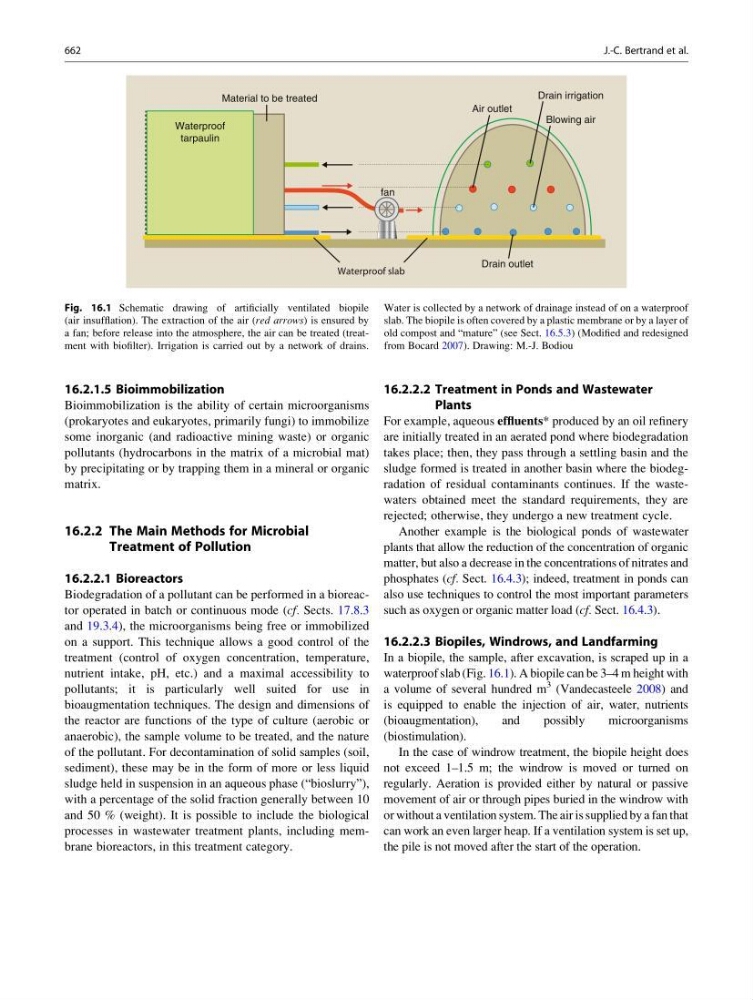
In a biopile, the sample, after excavation, is scraped up in a
waterproof slab (Fig. 16.1). A biopile can be 3–4 m height with
a volume of several hundred m
3 (Vandecasteele 2008) and
is equipped to enable the injection of air, water, nutrients
(bioaugmentation),
and
possibly
microorganisms
(biostimulation).
In the case of windrow treatment, the biopile height does
not exceed 1–1.5 m; the windrow is moved or turned on
regularly. Aeration is provided either by natural or passive
movement of air or through pipes buried in the windrow with
or without a ventilation system. The air is supplied by a fan that
can work an even larger heap. If a ventilation system is set up,
the pile is not moved after the start of the operation.
Waterproof
tarpaulin
Material to be treated
fan
Waterproof slab
Drain outlet
Blowing air
Drain irrigation
Air outlet
Fig. 16.1 Schematic drawing of artificially ventilated biopile
(air insufflation). The extraction of the air (red arrows) is ensured by
a fan; before release into the atmosphere, the air can be treated (treatment with biofilter). Irrigation is carried out by a network of drains.
Water is collected by a network of drainage instead of on a waterproof
slab. The biopile is often covered by a plastic membrane or by a layer of
old compost and “mature” (see Sect. 16.5.3) (Modified and redesigned
from Bocard 2007). Drawing: M.-J. Bodiou
662
J.-C. Bertrand et al.