

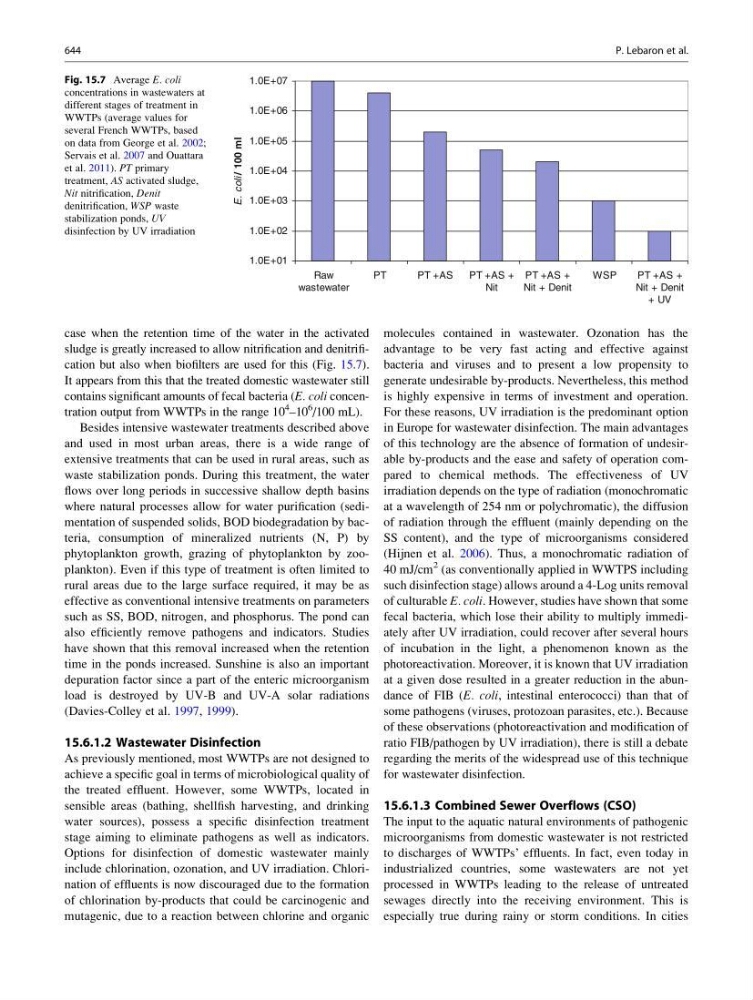
case when the retention time of the water in the activated
sludge is greatly increased to allow nitrification and denitrification but also when biofilters are used for this (Fig. 15.7).
It appears from this that the treated domestic wastewater still
contains significant amounts of fecal bacteria (E. coli concentration output from WWTPs in the range 10
4
–10
6
/100 mL).
Besides intensive wastewater treatments described above
and used in most urban areas, there is a wide range of
extensive treatments that can be used in rural areas, such as
waste stabilization ponds. During this treatment, the water
flows over long periods in successive shallow depth basins
where natural processes allow for water purification (sedimentation of suspended solids, BOD biodegradation by bacteria, consumption of mineralized nutrients (N, P) by
phytoplankton growth, grazing of phytoplankton by zooplankton). Even if this type of treatment is often limited to
rural areas due to the large surface required, it may be as
effective as conventional intensive treatments on parameters
such as SS, BOD, nitrogen, and phosphorus. The pond can
also efficiently remove pathogens and indicators. Studies
have shown that this removal increased when the retention
time in the ponds increased. Sunshine is also an important
depuration factor since a part of the enteric microorganism
load is destroyed by UV-B and UV-A solar radiations
(Davies-Colley et al. 1997, 1999).
15.6.1.2 Wastewater Disinfection
As previously mentioned, most WWTPs are not designed to
achieve a specific goal in terms of microbiological quality of
the treated effluent. However, some WWTPs, located in
sensible areas (bathing, shellfish harvesting, and drinking
water sources), possess a specific disinfection treatment
stage aiming to eliminate pathogens as well as indicators.
Options for disinfection of domestic wastewater mainly
include chlorination, ozonation, and UV irradiation. Chlorination of effluents is now discouraged due to the formation
of chlorination by-products that could be carcinogenic and
mutagenic, due to a reaction between chlorine and organic
molecules contained in wastewater. Ozonation has the
advantage to be very fast acting and effective against
bacteria and viruses and to present a low propensity to
generate undesirable by-products. Nevertheless, this method
is highly expensive in terms of investment and operation.
For these reasons, UV irradiation is the predominant option
in Europe for wastewater disinfection. The main advantages
of this technology are the absence of formation of undesirable by-products and the ease and safety of operation compared to chemical methods. The effectiveness of UV
irradiation depends on the type of radiation (monochromatic
at a wavelength of 254 nm or polychromatic), the diffusion
of radiation through the effluent (mainly depending on the
SS content), and the type of microorganisms considered
(Hijnen et al. 2006). Thus, a monochromatic radiation of
40 mJ/cm
2 (as conventionally applied in WWTPS including
such disinfection stage) allows around a 4-Log units removal
of culturable E. coli. However, studies have shown that some
fecal bacteria, which lose their ability to multiply immediately after UV irradiation, could recover after several hours
of incubation in the light, a phenomenon known as the
photoreactivation. Moreover, it is known that UV irradiation
at a given dose resulted in a greater reduction in the abundance of FIB (E. coli, intestinal enterococci) than that of
some pathogens (viruses, protozoan parasites, etc.). Because
of these observations (photoreactivation and modification of
ratio FIB/pathogen by UV irradiation), there is still a debate
regarding the merits of the widespread use of this technique
for wastewater disinfection.
15.6.1.3 Combined Sewer Overflows (CSO)
The input to the aquatic natural environments of pathogenic
microorganisms from domestic wastewater is not restricted
to discharges of WWTPs’ effluents. In fact, even today in
industrialized countries, some wastewaters are not yet
processed in WWTPs leading to the release of untreated
sewages directly into the receiving environment. This is
especially true during rainy or storm conditions. In cities
1.0E+01
1.0E+02
1.0E+03
1.0E+04
1.0E+05
1.0E+06
1.0E+07
Raw
wastewater
PT +AS +
Nit
PT
PT +AS
PT +AS +
Nit + Denit
PT +AS +
Nit + Denit
+ UV
WSP
E. coli
/ 100 ml
Fig. 15.7 Average E. coli
concentrations in wastewaters at
different stages of treatment in
WWTPs (average values for
several French WWTPs, based
on data from George et al. 2002;
Servais et al. 2007 and Ouattara
et al. 2011). PT primary
treatment, AS activated sludge,
Nit nitrification, Denit
denitrification, WSP waste
stabilization ponds, UV
disinfection by UV irradiation
644
P. Lebaron et al.