

concentrations in raw sewage arriving in WWTPs are
usually around 10
7 /100 mL (Servais et al. 2007). While
there are still 20 or 30 years, the wastewaters were often
discharged without treatment into the aquatic environment, most of the urban domestic wastes are today, in
industrialized countries, treated in wastewater treatment
plants (WWTPs).
15.6.1.1 Wastewater Treatment Plants Effluents
The goal of a WWTP is primarily to remove suspended
solids, organic matter (especially its biodegradable fraction),
nitrogen, and phosphorus. Although wastewaters carry out
many microorganisms, including some pathogens, very few
WWTPs are equipped with treatments specifically designed
to eliminate microorganisms. Presently, there is no European
standard on the bacteriological quality of treated wastewater
discharged into the natural environment.
Usually urban WWTPs include a pretreatment step
(screening, grit removal, oil removal), a primary settling
treatment which aims to retain suspended solids (SS) responsible for the turbidity of the water. This is often followed by
secondary treatment, i.e., biological treatment involving bacteria that will oxidize the biodegradable organic matter
(measured by biological oxygen demand, BOD). Generally,
the biological treatment used is the “activated sludge.”
In more and more WWTPs, secondary treatment is now
followed by a biological treatment of nitrogen; it may seek
to convert ammonium to nitrate (nitrification treatment) or to
remove nitrogen (nitrification treatment followed by denitrification). A biological or physicochemical treatment stage
devoted to remove phosphates can also be inserted in the
treatment line. According to European legislation (Directive
on Urban Waste Water, DERU), the treatment of nitrogen and
phosphorus is now compulsory for all WWTPs treating wastewater of more than 10,000 inhabitants. Studies on the removal
of fecal bacteria in WWTPs usually show for plants using
settling followed by activated sludge, a 2-Log units reduction
of FIB present in the raw effluent corresponding to a removal
of 99 % (Servais et al., 2007) (Fig. 15.7). The Log removal is
calculated as the difference between the Log of the FIB
concentration before treatment and the Log of the concentration after treatment. This elimination begins in the primary
treatment in which fecal bacteria attached to suspended solids
are removed with these particles by settling. It continues
during the biological treatment where they can be consumed
by protozoa. In WWTPs where a tertiary treatment of nitrogen
or phosphorus is added, one can observe an improvement in
the removal of fecal bacteria (up to 3-Log removal). It is the
Wastewater
treatment plant
URBAN ZONE
RURAL
AREA
Sewage
R u n o f f
R u n o f f
R u n o f f
Sanitation
Pastures
Agriculture
Forests
Wildlife
Cities
Effluent
Slaughterhouses
Nuclear power plants ...
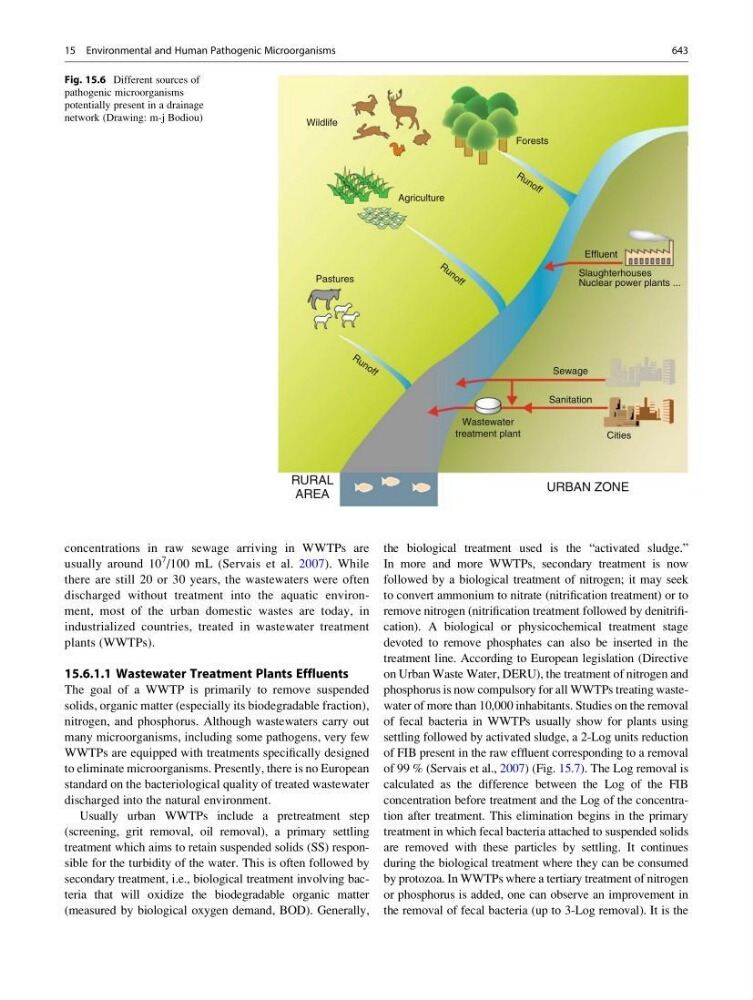
Fig. 15.6 Different sources of
pathogenic microorganisms
potentially present in a drainage
network (Drawing: m-j Bodiou)
15 Environmental and Human Pathogenic Microorganisms
643