

Gram-negative rods belonging to the Enterobacteriaceae
family. These microorganisms are not sporulated oxidase
negative, aerobic, or facultative anaerobes and able to grow
in the presence of bile salts or surfactants having the same
properties and fermenting lactose with the production of acid,
gas, or aldehydes in 24–48 h at 37
C. Habitat specificity of
total coliforms is weak, and some coliforms are present in the
environment without any source of fecal contamination.
The interpretation of their presence in a given environment
is often very difficult, and their use as FIB is becoming less
frequent. At the opposite, thermotolerant coliforms (TTC),
also called fecal coliforms, are natural inhabitants of the
digestive tract of humans and warm-blooded animals; they
are therefore a good indicator of the contamination of a
natural environment by feces. They are able to ferment lactose
at a temperature of 44.5
C. Their biochemical and physiological properties allow identifying them among very complex environmental microflora by the use of specific and very
selective culture media. The major representative of
the thermotolerant coliform group is Escherichia coli. This
species represents between 70 and 95 % of TTC and is highly
specific from feces. Escherichia coli is now the most often
used FIB in the context of microbiological analysis of water
quality (Edberg et al. 2000; Fewtrell and Bartram 2001).
15.4.2 Intestinal Enterococci
The group of intestinal enterococci is a very heterogeneous bacterial group belonging to the Streptococcaceae
family and including the Lancefield group D streptococci.
These microorganisms are characterized by a coccoid form,
0.5 to 1 μm in diameter, and are Gram-positive aerobic or
facultative anaerobic bacteria, catalase negative with the
group D antigen, forming chains of cells during cell
divisions. This group includes enterococci (e.g., E. faecalis,
E. faecium, E. durans, E. avium) and non-enterococci (e.g.,
S. bovis, S. equinus). Such as TTC, enterococci are abundant
in human and animal feces. In the natural environment,
enterococci have a better resistance to different environmental stresses than non-enterococci.
The enumeration of both intestinal enterococci and TTC
(or Escherichia coli) is therefore a good indicator of aquatic
contamination by human or animal feces. As the survival
time in the environment is generally greater for enterococci
than for TTC, a higher proportion of intestinal enterococci in
environmental samples may be interpreted as a contamination of animal origin if the pollution is recent or as a former
contamination. In practice, this distinction is often difficult
because of the complexity of events and potential sources of
pollution. In general, the specific detection of pathogenic
microorganisms is only performed in environments where
the concentration of FIB is higher than the guideline values.
Since the beginning of their routine use in legislation
purposes, TTC, Escherichia coli, and intestinal enterococci
were found to be effective indicators to assess the bacteriological quality of drinking and bathing waters. However,
these indicators are weak indicators of the potential presence
Box 15.3: Recreational, or Bathing, Water Quality:
World Health Organization (WHO)
Philippe Lebaron
Bathing is a very popular hobby worldwide. Yet,
there may also be adverse health effects associated
with recreational use if the water is polluted or unsafe.
Maintaining safe recreational waters requires a
concerted effort from all of its stakeholders. From
government at all levels, to local businesses and industry, to beach managers, community members, and
recreational water users, all have a role to play in
helping keep our beaches clean and our swimming
waters safe. The most effective way to ensure that
our waters remain safe for use is to become aware of
the types of hazards (microbiological, chemical, and
physical) that can impact a bathing area. The WHO
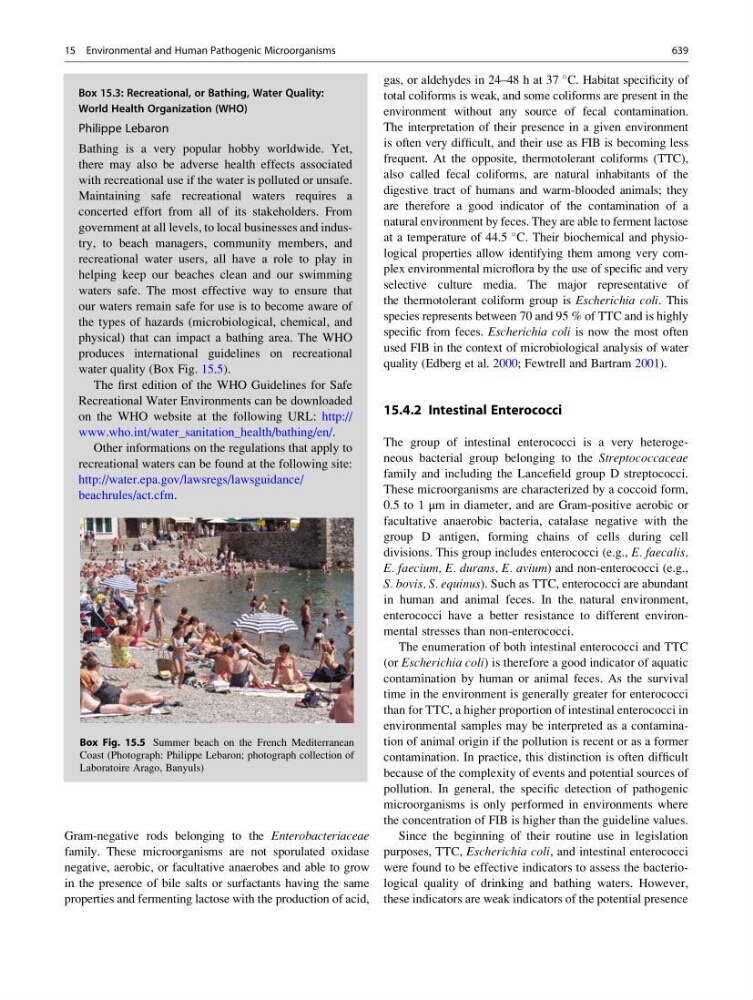
produces international guidelines on recreational
water quality (Box Fig. 15.5).
The first edition of the WHO Guidelines for Safe
Recreational Water Environments can be downloaded
on the WHO website at the following URL: http://
www.who.int/water_sanitation_health/bathing/en/.
Other informations on the regulations that apply to
recreational waters can be found at the following site:
http://water.epa.gov/lawsregs/lawsguidance/
beachrules/act.cfm.
Box Fig. 15.5 Summer beach on the French Mediterranean
Coast (Photograph: Philippe Lebaron; photograph collection of
Laboratoire Arago, Banyuls)
15 Environmental and Human Pathogenic Microorganisms
639