

15.3.6.2 Origin and Evolution of Antibiotic
Resistance: The Resistome Concept
Environment and especially soils are known to harbor
antibiotic-producing organisms, mainly fungi and actinomycetes, from which over 80 % of antibiotics in clinical
use originated. There is now growing evidence that not
only these organisms have biosynthesis genetic pathways
but also have associated resistance mechanisms enabling
their self-protection. Kanamycin and neomycin, two
antibiotics synthesized by bacteria belonging to the genus
Streptomyces, can be degraded by these bacteria, thanks
to acetylation and phosphorylation mechanisms. These
mechanisms have been identified among clinical pathogens
resistant to these antibiotics. An exhaustive inventory of
resistance susceptibilities among actinomycete isolates
from different soils revealed widespread resistance including multiresistance up to seven or eight antibiotics. Then,
ecological and evolutionary studies led to the conclusion
that antibiotic resistances are widespread in environment,
emerged long before our use of antibiotics, and coevolved
with biosynthesis genes (D’Costa et al. 2011). Phylogenetic
studies on resistance genes also suggest a physiological
role other than that of the resistance to antibiotics. For
instance, beta-lactamases would have evolved from
transpeptidases involved in the synthesis of the wall, and
enzymes modifying aminoglycosides would have evolved
from kinases and acyltransferases. Considering the efflux
pumps responsible from multidrug resistance among some
opportunistic pathogens (P. aeruginosa, B. cepacia,
S. maltophilia), it has been understood that they also have
physiological roles (Martinez et al. 2009). They participate
in the processes of detoxification of intracellular
metabolites, confer resistance to host-defense molecules,
and contribute to bacterial colonization and persistence in
the host. They are also involved in cell-to-cell communication, and antibiotics can play a role of signal molecules.
Finally natural and semisynthetic antibiotics can be
metabolized by various bacterial species, which were
found closely related to pathogenic ones as Serratia
marcescens and the Burkholderia cepacia complex. These
species also showed the ability to resist to high level of
antibiotics and exhibited a multidrug resistance phenotype.
We are now aware that the environment, especially the soil
compartment (as well as aquatic sediments), is a reservoir
of an extent diversity of indigenous resistant bacteria and
of large panel of genes that can potentially be involved
in antibiotic resistance (resistome concept: addition of
genes involved in the antibiotic-resistant phenotypes
plus cryptic genes able to confer resistance but without
the expressed phenotype plus precursors of resistant
determinants; Wright 2007).
15.4 Fecal Indicator Bacteria
The search for pathogenic microorganisms in natural
environments is a difficult, long, and tedious task. These
microorganisms are very diverse, and their detection often
requires very specific, sophisticated, and expensive methods
that are sometimes difficult to implement for routine analysis,
including in accredited laboratories. As a consequence, indicator organisms such as fecal indicator bacteria (FIB) are
generally used to evaluate the level of microbial contamination by fecal material in different environments (water, soil,
etc.). The abundance of these FIB in environmental samples is
supposed to be related with the presence of pathogenic
microorganisms from fecal origin. Indeed, even if some
pathogens have a primary habitat other than feces, the majority
of human pathogens encountered in the environment are from
enteric origin and released in the environment by feces of
humans and warm-blooded animals. Therefore, the detection
of FIB provides an indication of the sanitary risk associated
with the various water utilizations. The criteria governing the
choice of a good fecal indicator of fecal contamination are
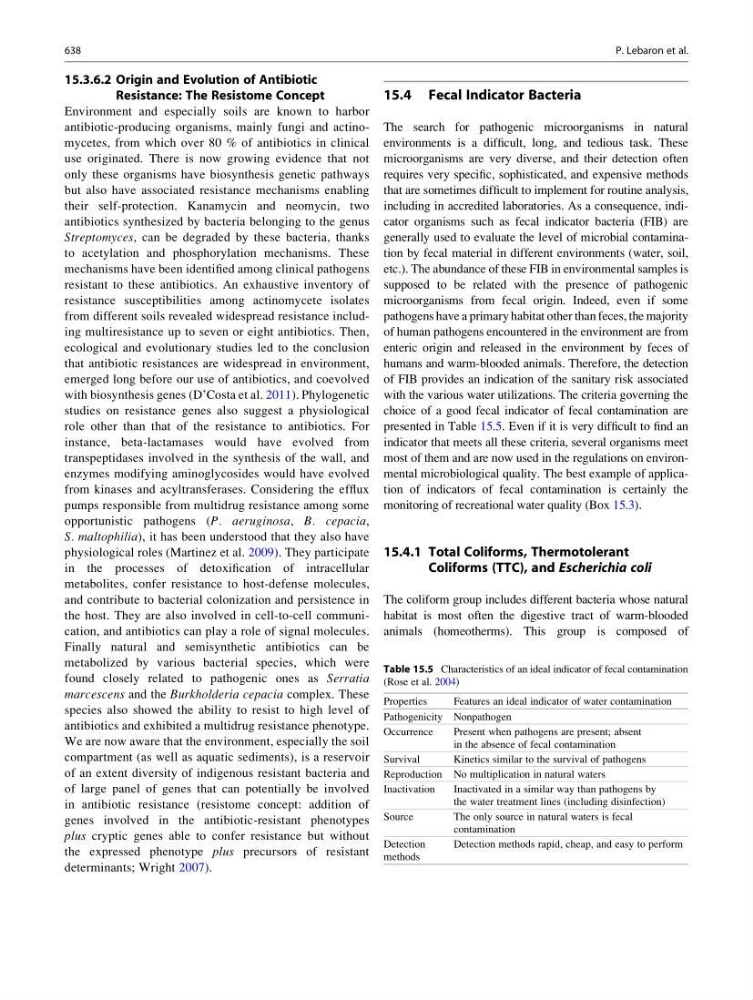
presented in Table 15.5. Even if it is very difficult to find an
indicator that meets all these criteria, several organisms meet
most of them and are now used in the regulations on environmental microbiological quality. The best example of application of indicators of fecal contamination is certainly the
monitoring of recreational water quality (Box 15.3).
15.4.1 Total Coliforms, Thermotolerant
Coliforms (TTC), and Escherichia coli
The coliform group includes different bacteria whose natural
habitat is most often the digestive tract of warm-blooded
animals (homeotherms). This group is composed of
Table 15.5 Characteristics of an ideal indicator of fecal contamination
(Rose et al. 2004)
Properties
Features an ideal indicator of water contamination
Pathogenicity Nonpathogen
Occurrence
Present when pathogens are present; absent
in the absence of fecal contamination
Survival
Kinetics similar to the survival of pathogens
Reproduction No multiplication in natural waters
Inactivation
Inactivated in a similar way than pathogens by
the water treatment lines (including disinfection)
Source
The only source in natural waters is fecal
contamination
Detection
methods
Detection methods rapid, cheap, and easy to perform
638
P. Lebaron et al.