

activate a transcriptional activator protein (named R) that can
modify the expression of a set of target genes (Table 15.4).
In Gram-positive bacteria, chemically different autoinducers
are produced, but their structure remains poorly characterized.
These play similar functions, that is to say, being involved in
conjugation, competence toward DNA or virulence, as
demonstrated in S. aureus.
15.3.5 Pathogenicity Islands (PAI) and Other
Mobile Genomic Islands (GI)
The term “pathogenicity island” (PAI) was introduced by
Knapp et al. (1986) to describe the genetic elements conferring high virulence among uropathogenic Escherichia coli
strains. It was subsequently used to describe all mobile genomic islands involved in virulence among pathogenic bacteria.
Nowadays, PAI are a part of the vast group of mobile genomic
islands (GI) being found in bacteria. Generally speaking, GI
have a variable length (5–10 kb to over 100 kb) with a specific
organization often showing a G + C % distinct from the core
genome. GI show short repeated sequences at their ends (attL
and attR). These are involved in the GI DNA integration
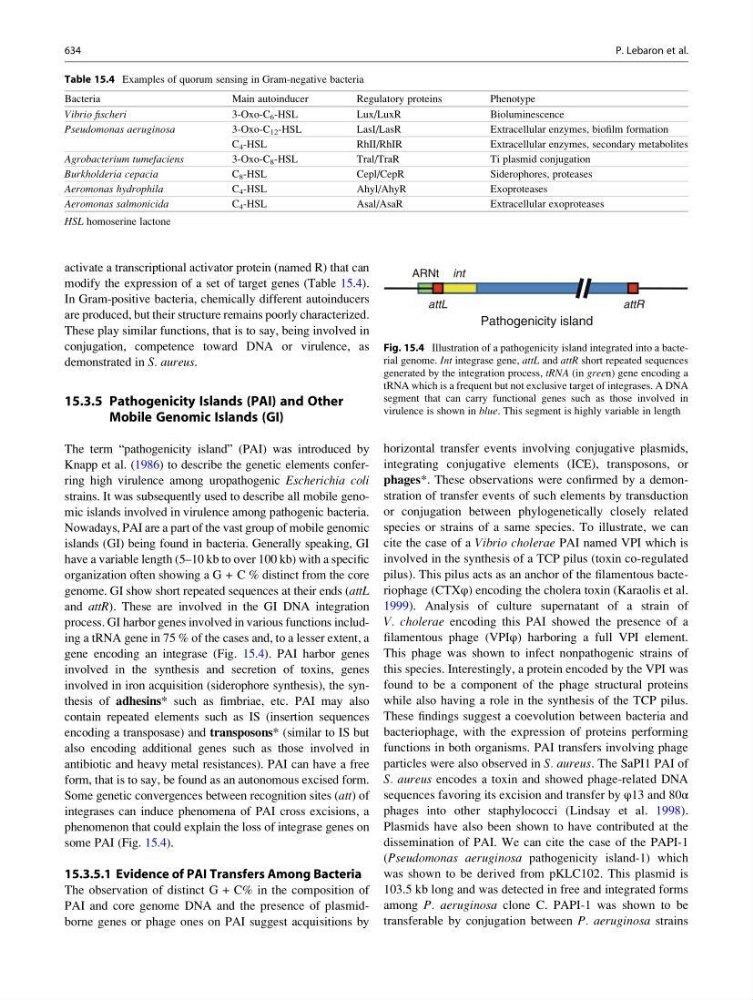
process. GI harbor genes involved in various functions including a tRNA gene in 75 % of the cases and, to a lesser extent, a
gene encoding an integrase (Fig. 15.4). PAI harbor genes
involved in the synthesis and secretion of toxins, genes
involved in iron acquisition (siderophore synthesis), the synthesis of adhesins* such as fimbriae, etc. PAI may also
contain repeated elements such as IS (insertion sequences
encoding a transposase) and transposons* (similar to IS but
also encoding additional genes such as those involved in
antibiotic and heavy metal resistances). PAI can have a free
form, that is to say, be found as an autonomous excised form.
Some genetic convergences between recognition sites (att) of
integrases can induce phenomena of PAI cross excisions, a
phenomenon that could explain the loss of integrase genes on
some PAI (Fig. 15.4).
15.3.5.1 Evidence of PAI Transfers Among Bacteria
The observation of distinct G + C% in the composition of
PAI and core genome DNA and the presence of plasmidborne genes or phage ones on PAI suggest acquisitions by
horizontal transfer events involving conjugative plasmids,
integrating conjugative elements (ICE), transposons, or
phages*. These observations were confirmed by a demonstration of transfer events of such elements by transduction
or conjugation between phylogenetically closely related
species or strains of a same species. To illustrate, we can
cite the case of a Vibrio cholerae PAI named VPI which is
involved in the synthesis of a TCP pilus (toxin co-regulated
pilus). This pilus acts as an anchor of the filamentous bacteriophage (CTXφ) encoding the cholera toxin (Karaolis et al.
1999). Analysis of culture supernatant of a strain of
V. cholerae encoding this PAI showed the presence of a
filamentous phage (VPIφ) harboring a full VPI element.
This phage was shown to infect nonpathogenic strains of
this species. Interestingly, a protein encoded by the VPI was
found to be a component of the phage structural proteins
while also having a role in the synthesis of the TCP pilus.
These findings suggest a coevolution between bacteria and
bacteriophage, with the expression of proteins performing
functions in both organisms. PAI transfers involving phage
particles were also observed in S. aureus. The SaPI1 PAI of
S. aureus encodes a toxin and showed phage-related DNA
sequences favoring its excision and transfer by φ13 and 80α
phages into other staphylococci (Lindsay et al. 1998).
Plasmids have also been shown to have contributed at the
dissemination of PAI. We can cite the case of the PAPI-1
(Pseudomonas aeruginosa pathogenicity island-1) which
was shown to be derived from pKLC102. This plasmid is
103.5 kb long and was detected in free and integrated forms
among P. aeruginosa clone C. PAPI-1 was shown to be
transferable by conjugation between P. aeruginosa strains
Pathogenicity island
ARNt int
attL
attR
Fig. 15.4 Illustration of a pathogenicity island integrated into a bacterial genome. Int integrase gene, attL and attR short repeated sequences
generated by the integration process, tRNA (in green) gene encoding a
tRNA which is a frequent but not exclusive target of integrases. A DNA
segment that can carry functional genes such as those involved in
virulence is shown in blue. This segment is highly variable in length
Table 15.4 Examples of quorum sensing in Gram-negative bacteria
Bacteria
Main autoinducer
Regulatory proteins
Phenotype
Vibrio fischeri
3-Oxo-C 6 -HSL
Lux/LuxR
Bioluminescence
Pseudomonas aeruginosa
3-Oxo-C 12 -HSL
LasI/LasR
Extracellular enzymes, biofilm formation
C 4 -HSL
RhII/RhIR
Extracellular enzymes, secondary metabolites
Agrobacterium tumefaciens
3-Oxo-C 8 -HSL
Tral/TraR
Ti plasmid conjugation
Burkholderia cepacia
C 8 -HSL
Cepl/CepR
Siderophores, proteases
Aeromonas hydrophila
C 4 -HSL
Ahyl/AhyR
Exoproteases
Aeromonas salmonicida
C 4 -HSL
Asal/AsaR
Extracellular exoproteases
HSL homoserine lactone
634
P. Lebaron et al.