

released after cell lysis and (2) exotoxins which are released
more readily in the environment by growing bacteria
(Table 15.2).
15.3.3.1 Exotoxins
Exotoxins are generally more virulent than endotoxins.
They generally have a domain A (activity) and a domain
B (binding domain). The B domain is responsible for the
introduction of the A domain into the cytoplasm of the
eukaryotic cell through the membrane. The organization of
these domains varies from one toxin to another (diphtheria
toxin, cholera, and anthrax ones). Nevertheless, other
exotoxins termed cytotoxins do not include a B domain as
they penetrate into the cell by a secretion system (e.g., type
III secretion system or TTSS). Examples of diseases due to
the action of exotoxins are listed in Table 15.3.
INHALATION
INGESTION
Staphylococcus
Pseudomonas
Vibrio
ACTIVE
CONTACT
Leptospira
PASSIVE CONTACT
AUTO-INFECTION
Staphylococcus
Sources
Feces, urine, human
body, natural water
Environment
Fresh- and marine-waters,
pools
Exposure
Ingestion, inhalation,
contact
Pathogens survival
Protozoa viruses bacteria
^
^
Infection
Diseases
Feces are the first source of contamination by pathogens but
there are other sources of pathogens.
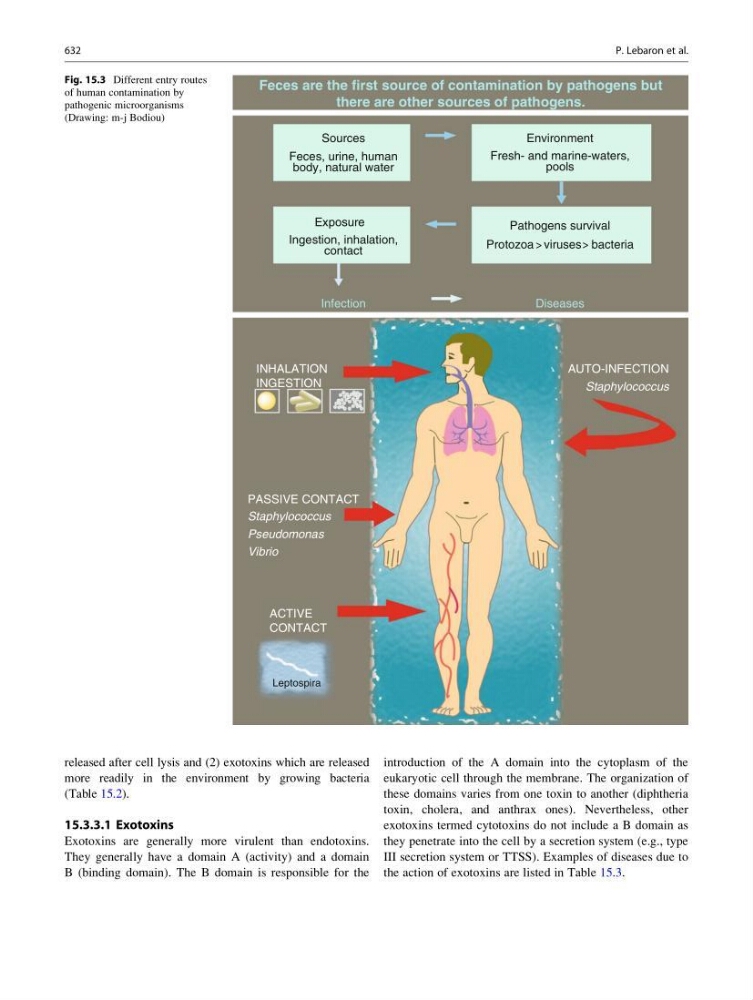
Fig. 15.3 Different entry routes
of human contamination by
pathogenic microorganisms
(Drawing: m-j Bodiou)
632
P. Lebaron et al.