

Some bacteria can reduce manganese aerobically or
anaerobically. Others perform reduction only in anoxic
conditions where electron donors vary depending of species.
These species include Geobacter metallireducens which can
use butyrate, propionate, lactate, succinate, acetate, and
other compounds which are fully oxidized to CO 2 .
Shewanella putrefaciens uses pyruvate and lactate as electron donors but oxidizes them up to only acetate; formate
and H 2 are also electron donors. During their development
on solid nutrient medium, colored in black by the addition of
manganese oxide (MnO 2 ), bacteria that reduce manganese
can be identified by the formation of a clear halo around the
colonies, which is due to the dissolution of MnO 2 .
In the environment, after oxygen and nitrate depletion,
the oxidation of organic matter coupled to the reduction of
Mn(IV) oxides to return back to the reduced and soluble
form Mn(II) is carried out according to the following primary reaction:
246 MnO 2 þ MO þ 364 CO 2 þ 104 H 2 O ! 470 HCO 3
À
þ 8 N 2 þ 236 Mn
2þ
þHPO 4
2À
ðMO ¼ Organic Matter of theoretical composition
C 106 H 263 O 110 N 16 PÞ
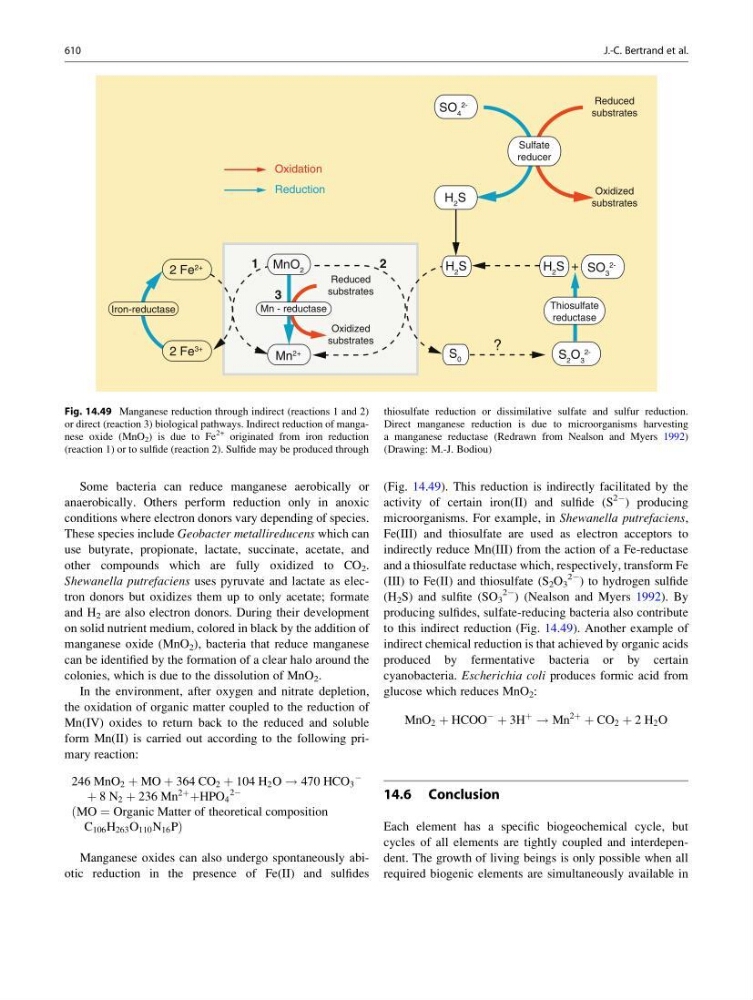
Manganese oxides can also undergo spontaneously abiotic reduction in the presence of Fe(II) and sulfides
(Fig. 14.49). This reduction is indirectly facilitated by the
activity of certain iron(II) and sulfide (S
2À ) producing
microorganisms. For example, in Shewanella putrefaciens,
Fe(III) and thiosulfate are used as electron acceptors to
indirectly reduce Mn(III) from the action of a Fe-reductase
and a thiosulfate reductase which, respectively, transform Fe
(III) to Fe(II) and thiosulfate (S 2 O 3
2À
) to hydrogen sulfide
(H 2 S) and sulfite (SO 3
2À ) (Nealson and Myers 1992). By
producing sulfides, sulfate-reducing bacteria also contribute
to this indirect reduction (Fig. 14.49). Another example of
indirect chemical reduction is that achieved by organic acids
produced by fermentative bacteria or by certain
cyanobacteria. Escherichia coli produces formic acid from
glucose which reduces MnO 2 :
MnO 2 þ HCOO
À
þ 3H
þ
! Mn
2þ
þ CO 2 þ 2 H 2 O
14.6 Conclusion
Each element has a specific biogeochemical cycle, but
cycles of all elements are tightly coupled and interdependent. The growth of living beings is only possible when all
required biogenic elements are simultaneously available in
1
2
3
+
Mn - reductase
Reduced
substrates
Oxidized
substrates
Reduced
substrates
Oxidized
substrates
Sulfate
reducer
S 0
SO 4
2SO 3
2H 2 S
H 2 S
H 2 S
S 2 O 3
2Thiosulfate
reductase
+
?
2 Fe
2+
2 Fe
3+
Iron-reductase
MnO 2
Mn
2+
Oxidation
Reduction
Fig. 14.49 Manganese reduction through indirect (reactions 1 and 2)
or direct (reaction 3) biological pathways. Indirect reduction of manganese oxide (MnO 2 ) is due to Fe
2+ originated from iron reduction
(reaction 1) or to sulfide (reaction 2). Sulfide may be produced through
thiosulfate reduction or dissimilative sulfate and sulfur reduction.
Direct manganese reduction is due to microorganisms harvesting
a manganese reductase (Redrawn from Nealson and Myers 1992)
(Drawing: M.-J. Bodiou)
610
J.-C. Bertrand et al.