

oxidation of manganese involves the transfer of two
electrons (Mn(II) ! Mn(IV)), and comprises an intermediate step involving a single electron Mn(III). As in the case of
iron(II), Mn(II) is soluble but its oxidation product Mn(IV) is
very insoluble. The resulting oxides can sometimes form
concretions around sediment grains, pebbles, dead, or
biological structures (mollusc shell, fragment of coral, or
other debris) or dark layers in sedimentary rocks.
However, unlike iron(II), Mn(II) is stable in oxic
conditions at neutral pH. Chemical oxidation indeed becomes
significant only when pH is equal or higher than 8. Because
Mn is less prone to chemical oxidation, Mn(II) will be present
at a concentration greater than that of iron in aerobic zones
(marine and fresh waters) as well as in anoxic soils.
Microorganisms capable of oxidizing manganese have
been isolated in many biotopes (marine and fresh waters,
soils, sediments, manganese nodules, hydrothermal vents).
They are particularly prevalent in oxic–anoxic interface
areas and in hydrothermal systems which are a major source
of dissolved Mn(II) in the oceans. Mn(II) is reoxidized by
many bacteria, present in several phylogenetic lineages
(Firmicutes, Proteobacteria) (Tebo et al. 2005). Most studied species are:
Pseudomonas putida strain GB-1 and MnB1;
Leptothrix discophora strain SS-1 (characterized by a double
precipitation of iron and manganese oxides in the sheet
which surrounds the cells, yielding dark brown or black
colors);
Gallionella spp.;
Bacillus sp. strain SG-1; it is important to note that some
marine Bacillus produce spores that oxidize Mn(II) and
thereby are recovered with a precipitate of manganese
dioxide.
Some Fungi can also oxidize manganese (Thompson
et al. 2005). The main related enzymatic mechanisms
involve a copper oxidase. Its existence is demonstrated by
the inhibition of its oxidizing activity by azide (inhibitor of
copper-protein), and by a stimulation in the presence of
copper (Francis et al. 2001).
Based on physiological criteria, it is possible to classify
microorganisms that oxidize manganese into three major
groups (Ehrlich 2002).
Some (group I) oxidize soluble species of Mn(II) using
oxygen as terminal acceptor of electrons; this oxidation can be
coupled or not to the synthesis of ATP. The overall reaction is:
Mn
2þ
þ 0:5 O 2 þ H 2 O ! MnO 2 þ 2H
þ
Organisms belonging to group II oxidize Mn(II) providing
that it is bound to a solid extracellular substrate Mn(IV)
oxide, ferromanganese, montmorillonite, kaolinite). These
organisms also use oxygen as terminal electrons acceptor.
For example, the reaction catalyzed by these bacteria when
manganese is bound to a hydrated oxidized form such as
MnO 2 .H 2 O (H 2 MnO 3 ) can be summarized as follows:
Mn
2þ
þ H 2 MnO 3 ! MnMnO 3 þ 2 H
þ
MnMnO 3 þ 0:5 O 2 þ 2 H 2 O ! 2 H 2 MnO 3
Microorganisms of group III oxidize dissolved Mn(II)
with H 2 O 2 using a catalase as enzyme. The reaction can be
summarized as follows:
Mn
2þ
þ H 2 O 2 ! MnO 2 þ 2 H
þ
14.5.3.4 Reduction by Microorganisms
As in the case of oxidation, the reduction of manganese can
be performed enzymatically or not. The reduction of Mn(III)
and Mn(IV) forms, which is particularly important in anoxic
environments, generally leads to the solubilization of
manganese.
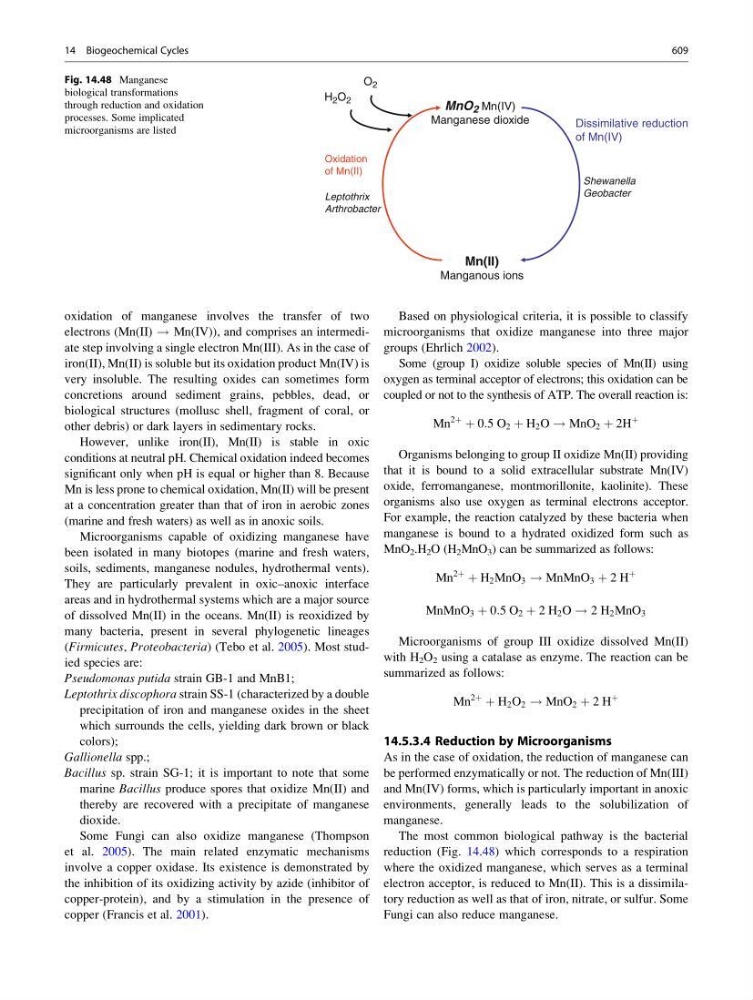
The most common biological pathway is the bacterial
reduction (Fig. 14.48) which corresponds to a respiration
where the oxidized manganese, which serves as a terminal
electron acceptor, is reduced to Mn(II). This is a dissimilatory reduction as well as that of iron, nitrate, or sulfur. Some
Fungi can also reduce manganese.
MnO 2 Mn(IV)
Manganese dioxide
Mn(II)
Manganous ions
Oxidation
of Mn(II)
Dissimilative reduction
of Mn(IV)
O 2
Shewanella
Geobacter
Leptothrix
Arthrobacter
H 2 O 2
Fig. 14.48 Manganese
biological transformations
through reduction and oxidation
processes. Some implicated
microorganisms are listed
14 Biogeochemical Cycles
609