

Box 14.10 (continued)
total flow of N 2 (Thamdrup and Dalsgaard 2002). This
process involves one molecule of ammonium and
nitrite to oxidize ammonium directly in di-nitrogen,
ammonium being used as an electron donor and nitrite
electron acceptor. As a result, the production of N 2
measured by IPM is not exclusively produced by denitrification but may result from both denitrification and
anammox that occur simultaneously in the sediment.
The expression of the anammox violates the basic
assumptions of the calculations of IPM since
anammox can only lead to the production of
29 N 2
without the production of
28/30 N 2 . When both processes take place simultaneously, binomial distribution is not respected and calculations originally
proposed by Nielsen cannot be applied. A modification
of the original method has recently been proposed to
quantify the proportion of N 2 from anammox in the
total N 2 fluxes. If anammox occurs, different alternative methods to quantify denitrification and anammox
have been proposed and are discussed (Thamdrup and
Dalsgaard 2002; Risgaard-Petersen 2003; Trimmer
et al 2006. Minjeaud et al. 2008). It appears that: (1)
change in stocks
14 NO 3 via nitrification during the
incubation period has no effect on the denitrifying
activity measured, (2) it is vital to determine the
range of added
15 NO 3 concentrations for which the
activity is independent of the
15 NO 3 concentration
(3) IPM can be used only after verifying the absence
of anammox and (4) modification of the original
(continued)
Box 14.10 (continued)
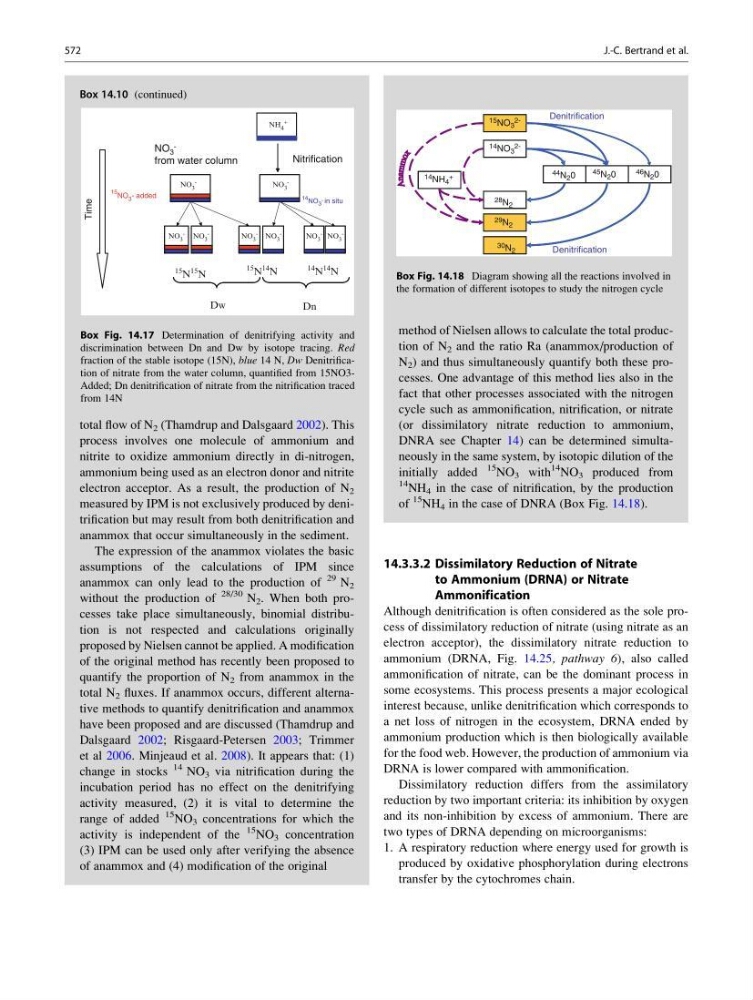
method of Nielsen allows to calculate the total production of N 2 and the ratio Ra (anammox/production of
N 2 ) and thus simultaneously quantify both these processes. One advantage of this method lies also in the
fact that other processes associated with the nitrogen
cycle such as ammonification, nitrification, or nitrate
(or dissimilatory nitrate reduction to ammonium,
DNRA see Chapter 14) can be determined simultaneously in the same system, by isotopic dilution of the
initially added
15 NO 3 with
14 NO 3 produced from
14 NH 4 in the case of nitrification, by the production
of
15 NH 4 in the case of DNRA (Box Fig. 14.18).
14.3.3.2 Dissimilatory Reduction of Nitrate
to Ammonium (DRNA) or Nitrate
Ammonification
Although denitrification is often considered as the sole process of dissimilatory reduction of nitrate (using nitrate as an
electron acceptor), the dissimilatory nitrate reduction to
ammonium (DRNA, Fig. 14.25, pathway 6), also called
ammonification of nitrate, can be the dominant process in
some ecosystems. This process presents a major ecological
interest because, unlike denitrification which corresponds to
a net loss of nitrogen in the ecosystem, DRNA ended by
ammonium production which is then biologically available
for the food web. However, the production of ammonium via
DRNA is lower compared with ammonification.
Dissimilatory reduction differs from the assimilatory
reduction by two important criteria: its inhibition by oxygen
and its non-inhibition by excess of ammonium. There are
two types of DRNA depending on microorganisms:
1. A respiratory reduction where energy used for growth is
produced by oxidative phosphorylation during electrons
transfer by the cytochromes chain.
30
2
44 N 2 0
15 NO 3
214 NO 3
214 NH 4
+
28 N 2
29 N 2
30 N 2
45 N 2 0
46 N 2 0
Denitrification
Denitrification
Box Fig. 14.18 Diagram showing all the reactions involved in
the formation of different isotopes to study the nitrogen cycle
NO 3
NO 3
NO 3
NO 3
NO 3
NO 3
NO 3
NO 3
15 N
15 N
15
N
14
N
14
N
14 N
Dn
Dw
NH 4
NO 3
NO 3
NO 3
NO 3
NO 3
NO 3
NO 3
NO 3
Nitrification
NO 3
NO 3
-
from water column
NO 3
- NO 3
-
NO 3
-
NO 3
-
NO 3
-
NH 4
+
NO 3
-
NO 3
- NO 3
-
15 NO 3 - added
14 NO 3
- in situ
Time
Box Fig. 14.17 Determination of denitrifying activity and
discrimination between Dn and Dw by isotope tracing. Red
fraction of the stable isotope (15N), blue 14 N, Dw Denitrification of nitrate from the water column, quantified from 15NO3Added; Dn denitrification of nitrate from the nitrification traced
from 14N
572
J.-C. Bertrand et al.