

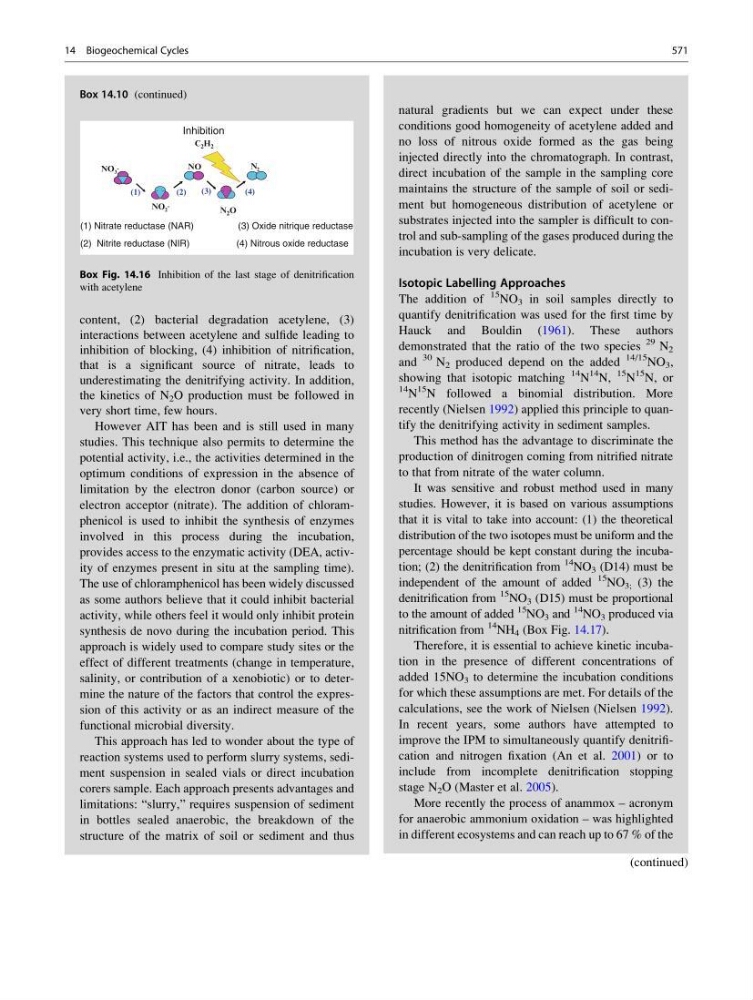
Box 14.10 (continued)
content, (2) bacterial degradation acetylene, (3)
interactions between acetylene and sulfide leading to
inhibition of blocking, (4) inhibition of nitrification,
that is a significant source of nitrate, leads to
underestimating the denitrifying activity. In addition,
the kinetics of N 2 O production must be followed in
very short time, few hours.
However AIT has been and is still used in many
studies. This technique also permits to determine the
potential activity, i.e., the activities determined in the
optimum conditions of expression in the absence of
limitation by the electron donor (carbon source) or
electron acceptor (nitrate). The addition of chloramphenicol is used to inhibit the synthesis of enzymes
involved in this process during the incubation,
provides access to the enzymatic activity (DEA, activity of enzymes present in situ at the sampling time).
The use of chloramphenicol has been widely discussed
as some authors believe that it could inhibit bacterial
activity, while others feel it would only inhibit protein
synthesis de novo during the incubation period. This
approach is widely used to compare study sites or the
effect of different treatments (change in temperature,
salinity, or contribution of a xenobiotic) or to determine the nature of the factors that control the expression of this activity or as an indirect measure of the
functional microbial diversity.
This approach has led to wonder about the type of
reaction systems used to perform slurry systems, sediment suspension in sealed vials or direct incubation
corers sample. Each approach presents advantages and
limitations: “slurry,” requires suspension of sediment
in bottles sealed anaerobic, the breakdown of the
structure of the matrix of soil or sediment and thus
(continued)
Box 14.10 (continued)
natural gradients but we can expect under these
conditions good homogeneity of acetylene added and
no loss of nitrous oxide formed as the gas being
injected directly into the chromatograph. In contrast,
direct incubation of the sample in the sampling core
maintains the structure of the sample of soil or sediment but homogeneous distribution of acetylene or
substrates injected into the sampler is difficult to control and sub-sampling of the gases produced during the
incubation is very delicate.
Isotopic Labelling Approaches
The addition of
15 NO 3 in soil samples directly to
quantify denitrification was used for the first time by
Hauck and Bouldin (1961). These authors
demonstrated that the ratio of the two species
29 N 2
and
30 N 2 produced depend on the added
14/15 NO 3 ,
showing that isotopic matching
14 N
14 N,
15 N
15 N, or
14 N
15 N followed a binomial distribution. More
recently (Nielsen 1992) applied this principle to quantify the denitrifying activity in sediment samples.
This method has the advantage to discriminate the
production of dinitrogen coming from nitrified nitrate
to that from nitrate of the water column.
It was sensitive and robust method used in many
studies. However, it is based on various assumptions
that it is vital to take into account: (1) the theoretical
distribution of the two isotopes must be uniform and the
percentage should be kept constant during the incubation; (2) the denitrification from
14
NO 3 (D14) must be
independent of the amount of added
15
NO 3; (3) the
denitrification from
15
NO 3 (D15) must be proportional
to the amount of added
15
NO 3 and
14
NO 3 produced via
nitrification from
14
NH 4 (Box Fig. 14.17).
Therefore, it is essential to achieve kinetic incubation in the presence of different concentrations of
added 15NO 3 to determine the incubation conditions
for which these assumptions are met. For details of the
calculations, see the work of Nielsen (Nielsen 1992).
In recent years, some authors have attempted to
improve the IPM to simultaneously quantify denitrification and nitrogen fixation (An et al. 2001) or to
include from incomplete denitrification stopping
stage N 2 O (Master et al. 2005).
More recently the process of anammox – acronym
for anaerobic ammonium oxidation – was highlighted
in different ecosystems and can reach up to 67 % of the
(continued)
(1) Nitrate reductase (NAR)
(3) Oxide nitrique reductase
(2) Nitrite reductase (NIR)
(4) Nitrous oxide reductase
Inhibition
NO
(1)
(2)
(3)
(4)
NO 3
-
NO 2
-
N 2 O
N 2
C 2 H 2
Box Fig. 14.16 Inhibition of the last stage of denitrification
with acetylene
14 Biogeochemical Cycles
571