

hydrogen-producing and hydrogenotrophic prokaryotes
(mostly methanoarchaea). These organisms lower the
partial pressure of hydrogen produced by hydrogenproducing bacteria and favor essential processes such as
cellulose degradation. By reducing the volume of gas
produced during digestion, methanogenesis also has a
beneficial effect on the animal. The CH 4 origin and production in the human digestive tract is presented in
Box 14.8.
3. In the absence of organic matter (e.g., in hot springs),
methanogenesis is exclusively fueled by hydrogen
originating from geochemical processes.
Box 14.8: Methanogenic Archaea of the Human
Intestinal Microbiota
Joe ¨l Dore ´
The human intestinal tract is a mesophilic, physicochemically stable biotope, receiving complex dietary
polymers and endogenous mucins that supply carbon
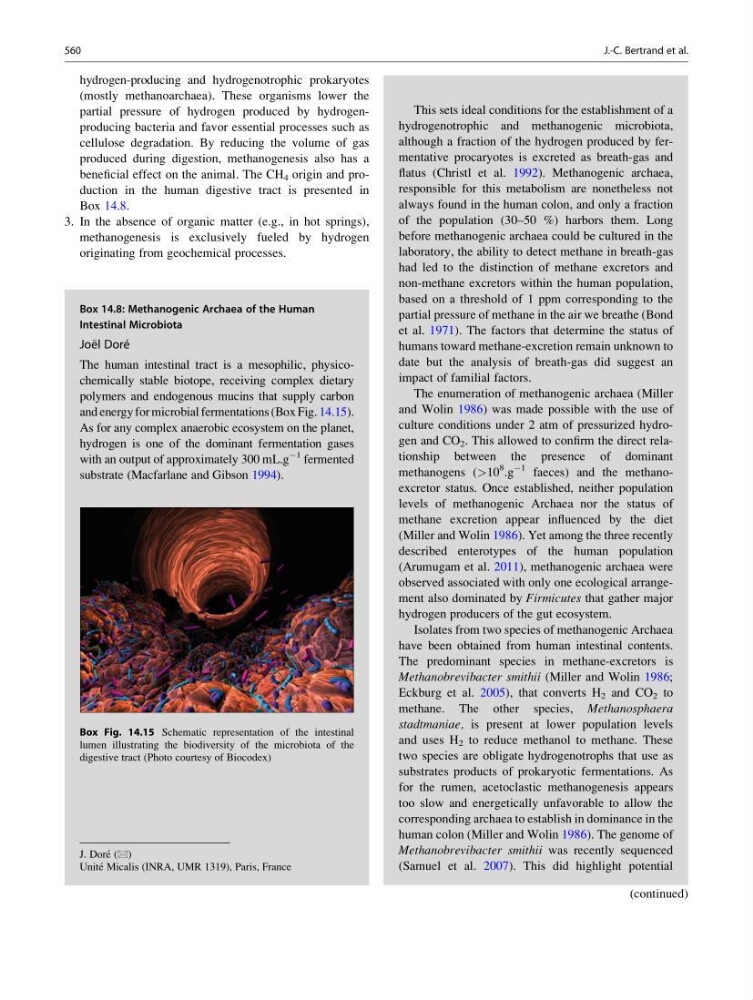
and energy for microbial fermentations (Box Fig. 14.15).
As for any complex anaerobic ecosystem on the planet,
hydrogen is one of the dominant fermentation gases
with an output of approximately 300 mL.g
À1 fermented
substrate (Macfarlane and Gibson 1994).
J. Dore ´ (*)
Unite ´ Micalis (INRA, UMR 1319), Paris, France
(continued)
Box Fig. 14.15 Schematic representation of the intestinal
lumen illustrating the biodiversity of the microbiota of the
digestive tract (Photo courtesy of Biocodex)
Box 14.8 (continued)
This sets ideal conditions for the establishment of a
hydrogenotrophic and methanogenic microbiota,
although a fraction of the hydrogen produced by fermentative procaryotes is excreted as breath-gas and
flatus (Christl et al. 1992). Methanogenic archaea,
responsible for this metabolism are nonetheless not
always found in the human colon, and only a fraction
of the population (30–50 %) harbors them. Long
before methanogenic archaea could be cultured in the
laboratory, the ability to detect methane in breath-gas
had led to the distinction of methane excretors and
non-methane excretors within the human population,
based on a threshold of 1 ppm corresponding to the
partial pressure of methane in the air we breathe (Bond
et al. 1971). The factors that determine the status of
humans toward methane-excretion remain unknown to
date but the analysis of breath-gas did suggest an
impact of familial factors.
The enumeration of methanogenic archaea (Miller
and Wolin 1986) was made possible with the use of
culture conditions under 2 atm of pressurized hydrogen and CO 2 . This allowed to confirm the direct relationship between the presence of dominant
methanogens (>10
8 .g
À1 faeces) and the methanoexcretor status. Once established, neither population
levels of methanogenic Archaea nor the status of
methane excretion appear influenced by the diet
(Miller and Wolin 1986). Yet among the three recently
described enterotypes of the human population
(Arumugam et al. 2011), methanogenic archaea were
observed associated with only one ecological arrangement also dominated by Firmicutes that gather major
hydrogen producers of the gut ecosystem.
Isolates from two species of methanogenic Archaea
have been obtained from human intestinal contents.
The predominant species in methane-excretors is
Methanobrevibacter smithii (Miller and Wolin 1986;
Eckburg et al. 2005), that converts H 2 and CO 2 to
methane. The other species, Methanosphaera
stadtmaniae, is present at lower population levels
and uses H 2 to reduce methanol to methane. These
two species are obligate hydrogenotrophs that use as
substrates products of prokaryotic fermentations. As
for the rumen, acetoclastic methanogenesis appears
too slow and energetically unfavorable to allow the
corresponding archaea to establish in dominance in the
human colon (Miller and Wolin 1986). The genome of
Methanobrevibacter smithii was recently sequenced
(Samuel et al. 2007). This did highlight potential
(continued)
560
J.-C. Bertrand et al.
(mostly methanoarchaea). These organisms lower the
partial pressure of hydrogen produced by hydrogenproducing bacteria and favor essential processes such as
cellulose degradation. By reducing the volume of gas
produced during digestion, methanogenesis also has a
beneficial effect on the animal. The CH 4 origin and production in the human digestive tract is presented in
Box 14.8.
3. In the absence of organic matter (e.g., in hot springs),
methanogenesis is exclusively fueled by hydrogen
originating from geochemical processes.
Box 14.8: Methanogenic Archaea of the Human
Intestinal Microbiota
Joe ¨l Dore ´
The human intestinal tract is a mesophilic, physicochemically stable biotope, receiving complex dietary
polymers and endogenous mucins that supply carbon
and energy for microbial fermentations (Box Fig. 14.15).
As for any complex anaerobic ecosystem on the planet,
hydrogen is one of the dominant fermentation gases
with an output of approximately 300 mL.g
À1 fermented
substrate (Macfarlane and Gibson 1994).
J. Dore ´ (*)
Unite ´ Micalis (INRA, UMR 1319), Paris, France
(continued)
Box Fig. 14.15 Schematic representation of the intestinal
lumen illustrating the biodiversity of the microbiota of the
digestive tract (Photo courtesy of Biocodex)
Box 14.8 (continued)
This sets ideal conditions for the establishment of a
hydrogenotrophic and methanogenic microbiota,
although a fraction of the hydrogen produced by fermentative procaryotes is excreted as breath-gas and
flatus (Christl et al. 1992). Methanogenic archaea,
responsible for this metabolism are nonetheless not
always found in the human colon, and only a fraction
of the population (30–50 %) harbors them. Long
before methanogenic archaea could be cultured in the
laboratory, the ability to detect methane in breath-gas
had led to the distinction of methane excretors and
non-methane excretors within the human population,
based on a threshold of 1 ppm corresponding to the
partial pressure of methane in the air we breathe (Bond
et al. 1971). The factors that determine the status of
humans toward methane-excretion remain unknown to
date but the analysis of breath-gas did suggest an
impact of familial factors.
The enumeration of methanogenic archaea (Miller
and Wolin 1986) was made possible with the use of
culture conditions under 2 atm of pressurized hydrogen and CO 2 . This allowed to confirm the direct relationship between the presence of dominant
methanogens (>10
8 .g
À1 faeces) and the methanoexcretor status. Once established, neither population
levels of methanogenic Archaea nor the status of
methane excretion appear influenced by the diet
(Miller and Wolin 1986). Yet among the three recently
described enterotypes of the human population
(Arumugam et al. 2011), methanogenic archaea were
observed associated with only one ecological arrangement also dominated by Firmicutes that gather major
hydrogen producers of the gut ecosystem.
Isolates from two species of methanogenic Archaea
have been obtained from human intestinal contents.
The predominant species in methane-excretors is
Methanobrevibacter smithii (Miller and Wolin 1986;
Eckburg et al. 2005), that converts H 2 and CO 2 to
methane. The other species, Methanosphaera
stadtmaniae, is present at lower population levels
and uses H 2 to reduce methanol to methane. These
two species are obligate hydrogenotrophs that use as
substrates products of prokaryotic fermentations. As
for the rumen, acetoclastic methanogenesis appears
too slow and energetically unfavorable to allow the
corresponding archaea to establish in dominance in the
human colon (Miller and Wolin 1986). The genome of
Methanobrevibacter smithii was recently sequenced
(Samuel et al. 2007). This did highlight potential
(continued)
560
J.-C. Bertrand et al.