

Box 14.7 (continued)
permafrost; pressure is low, but temperature very
cold, far below 0
C (À10 to À20
C). Gas hydrate
deposits are generally found a few hundred meters
below the ground in circumpolar permafrost
regions (Canada, Siberia, or Alaska); average thickness of the deposits is about 400 m, but sometimes
extends over more than one kilometer.
2. In marine sediments along continental slopes and
rises; gas hydrates are distributed through seafloor
sediments around all continent. Gas hydrate
deposits occur where the bottom water
temperatures are cold (between 0 and 10
C) and
the pressures high (>3 MPa). Marine gas hydrate
are typically buried within sediment at water depths
below 150–200 m at high latitudes, and more than
500 m at low and middle latitudes; the average
thickness of marine hydrate deposits is about
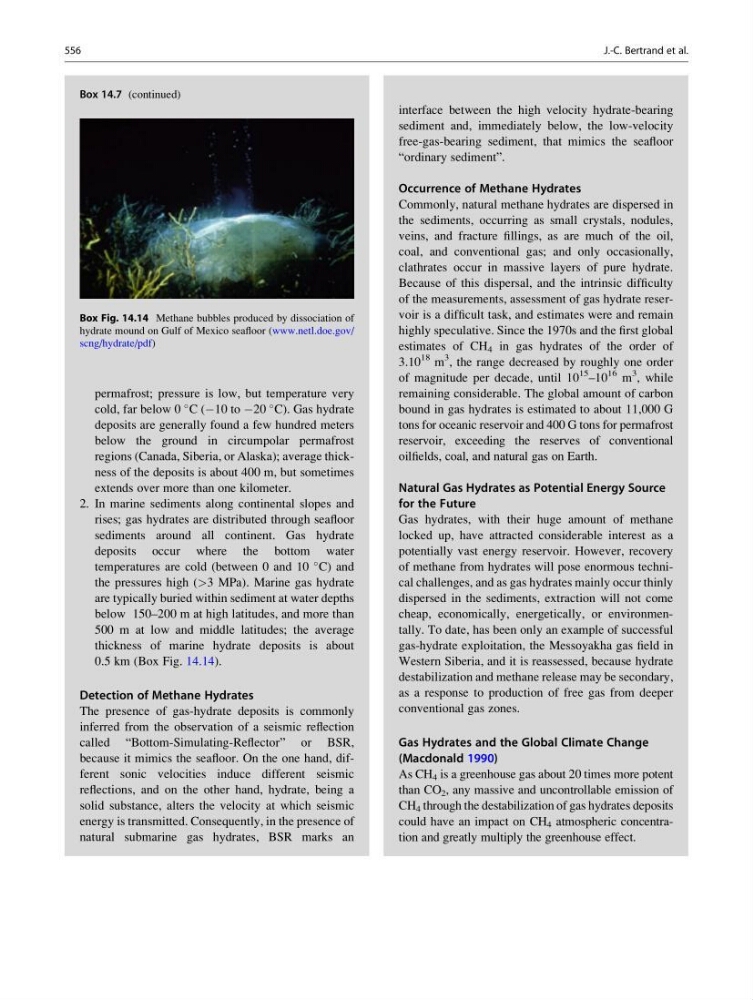
0.5 km (Box Fig. 14.14).
Detection of Methane Hydrates
The presence of gas-hydrate deposits is commonly
inferred from the observation of a seismic reflection
called “Bottom-Simulating-Reflector” or BSR,
because it mimics the seafloor. On the one hand, different sonic velocities induce different seismic
reflections, and on the other hand, hydrate, being a
solid substance, alters the velocity at which seismic
energy is transmitted. Consequently, in the presence of
natural submarine gas hydrates, BSR marks an
(continued)
Box 14.7 (continued)
interface between the high velocity hydrate-bearing
sediment and, immediately below, the low-velocity
free-gas-bearing sediment, that mimics the seafloor
“ordinary sediment”.
Occurrence of Methane Hydrates
Commonly, natural methane hydrates are dispersed in
the sediments, occurring as small crystals, nodules,
veins, and fracture fillings, as are much of the oil,
coal, and conventional gas; and only occasionally,
clathrates occur in massive layers of pure hydrate.
Because of this dispersal, and the intrinsic difficulty
of the measurements, assessment of gas hydrate reservoir is a difficult task, and estimates were and remain
highly speculative. Since the 1970s and the first global
estimates of CH 4 in gas hydrates of the order of
3.10
18 m
3 , the range decreased by roughly one order
of magnitude per decade, until 10
15 –10
16 m
3 , while
remaining considerable. The global amount of carbon
bound in gas hydrates is estimated to about 11,000 G
tons for oceanic reservoir and 400 G tons for permafrost
reservoir, exceeding the reserves of conventional
oilfields, coal, and natural gas on Earth.
Natural Gas Hydrates as Potential Energy Source
for the Future
Gas hydrates, with their huge amount of methane
locked up, have attracted considerable interest as a
potentially vast energy reservoir. However, recovery
of methane from hydrates will pose enormous technical challenges, and as gas hydrates mainly occur thinly
dispersed in the sediments, extraction will not come
cheap, economically, energetically, or environmentally. To date, has been only an example of successful
gas-hydrate exploitation, the Messoyakha gas field in
Western Siberia, and it is reassessed, because hydrate
destabilization and methane release may be secondary,
as a response to production of free gas from deeper
conventional gas zones.
Gas Hydrates and the Global Climate Change
(Macdonald 1990)
As CH 4 is a greenhouse gas about 20 times more potent
than CO 2 , any massive and uncontrollable emission of
CH 4 through the destabilization of gas hydrates deposits
could have an impact on CH 4 atmospheric concentration and greatly multiply the greenhouse effect.
Box Fig. 14.14 Methane bubbles produced by dissociation of
hydrate mound on Gulf of Mexico seafloor (www.netl.doe.gov/
scng/hydrate/pdf)
556
J.-C. Bertrand et al.
permafrost; pressure is low, but temperature very
cold, far below 0
C (À10 to À20
C). Gas hydrate
deposits are generally found a few hundred meters
below the ground in circumpolar permafrost
regions (Canada, Siberia, or Alaska); average thickness of the deposits is about 400 m, but sometimes
extends over more than one kilometer.
2. In marine sediments along continental slopes and
rises; gas hydrates are distributed through seafloor
sediments around all continent. Gas hydrate
deposits occur where the bottom water
temperatures are cold (between 0 and 10
C) and
the pressures high (>3 MPa). Marine gas hydrate
are typically buried within sediment at water depths
below 150–200 m at high latitudes, and more than
500 m at low and middle latitudes; the average
thickness of marine hydrate deposits is about
0.5 km (Box Fig. 14.14).
Detection of Methane Hydrates
The presence of gas-hydrate deposits is commonly
inferred from the observation of a seismic reflection
called “Bottom-Simulating-Reflector” or BSR,
because it mimics the seafloor. On the one hand, different sonic velocities induce different seismic
reflections, and on the other hand, hydrate, being a
solid substance, alters the velocity at which seismic
energy is transmitted. Consequently, in the presence of
natural submarine gas hydrates, BSR marks an
(continued)
Box 14.7 (continued)
interface between the high velocity hydrate-bearing
sediment and, immediately below, the low-velocity
free-gas-bearing sediment, that mimics the seafloor
“ordinary sediment”.
Occurrence of Methane Hydrates
Commonly, natural methane hydrates are dispersed in
the sediments, occurring as small crystals, nodules,
veins, and fracture fillings, as are much of the oil,
coal, and conventional gas; and only occasionally,
clathrates occur in massive layers of pure hydrate.
Because of this dispersal, and the intrinsic difficulty
of the measurements, assessment of gas hydrate reservoir is a difficult task, and estimates were and remain
highly speculative. Since the 1970s and the first global
estimates of CH 4 in gas hydrates of the order of
3.10
18 m
3 , the range decreased by roughly one order
of magnitude per decade, until 10
15 –10
16 m
3 , while
remaining considerable. The global amount of carbon
bound in gas hydrates is estimated to about 11,000 G
tons for oceanic reservoir and 400 G tons for permafrost
reservoir, exceeding the reserves of conventional
oilfields, coal, and natural gas on Earth.
Natural Gas Hydrates as Potential Energy Source
for the Future
Gas hydrates, with their huge amount of methane
locked up, have attracted considerable interest as a
potentially vast energy reservoir. However, recovery
of methane from hydrates will pose enormous technical challenges, and as gas hydrates mainly occur thinly
dispersed in the sediments, extraction will not come
cheap, economically, energetically, or environmentally. To date, has been only an example of successful
gas-hydrate exploitation, the Messoyakha gas field in
Western Siberia, and it is reassessed, because hydrate
destabilization and methane release may be secondary,
as a response to production of free gas from deeper
conventional gas zones.
Gas Hydrates and the Global Climate Change
(Macdonald 1990)
As CH 4 is a greenhouse gas about 20 times more potent
than CO 2 , any massive and uncontrollable emission of
CH 4 through the destabilization of gas hydrates deposits
could have an impact on CH 4 atmospheric concentration and greatly multiply the greenhouse effect.
Box Fig. 14.14 Methane bubbles produced by dissociation of
hydrate mound on Gulf of Mexico seafloor (www.netl.doe.gov/
scng/hydrate/pdf)
556
J.-C. Bertrand et al.