

Box 14.7 (continued)
specific conditions of pressure and temperature are
required, any shift leading to the destabilization and
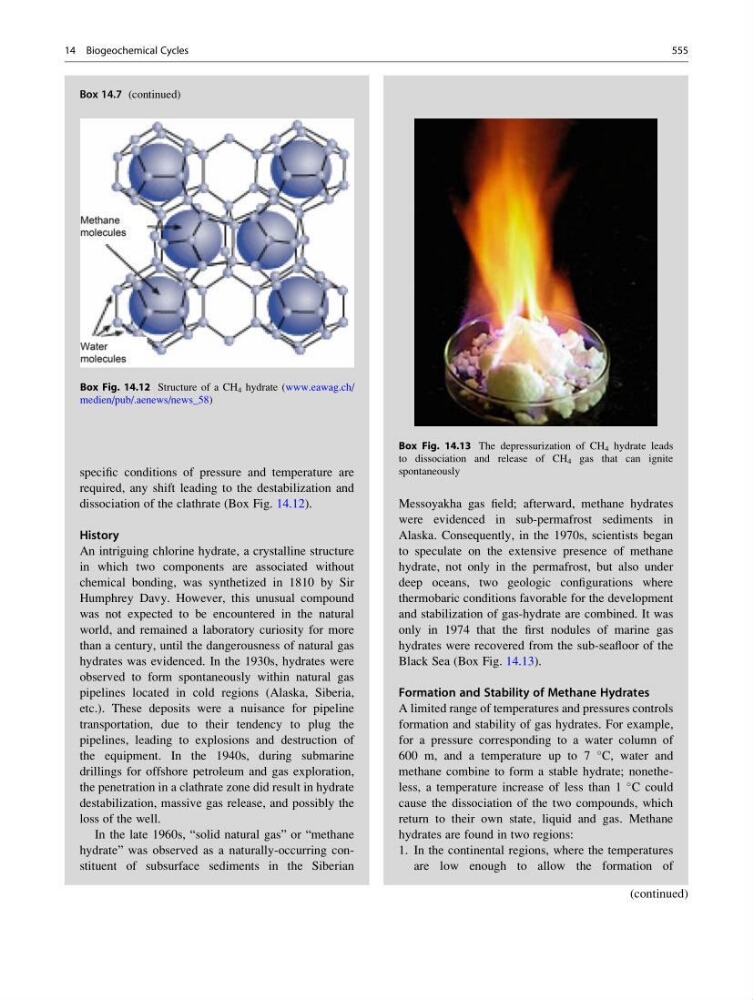
dissociation of the clathrate (Box Fig. 14.12).
History
An intriguing chlorine hydrate, a crystalline structure
in which two components are associated without
chemical bonding, was synthetized in 1810 by Sir
Humphrey Davy. However, this unusual compound
was not expected to be encountered in the natural
world, and remained a laboratory curiosity for more
than a century, until the dangerousness of natural gas
hydrates was evidenced. In the 1930s, hydrates were
observed to form spontaneously within natural gas
pipelines located in cold regions (Alaska, Siberia,
etc.). These deposits were a nuisance for pipeline
transportation, due to their tendency to plug the
pipelines, leading to explosions and destruction of
the equipment. In the 1940s, during submarine
drillings for offshore petroleum and gas exploration,
the penetration in a clathrate zone did result in hydrate
destabilization, massive gas release, and possibly the
loss of the well.
In the late 1960s, “solid natural gas” or “methane
hydrate” was observed as a naturally-occurring constituent of subsurface sediments in the Siberian
(continued)
Box 14.7 (continued)
Messoyakha gas field; afterward, methane hydrates
were evidenced in sub-permafrost sediments in
Alaska. Consequently, in the 1970s, scientists began
to speculate on the extensive presence of methane
hydrate, not only in the permafrost, but also under
deep oceans, two geologic configurations where
thermobaric conditions favorable for the development
and stabilization of gas-hydrate are combined. It was
only in 1974 that the first nodules of marine gas
hydrates were recovered from the sub-seafloor of the
Black Sea (Box Fig. 14.13).
Formation and Stability of Methane Hydrates
A limited range of temperatures and pressures controls
formation and stability of gas hydrates. For example,
for a pressure corresponding to a water column of
600 m, and a temperature up to 7
C, water and
methane combine to form a stable hydrate; nonetheless, a temperature increase of less than 1
C could
cause the dissociation of the two compounds, which
return to their own state, liquid and gas. Methane
hydrates are found in two regions:
1. In the continental regions, where the temperatures
are low enough to allow the formation of
(continued)
Box Fig. 14.12 Structure of a CH 4 hydrate (www.eawag.ch/
medien/pub/.aenews/news_58)
Box Fig. 14.13 The depressurization of CH 4 hydrate leads
to dissociation and release of CH 4 gas that can ignite
spontaneously
14 Biogeochemical Cycles
555
specific conditions of pressure and temperature are
required, any shift leading to the destabilization and
dissociation of the clathrate (Box Fig. 14.12).
History
An intriguing chlorine hydrate, a crystalline structure
in which two components are associated without
chemical bonding, was synthetized in 1810 by Sir
Humphrey Davy. However, this unusual compound
was not expected to be encountered in the natural
world, and remained a laboratory curiosity for more
than a century, until the dangerousness of natural gas
hydrates was evidenced. In the 1930s, hydrates were
observed to form spontaneously within natural gas
pipelines located in cold regions (Alaska, Siberia,
etc.). These deposits were a nuisance for pipeline
transportation, due to their tendency to plug the
pipelines, leading to explosions and destruction of
the equipment. In the 1940s, during submarine
drillings for offshore petroleum and gas exploration,
the penetration in a clathrate zone did result in hydrate
destabilization, massive gas release, and possibly the
loss of the well.
In the late 1960s, “solid natural gas” or “methane
hydrate” was observed as a naturally-occurring constituent of subsurface sediments in the Siberian
(continued)
Box 14.7 (continued)
Messoyakha gas field; afterward, methane hydrates
were evidenced in sub-permafrost sediments in
Alaska. Consequently, in the 1970s, scientists began
to speculate on the extensive presence of methane
hydrate, not only in the permafrost, but also under
deep oceans, two geologic configurations where
thermobaric conditions favorable for the development
and stabilization of gas-hydrate are combined. It was
only in 1974 that the first nodules of marine gas
hydrates were recovered from the sub-seafloor of the
Black Sea (Box Fig. 14.13).
Formation and Stability of Methane Hydrates
A limited range of temperatures and pressures controls
formation and stability of gas hydrates. For example,
for a pressure corresponding to a water column of
600 m, and a temperature up to 7
C, water and
methane combine to form a stable hydrate; nonetheless, a temperature increase of less than 1
C could
cause the dissociation of the two compounds, which
return to their own state, liquid and gas. Methane
hydrates are found in two regions:
1. In the continental regions, where the temperatures
are low enough to allow the formation of
(continued)
Box Fig. 14.12 Structure of a CH 4 hydrate (www.eawag.ch/
medien/pub/.aenews/news_58)
Box Fig. 14.13 The depressurization of CH 4 hydrate leads
to dissociation and release of CH 4 gas that can ignite
spontaneously
14 Biogeochemical Cycles
555