

Box 14.2 (continued)
(continued)
Box 14.2 (continued)
penetration of anthropogenic carbon dioxide in the
ocean at the decadal time scale, and thus increase its
accumulation in the atmosphere and global warming.
We must nevertheless remain very careful on these
predictions because many biological processes are
still poorly known. To improve predictions, it will be
necessary to obtain a better understanding of the processes controlling all important steps of the biological
pump, i.e., the surface production, mineralization, and
export. It is particularly important to be able to quantify the fraction of organic phosphate which is
exported outside the annually winter mixed layer and
whose mineralization will not enrich in phosphate the
surface layer at the decadal time scale.
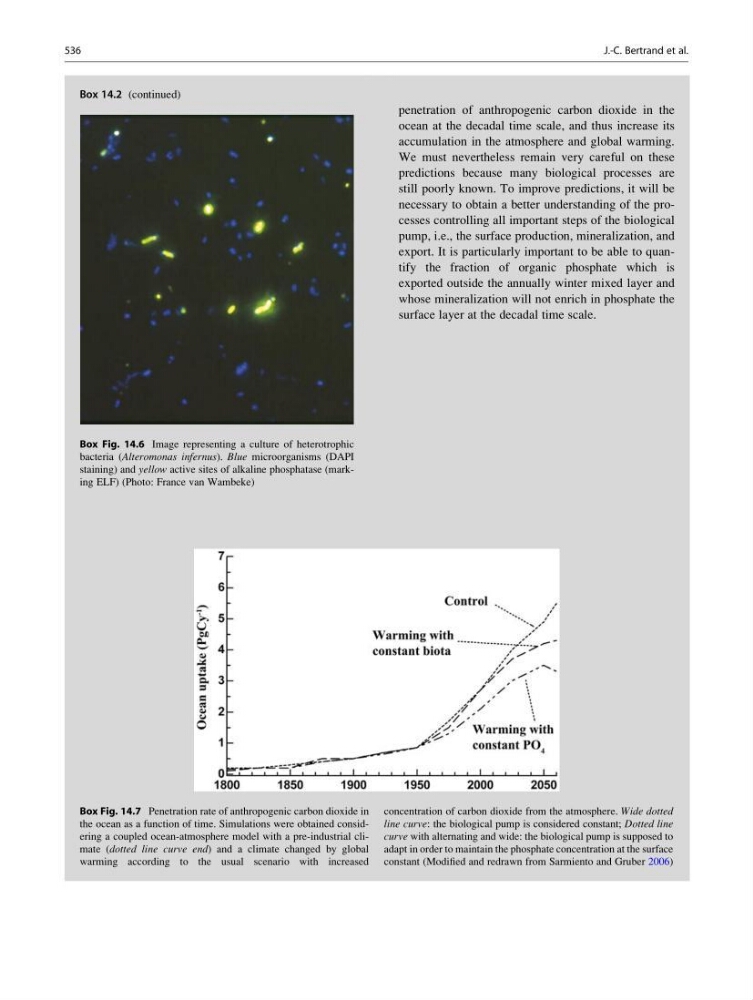
Box Fig. 14.6 Image representing a culture of heterotrophic
bacteria (Alteromonas infernus). Blue microorganisms (DAPI
staining) and yellow active sites of alkaline phosphatase (marking ELF) (Photo: France van Wambeke)
Box Fig. 14.7 Penetration rate of anthropogenic carbon dioxide in
the ocean as a function of time. Simulations were obtained considering a coupled ocean-atmosphere model with a pre-industrial climate (dotted line curve end) and a climate changed by global
warming according to the usual scenario with increased
concentration of carbon dioxide from the atmosphere. Wide dotted
line curve: the biological pump is considered constant; Dotted line
curve with alternating and wide: the biological pump is supposed to
adapt in order to maintain the phosphate concentration at the surface
constant (Modified and redrawn from Sarmiento and Gruber 2006)
536
J.-C. Bertrand et al.
(continued)
Box 14.2 (continued)
penetration of anthropogenic carbon dioxide in the
ocean at the decadal time scale, and thus increase its
accumulation in the atmosphere and global warming.
We must nevertheless remain very careful on these
predictions because many biological processes are
still poorly known. To improve predictions, it will be
necessary to obtain a better understanding of the processes controlling all important steps of the biological
pump, i.e., the surface production, mineralization, and
export. It is particularly important to be able to quantify the fraction of organic phosphate which is
exported outside the annually winter mixed layer and
whose mineralization will not enrich in phosphate the
surface layer at the decadal time scale.
Box Fig. 14.6 Image representing a culture of heterotrophic
bacteria (Alteromonas infernus). Blue microorganisms (DAPI
staining) and yellow active sites of alkaline phosphatase (marking ELF) (Photo: France van Wambeke)
Box Fig. 14.7 Penetration rate of anthropogenic carbon dioxide in
the ocean as a function of time. Simulations were obtained considering a coupled ocean-atmosphere model with a pre-industrial climate (dotted line curve end) and a climate changed by global
warming according to the usual scenario with increased
concentration of carbon dioxide from the atmosphere. Wide dotted
line curve: the biological pump is considered constant; Dotted line
curve with alternating and wide: the biological pump is supposed to
adapt in order to maintain the phosphate concentration at the surface
constant (Modified and redrawn from Sarmiento and Gruber 2006)
536
J.-C. Bertrand et al.