

Box 14.2 (continued)
important efforts are currently made to characterize the
role of microorganisms in the phosphate cycle at the level
of functional groups (Dyhrman et al. 2007; van Wambeke
et al. 2008; Van Mooy et al. 2009; Duhamel et al. 2011).
Phosphate availability and climate change: The
increase of atmospheric carbon dioxide concentration
due to the burning of fossil fuels is the main cause of
global warming. It depends on the fraction that the
ocean can absorb. If it is commonly accepted that the
(continued)
Box 14.2 (continued)
oceanic penetration of anthropogenic CO 2 depends so
far mainly on chemical and physical processes, it
seems that the future penetration will strongly depend
on biological processes mainly controlled by nutrient
availability in the ocean’s surface (Box Fig. 14.7, from
Sarmiento and Gruber 2006). It seems that the
expected climate change would lead to a decrease in
the surface ocean phosphate availability (Karl 2007;
Moutin et al. 2008) that could significantly curb the
(continued)
Zooplankton
Fishes
Phytoplankton
Bacteria
POP
Imput from atmosphere
Imput from rivers
DOP
PO 4
ATMOSPHERE
OCEAN
CONTINENT
Sedimentation
Mineralization
Mineralization
Convection - Diffusion
Upwelling
Depth of the
winter mixed layer
Diffusion
Sedimentary burial
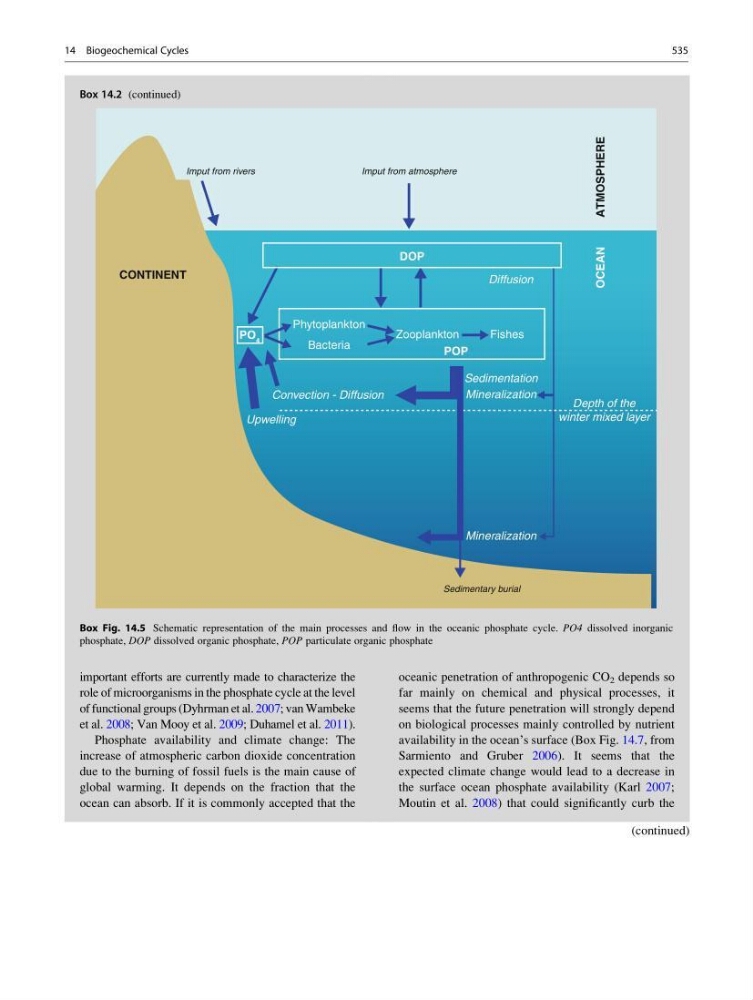
Box Fig. 14.5 Schematic representation of the main processes and flow in the oceanic phosphate cycle. PO4 dissolved inorganic
phosphate, DOP dissolved organic phosphate, POP particulate organic phosphate
14 Biogeochemical Cycles
535
important efforts are currently made to characterize the
role of microorganisms in the phosphate cycle at the level
of functional groups (Dyhrman et al. 2007; van Wambeke
et al. 2008; Van Mooy et al. 2009; Duhamel et al. 2011).
Phosphate availability and climate change: The
increase of atmospheric carbon dioxide concentration
due to the burning of fossil fuels is the main cause of
global warming. It depends on the fraction that the
ocean can absorb. If it is commonly accepted that the
(continued)
Box 14.2 (continued)
oceanic penetration of anthropogenic CO 2 depends so
far mainly on chemical and physical processes, it
seems that the future penetration will strongly depend
on biological processes mainly controlled by nutrient
availability in the ocean’s surface (Box Fig. 14.7, from
Sarmiento and Gruber 2006). It seems that the
expected climate change would lead to a decrease in
the surface ocean phosphate availability (Karl 2007;
Moutin et al. 2008) that could significantly curb the
(continued)
Zooplankton
Fishes
Phytoplankton
Bacteria
POP
Imput from atmosphere
Imput from rivers
DOP
PO 4
ATMOSPHERE
OCEAN
CONTINENT
Sedimentation
Mineralization
Mineralization
Convection - Diffusion
Upwelling
Depth of the
winter mixed layer
Diffusion
Sedimentary burial
Box Fig. 14.5 Schematic representation of the main processes and flow in the oceanic phosphate cycle. PO4 dissolved inorganic
phosphate, DOP dissolved organic phosphate, POP particulate organic phosphate
14 Biogeochemical Cycles
535