

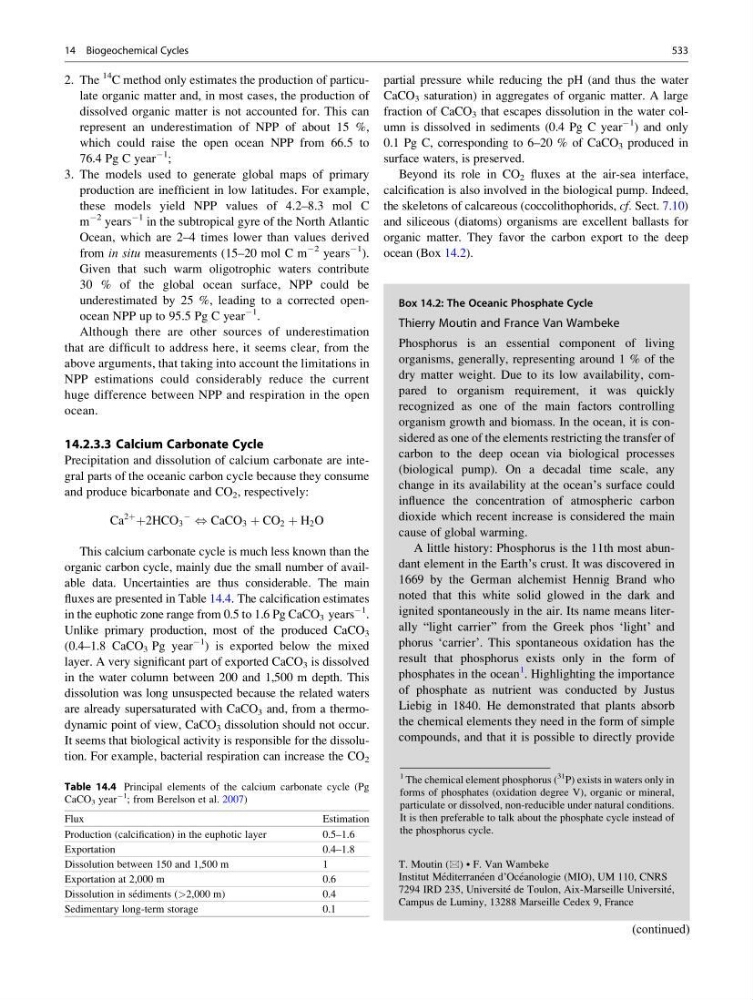
2. The
14 C method only estimates the production of particulate organic matter and, in most cases, the production of
dissolved organic matter is not accounted for. This can
represent an underestimation of NPP of about 15 %,
which could raise the open ocean NPP from 66.5 to
76.4 Pg C year
À1 ;
3. The models used to generate global maps of primary
production are inefficient in low latitudes. For example,
these models yield NPP values of 4.2–8.3 mol C
m
À2 years
À1 in the subtropical gyre of the North Atlantic
Ocean, which are 2–4 times lower than values derived
from in situ measurements (15–20 mol C m
À2 years
À1 ).
Given that such warm oligotrophic waters contribute
30 % of the global ocean surface, NPP could be
underestimated by 25 %, leading to a corrected openocean NPP up to 95.5 Pg C year
À1 .
Although there are other sources of underestimation
that are difficult to address here, it seems clear, from the
above arguments, that taking into account the limitations in
NPP estimations could considerably reduce the current
huge difference between NPP and respiration in the open
ocean.
14.2.3.3 Calcium Carbonate Cycle
Precipitation and dissolution of calcium carbonate are integral parts of the oceanic carbon cycle because they consume
and produce bicarbonate and CO 2 , respectively:
Ca
2þ
þ2HCO 3
À
, CaCO 3 þ CO 2 þ H 2 O
This calcium carbonate cycle is much less known than the
organic carbon cycle, mainly due the small number of available data. Uncertainties are thus considerable. The main
fluxes are presented in Table 14.4. The calcification estimates
in the euphotic zone range from 0.5 to 1.6 Pg CaCO 3 years
À1
.
Unlike primary production, most of the produced CaCO 3
(0.4–1.8 CaCO 3 Pg year
À1
) is exported below the mixed
layer. A very significant part of exported CaCO 3 is dissolved
in the water column between 200 and 1,500 m depth. This
dissolution was long unsuspected because the related waters
are already supersaturated with CaCO 3 and, from a thermodynamic point of view, CaCO 3 dissolution should not occur.
It seems that biological activity is responsible for the dissolution. For example, bacterial respiration can increase the CO 2
partial pressure while reducing the pH (and thus the water
CaCO 3 saturation) in aggregates of organic matter. A large
fraction of CaCO 3 that escapes dissolution in the water column is dissolved in sediments (0.4 Pg C year
À1
) and only
0.1 Pg C, corresponding to 6–20 % of CaCO 3 produced in
surface waters, is preserved.
Beyond its role in CO 2 fluxes at the air-sea interface,
calcification is also involved in the biological pump. Indeed,
the skeletons of calcareous (coccolithophorids, cf. Sect. 7.10)
and siliceous (diatoms) organisms are excellent ballasts for
organic matter. They favor the carbon export to the deep
ocean (Box 14.2).
Table 14.4 Principal elements of the calcium carbonate cycle (Pg
CaCO 3 year
À1
; from Berelson et al. 2007)
Flux
Estimation
Production (calcification) in the euphotic layer
0.5–1.6
Exportation
0.4–1.8
Dissolution between 150 and 1,500 m
1
Exportation at 2,000 m
0.6
Dissolution in se ´diments (>2,000 m)
0.4
Sedimentary long-term storage
0.1
Box 14.2: The Oceanic Phosphate Cycle
Thierry Moutin and France Van Wambeke
Phosphorus is an essential component of living
organisms, generally, representing around 1 % of the
dry matter weight. Due to its low availability, compared to organism requirement, it was quickly
recognized as one of the main factors controlling
organism growth and biomass. In the ocean, it is considered as one of the elements restricting the transfer of
carbon to the deep ocean via biological processes
(biological pump). On a decadal time scale, any
change in its availability at the ocean’s surface could
influence the concentration of atmospheric carbon
dioxide which recent increase is considered the main
cause of global warming.
A little history: Phosphorus is the 11th most abundant element in the Earth’s crust. It was discovered in
1669 by the German alchemist Hennig Brand who
noted that this white solid glowed in the dark and
ignited spontaneously in the air. Its name means literally “light carrier” from the Greek phos ‘light’ and
phorus ‘carrier’. This spontaneous oxidation has the
result that phosphorus exists only in the form of
phosphates in the ocean
1
. Highlighting the importance
of phosphate as nutrient was conducted by Justus
Liebig in 1840. He demonstrated that plants absorb
the chemical elements they need in the form of simple
compounds, and that it is possible to directly provide
T. Moutin (*) F. Van Wambeke
Institut Me ´diterrane ´en d’Oce ´anologie (MIO), UM 110, CNRS
7294 IRD 235, Universite ´ de Toulon, Aix-Marseille Universite ´,
Campus de Luminy, 13288 Marseille Cedex 9, France
(continued)
1 The chemical element phosphorus (
31
P) exists in waters only in
forms of phosphates (oxidation degree V), organic or mineral,
particulate or dissolved, non-reducible under natural conditions.
It is then preferable to talk about the phosphate cycle instead of
the phosphorus cycle.
14 Biogeochemical Cycles
533
14 C method only estimates the production of particulate organic matter and, in most cases, the production of
dissolved organic matter is not accounted for. This can
represent an underestimation of NPP of about 15 %,
which could raise the open ocean NPP from 66.5 to
76.4 Pg C year
À1 ;
3. The models used to generate global maps of primary
production are inefficient in low latitudes. For example,
these models yield NPP values of 4.2–8.3 mol C
m
À2 years
À1 in the subtropical gyre of the North Atlantic
Ocean, which are 2–4 times lower than values derived
from in situ measurements (15–20 mol C m
À2 years
À1 ).
Given that such warm oligotrophic waters contribute
30 % of the global ocean surface, NPP could be
underestimated by 25 %, leading to a corrected openocean NPP up to 95.5 Pg C year
À1 .
Although there are other sources of underestimation
that are difficult to address here, it seems clear, from the
above arguments, that taking into account the limitations in
NPP estimations could considerably reduce the current
huge difference between NPP and respiration in the open
ocean.
14.2.3.3 Calcium Carbonate Cycle
Precipitation and dissolution of calcium carbonate are integral parts of the oceanic carbon cycle because they consume
and produce bicarbonate and CO 2 , respectively:
Ca
2þ
þ2HCO 3
À
, CaCO 3 þ CO 2 þ H 2 O
This calcium carbonate cycle is much less known than the
organic carbon cycle, mainly due the small number of available data. Uncertainties are thus considerable. The main
fluxes are presented in Table 14.4. The calcification estimates
in the euphotic zone range from 0.5 to 1.6 Pg CaCO 3 years
À1
.
Unlike primary production, most of the produced CaCO 3
(0.4–1.8 CaCO 3 Pg year
À1
) is exported below the mixed
layer. A very significant part of exported CaCO 3 is dissolved
in the water column between 200 and 1,500 m depth. This
dissolution was long unsuspected because the related waters
are already supersaturated with CaCO 3 and, from a thermodynamic point of view, CaCO 3 dissolution should not occur.
It seems that biological activity is responsible for the dissolution. For example, bacterial respiration can increase the CO 2
partial pressure while reducing the pH (and thus the water
CaCO 3 saturation) in aggregates of organic matter. A large
fraction of CaCO 3 that escapes dissolution in the water column is dissolved in sediments (0.4 Pg C year
À1
) and only
0.1 Pg C, corresponding to 6–20 % of CaCO 3 produced in
surface waters, is preserved.
Beyond its role in CO 2 fluxes at the air-sea interface,
calcification is also involved in the biological pump. Indeed,
the skeletons of calcareous (coccolithophorids, cf. Sect. 7.10)
and siliceous (diatoms) organisms are excellent ballasts for
organic matter. They favor the carbon export to the deep
ocean (Box 14.2).
Table 14.4 Principal elements of the calcium carbonate cycle (Pg
CaCO 3 year
À1
; from Berelson et al. 2007)
Flux
Estimation
Production (calcification) in the euphotic layer
0.5–1.6
Exportation
0.4–1.8
Dissolution between 150 and 1,500 m
1
Exportation at 2,000 m
0.6
Dissolution in se ´diments (>2,000 m)
0.4
Sedimentary long-term storage
0.1
Box 14.2: The Oceanic Phosphate Cycle
Thierry Moutin and France Van Wambeke
Phosphorus is an essential component of living
organisms, generally, representing around 1 % of the
dry matter weight. Due to its low availability, compared to organism requirement, it was quickly
recognized as one of the main factors controlling
organism growth and biomass. In the ocean, it is considered as one of the elements restricting the transfer of
carbon to the deep ocean via biological processes
(biological pump). On a decadal time scale, any
change in its availability at the ocean’s surface could
influence the concentration of atmospheric carbon
dioxide which recent increase is considered the main
cause of global warming.
A little history: Phosphorus is the 11th most abundant element in the Earth’s crust. It was discovered in
1669 by the German alchemist Hennig Brand who
noted that this white solid glowed in the dark and
ignited spontaneously in the air. Its name means literally “light carrier” from the Greek phos ‘light’ and
phorus ‘carrier’. This spontaneous oxidation has the
result that phosphorus exists only in the form of
phosphates in the ocean
1
. Highlighting the importance
of phosphate as nutrient was conducted by Justus
Liebig in 1840. He demonstrated that plants absorb
the chemical elements they need in the form of simple
compounds, and that it is possible to directly provide
T. Moutin (*) F. Van Wambeke
Institut Me ´diterrane ´en d’Oce ´anologie (MIO), UM 110, CNRS
7294 IRD 235, Universite ´ de Toulon, Aix-Marseille Universite ´,
Campus de Luminy, 13288 Marseille Cedex 9, France
(continued)
1 The chemical element phosphorus (
31
P) exists in waters only in
forms of phosphates (oxidation degree V), organic or mineral,
particulate or dissolved, non-reducible under natural conditions.
It is then preferable to talk about the phosphate cycle instead of
the phosphorus cycle.
14 Biogeochemical Cycles
533