

humans is totally dependant upon microbial activity. This
chapter addresses the biogeochemical cycles of carbon,
nitrogen, sulfur, phosphorus, iron, manganese, and in small
boxes of silica and mercury, with a particular focus on the
role of involved microorganisms.
14.2 The Carbon Cycle
14.2.1 Introduction
On Earth, carbon undergoes a set of transformations
characterized by redox processes from the most oxidized
(CO 2 , +IV oxidation state) to the most reduced form (the
Methane CH 4 , ÀIV oxidation state). Carbon in its neutral
state, that is to say, pure (oxidation state 0), is in the form
of graphite or diamond. The carbon associated with
organic oxygen, hydrogen, nitrogen, sulfur, and phosphorus, can be found in oxidation forms ranging from 0 (glucose, acetate) to ÀIV (methane) depending on the
compound. However, the oxidation state for mineral carbon is always between 0 and +IV; examples: CO 2 , CaCO 3
(+IV), CO (+II), etc. The whole oxidation–reduction process of the carbon is the carbon cycle (Fig. 14.4).
The carbon cycle is expressed through fluxes between
its major reservoirs: atmosphere, hydrosphere (mainly
oceans), mainland biosphere (including soils), and lithosphere (fossil carbon) (Prentice et al. 2001; Houghton
et al. 2004; IPCC 2007). Despite its very low concentration in the crust (about 0.27 %), carbon is present in all
living organisms and it is at the basis of organic chemistry. Associated with oxygen, it forms CO 2 , the main carbon source allowing the growth of autotrophic organisms
and in particular plants. Combined with hydrogen, it forms
hydrocarbons. Associated with oxygen and hydrogen, it
gives rise to carbohydrates and lipids. Finally, with nitrogen and sulfur, carbon forms amino acids which are the
basic units of proteins, and the addition of phosphorus
allows the formation of nucleotides, the basic units of
nucleic acids that encode the genetic information.
The importance of carbon in the cycling of matter and in
processes that serve as support for human activities can be
illustrated by the photosynthetic fixation of CO 2 , the transfer
of organic matter in food webs (which is a great provider of
services and resources to Mankind), the storage of detritus,
and the formation of fossil carbon (Figs. 14.1 and 14.2). The
increasingly intensive use of fossil carbon reservoir as a
source of energy for human activities causes a major
N 2
CO 2
CO 2
CO 2
N 2 O
N 2 O
N 2 O
NO 2
-
NO 3
-
NO 2
-
H 2 O
NH 4
+
NH 4
+
OM
O 2
N 2
CH 4
C H4
CH 4
NO 2
-
NO 3
-
D N
DN
DN
DN
DN
D N
M ET HAN OTRO PH Y
M
E T H A N O T R O P H Y
METHANOGENESIS
FERMENTATIONS
C 1 - C 2
Compounds
NI TR IFICATIO N
OXIC
ZONE
ANOXIC
ZONE
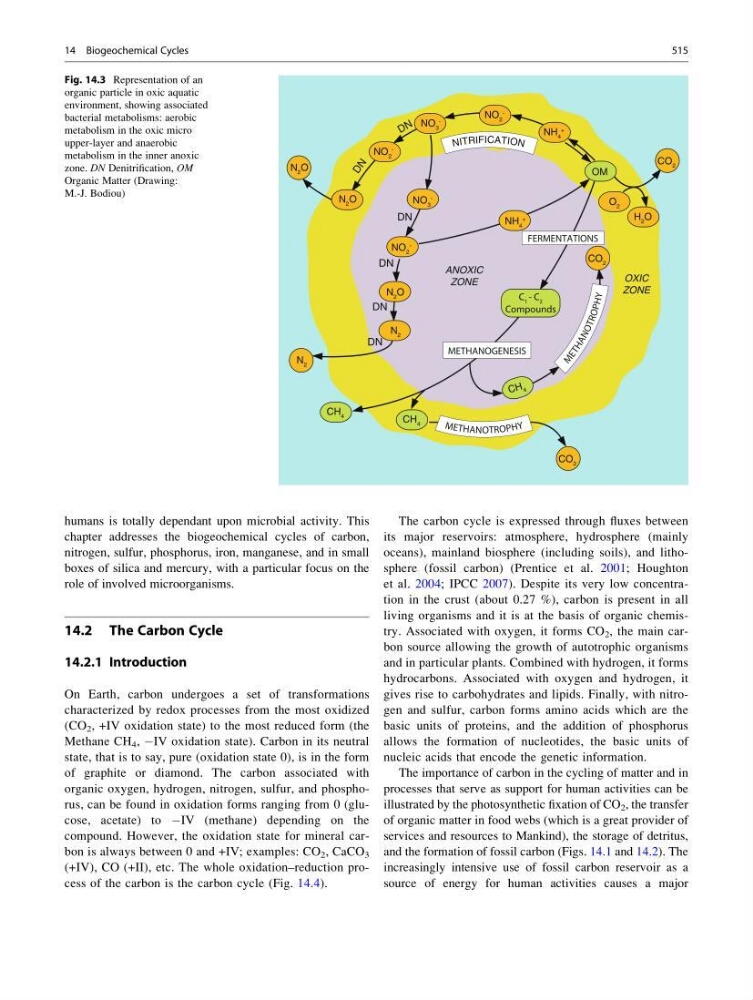
Fig. 14.3 Representation of an
organic particle in oxic aquatic
environment, showing associated
bacterial metabolisms: aerobic
metabolism in the oxic micro
upper-layer and anaerobic
metabolism in the inner anoxic
zone. DN Denitrification, OM
Organic Matter (Drawing:
M.-J. Bodiou)
14 Biogeochemical Cycles
515
chapter addresses the biogeochemical cycles of carbon,
nitrogen, sulfur, phosphorus, iron, manganese, and in small
boxes of silica and mercury, with a particular focus on the
role of involved microorganisms.
14.2 The Carbon Cycle
14.2.1 Introduction
On Earth, carbon undergoes a set of transformations
characterized by redox processes from the most oxidized
(CO 2 , +IV oxidation state) to the most reduced form (the
Methane CH 4 , ÀIV oxidation state). Carbon in its neutral
state, that is to say, pure (oxidation state 0), is in the form
of graphite or diamond. The carbon associated with
organic oxygen, hydrogen, nitrogen, sulfur, and phosphorus, can be found in oxidation forms ranging from 0 (glucose, acetate) to ÀIV (methane) depending on the
compound. However, the oxidation state for mineral carbon is always between 0 and +IV; examples: CO 2 , CaCO 3
(+IV), CO (+II), etc. The whole oxidation–reduction process of the carbon is the carbon cycle (Fig. 14.4).
The carbon cycle is expressed through fluxes between
its major reservoirs: atmosphere, hydrosphere (mainly
oceans), mainland biosphere (including soils), and lithosphere (fossil carbon) (Prentice et al. 2001; Houghton
et al. 2004; IPCC 2007). Despite its very low concentration in the crust (about 0.27 %), carbon is present in all
living organisms and it is at the basis of organic chemistry. Associated with oxygen, it forms CO 2 , the main carbon source allowing the growth of autotrophic organisms
and in particular plants. Combined with hydrogen, it forms
hydrocarbons. Associated with oxygen and hydrogen, it
gives rise to carbohydrates and lipids. Finally, with nitrogen and sulfur, carbon forms amino acids which are the
basic units of proteins, and the addition of phosphorus
allows the formation of nucleotides, the basic units of
nucleic acids that encode the genetic information.
The importance of carbon in the cycling of matter and in
processes that serve as support for human activities can be
illustrated by the photosynthetic fixation of CO 2 , the transfer
of organic matter in food webs (which is a great provider of
services and resources to Mankind), the storage of detritus,
and the formation of fossil carbon (Figs. 14.1 and 14.2). The
increasingly intensive use of fossil carbon reservoir as a
source of energy for human activities causes a major
N 2
CO 2
CO 2
CO 2
N 2 O
N 2 O
N 2 O
NO 2
-
NO 3
-
NO 2
-
H 2 O
NH 4
+
NH 4
+
OM
O 2
N 2
CH 4
C H4
CH 4
NO 2
-
NO 3
-
D N
DN
DN
DN
DN
D N
M ET HAN OTRO PH Y
M
E T H A N O T R O P H Y
METHANOGENESIS
FERMENTATIONS
C 1 - C 2
Compounds
NI TR IFICATIO N
OXIC
ZONE
ANOXIC
ZONE
Fig. 14.3 Representation of an
organic particle in oxic aquatic
environment, showing associated
bacterial metabolisms: aerobic
metabolism in the oxic micro
upper-layer and anaerobic
metabolism in the inner anoxic
zone. DN Denitrification, OM
Organic Matter (Drawing:
M.-J. Bodiou)
14 Biogeochemical Cycles
515