

algal in soils being of minor importance. This contrasts
with aquatic environments where phytoplanktonic
microorganisms play the major role; large marine algae
(i.e., seaweed) only develop on coastal areas.
Chemolithotrophic and photolithotrophic bacteria
are mainly autotrophic (cf. Sect. 3.3.2). When biomass
is produced from carbon and electron donors known
from a metabolism pathway, the production is then
qualified as paraprimary production. This is the case
of photosynthetic purple and green bacteria that consume sulfide produced by sulfate-reducing bacteria.
Paraprimary production also applies to the amount of
biomass produced by methanogenic archaea that
consume hydrogen produced by fermentative bacteria.
The term of primary production when applied to bacteria (prokaryotes) relates only to microorganisms that
typically use light as energy source and electron donors
of geochemical origin (H 2 , H 2 S, NH 3 , Fe
2+ ). This is for
example the case of purple or green bacteria that perform anoxigenic photosynthesis by oxidizing sulfide
from ground via volcanism;
2. The organic matter synthesized by autotrophs flows
through food webs (Fig. 14.1) and is used by heterotrophic consumers that release carbon dioxide gas and produce organic waste or minerals;
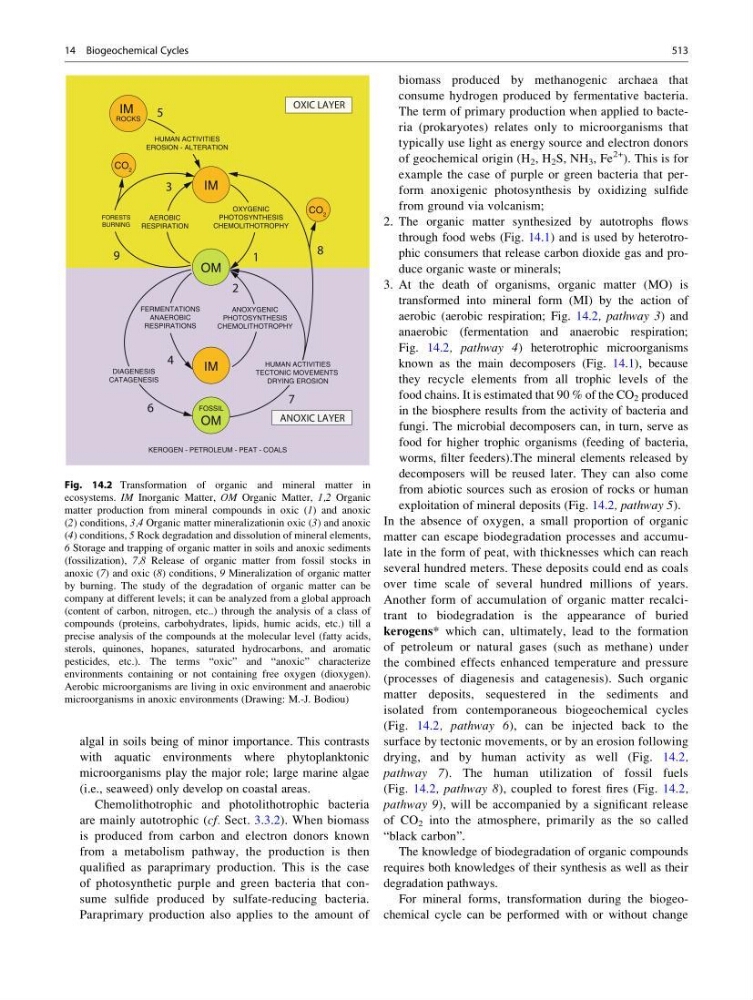
3. At the death of organisms, organic matter (MO) is
transformed into mineral form (MI) by the action of
aerobic (aerobic respiration; Fig. 14.2, pathway 3) and
anaerobic (fermentation and anaerobic respiration;
Fig. 14.2, pathway 4) heterotrophic microorganisms
known as the main decomposers (Fig. 14.1), because
they recycle elements from all trophic levels of the
food chains. It is estimated that 90 % of the CO 2 produced
in the biosphere results from the activity of bacteria and
fungi. The microbial decomposers can, in turn, serve as
food for higher trophic organisms (feeding of bacteria,
worms, filter feeders).The mineral elements released by
decomposers will be reused later. They can also come
from abiotic sources such as erosion of rocks or human
exploitation of mineral deposits (Fig. 14.2, pathway 5).
In the absence of oxygen, a small proportion of organic
matter can escape biodegradation processes and accumulate in the form of peat, with thicknesses which can reach
several hundred meters. These deposits could end as coals
over time scale of several hundred millions of years.
Another form of accumulation of organic matter recalcitrant to biodegradation is the appearance of buried
kerogens* which can, ultimately, lead to the formation
of petroleum or natural gases (such as methane) under
the combined effects enhanced temperature and pressure
(processes of diagenesis and catagenesis). Such organic
matter deposits, sequestered in the sediments and
isolated from contemporaneous biogeochemical cycles
(Fig. 14.2, pathway 6), can be injected back to the
surface by tectonic movements, or by an erosion following
drying, and by human activity as well (Fig. 14.2,
pathway 7). The human utilization of fossil fuels
(Fig. 14.2, pathway 8), coupled to forest fires (Fig. 14.2,
pathway 9), will be accompanied by a significant release
of CO 2 into the atmosphere, primarily as the so called
“black carbon”.
The knowledge of biodegradation of organic compounds
requires both knowledges of their synthesis as well as their
degradation pathways.
For mineral forms, transformation during the biogeochemical cycle can be performed with or without change
1
2
3
4
5
6
7
8
9
HUMAN ACTIVITIES
TECTONIC MOVEMENTS
DRYING EROSION
DIAGENESIS
CATAGENESIS
FORESTS
BURNING
IM
IM
IM
OM
OM
ROCKS
FOSSIL
HUMAN ACTIVITIES
EROSION - ALTERATION
AEROBIC
RESPIRATION
OXYGENIC
PHOTOSYNTHESIS
CHEMOLITHOTROPHY
ANOXYGENIC
PHOTOSYNTHESIS
CHEMOLITHOTROPHY
FERMENTATIONS
ANAEROBIC
RESPIRATIONS
CO 2
CO 2
KEROGEN - PETROLEUM - PEAT - COALS
OXIC LAYER
ANOXIC LAYER
Fig. 14.2 Transformation of organic and mineral matter in
ecosystems. IM Inorganic Matter, OM Organic Matter, 1,2 Organic
matter production from mineral compounds in oxic (1) and anoxic
(2) conditions, 3,4 Organic matter mineralizationin oxic (3) and anoxic
(4) conditions, 5 Rock degradation and dissolution of mineral elements,
6 Storage and trapping of organic matter in soils and anoxic sediments
(fossilization), 7,8 Release of organic matter from fossil stocks in
anoxic (7) and oxic (8) conditions, 9 Mineralization of organic matter
by burning. The study of the degradation of organic matter can be
company at different levels; it can be analyzed from a global approach
(content of carbon, nitrogen, etc..) through the analysis of a class of
compounds (proteins, carbohydrates, lipids, humic acids, etc.) till a
precise analysis of the compounds at the molecular level (fatty acids,
sterols, quinones, hopanes, saturated hydrocarbons, and aromatic
pesticides, etc.). The terms “oxic” and “anoxic” characterize
environments containing or not containing free oxygen (dioxygen).
Aerobic microorganisms are living in oxic environment and anaerobic
microorganisms in anoxic environments (Drawing: M.-J. Bodiou)
14 Biogeochemical Cycles
513
with aquatic environments where phytoplanktonic
microorganisms play the major role; large marine algae
(i.e., seaweed) only develop on coastal areas.
Chemolithotrophic and photolithotrophic bacteria
are mainly autotrophic (cf. Sect. 3.3.2). When biomass
is produced from carbon and electron donors known
from a metabolism pathway, the production is then
qualified as paraprimary production. This is the case
of photosynthetic purple and green bacteria that consume sulfide produced by sulfate-reducing bacteria.
Paraprimary production also applies to the amount of
biomass produced by methanogenic archaea that
consume hydrogen produced by fermentative bacteria.
The term of primary production when applied to bacteria (prokaryotes) relates only to microorganisms that
typically use light as energy source and electron donors
of geochemical origin (H 2 , H 2 S, NH 3 , Fe
2+ ). This is for
example the case of purple or green bacteria that perform anoxigenic photosynthesis by oxidizing sulfide
from ground via volcanism;
2. The organic matter synthesized by autotrophs flows
through food webs (Fig. 14.1) and is used by heterotrophic consumers that release carbon dioxide gas and produce organic waste or minerals;
3. At the death of organisms, organic matter (MO) is
transformed into mineral form (MI) by the action of
aerobic (aerobic respiration; Fig. 14.2, pathway 3) and
anaerobic (fermentation and anaerobic respiration;
Fig. 14.2, pathway 4) heterotrophic microorganisms
known as the main decomposers (Fig. 14.1), because
they recycle elements from all trophic levels of the
food chains. It is estimated that 90 % of the CO 2 produced
in the biosphere results from the activity of bacteria and
fungi. The microbial decomposers can, in turn, serve as
food for higher trophic organisms (feeding of bacteria,
worms, filter feeders).The mineral elements released by
decomposers will be reused later. They can also come
from abiotic sources such as erosion of rocks or human
exploitation of mineral deposits (Fig. 14.2, pathway 5).
In the absence of oxygen, a small proportion of organic
matter can escape biodegradation processes and accumulate in the form of peat, with thicknesses which can reach
several hundred meters. These deposits could end as coals
over time scale of several hundred millions of years.
Another form of accumulation of organic matter recalcitrant to biodegradation is the appearance of buried
kerogens* which can, ultimately, lead to the formation
of petroleum or natural gases (such as methane) under
the combined effects enhanced temperature and pressure
(processes of diagenesis and catagenesis). Such organic
matter deposits, sequestered in the sediments and
isolated from contemporaneous biogeochemical cycles
(Fig. 14.2, pathway 6), can be injected back to the
surface by tectonic movements, or by an erosion following
drying, and by human activity as well (Fig. 14.2,
pathway 7). The human utilization of fossil fuels
(Fig. 14.2, pathway 8), coupled to forest fires (Fig. 14.2,
pathway 9), will be accompanied by a significant release
of CO 2 into the atmosphere, primarily as the so called
“black carbon”.
The knowledge of biodegradation of organic compounds
requires both knowledges of their synthesis as well as their
degradation pathways.
For mineral forms, transformation during the biogeochemical cycle can be performed with or without change
1
2
3
4
5
6
7
8
9
HUMAN ACTIVITIES
TECTONIC MOVEMENTS
DRYING EROSION
DIAGENESIS
CATAGENESIS
FORESTS
BURNING
IM
IM
IM
OM
OM
ROCKS
FOSSIL
HUMAN ACTIVITIES
EROSION - ALTERATION
AEROBIC
RESPIRATION
OXYGENIC
PHOTOSYNTHESIS
CHEMOLITHOTROPHY
ANOXYGENIC
PHOTOSYNTHESIS
CHEMOLITHOTROPHY
FERMENTATIONS
ANAEROBIC
RESPIRATIONS
CO 2
CO 2
KEROGEN - PETROLEUM - PEAT - COALS
OXIC LAYER
ANOXIC LAYER
Fig. 14.2 Transformation of organic and mineral matter in
ecosystems. IM Inorganic Matter, OM Organic Matter, 1,2 Organic
matter production from mineral compounds in oxic (1) and anoxic
(2) conditions, 3,4 Organic matter mineralizationin oxic (3) and anoxic
(4) conditions, 5 Rock degradation and dissolution of mineral elements,
6 Storage and trapping of organic matter in soils and anoxic sediments
(fossilization), 7,8 Release of organic matter from fossil stocks in
anoxic (7) and oxic (8) conditions, 9 Mineralization of organic matter
by burning. The study of the degradation of organic matter can be
company at different levels; it can be analyzed from a global approach
(content of carbon, nitrogen, etc..) through the analysis of a class of
compounds (proteins, carbohydrates, lipids, humic acids, etc.) till a
precise analysis of the compounds at the molecular level (fatty acids,
sterols, quinones, hopanes, saturated hydrocarbons, and aromatic
pesticides, etc.). The terms “oxic” and “anoxic” characterize
environments containing or not containing free oxygen (dioxygen).
Aerobic microorganisms are living in oxic environment and anaerobic
microorganisms in anoxic environments (Drawing: M.-J. Bodiou)
14 Biogeochemical Cycles
513