

14.1 Introduction
In order to grow, to reproduce and to maintain their
structural and functional integrity, living organisms select
a limited number of chemical compounds in their
surrounding environment to build organic biomolecules
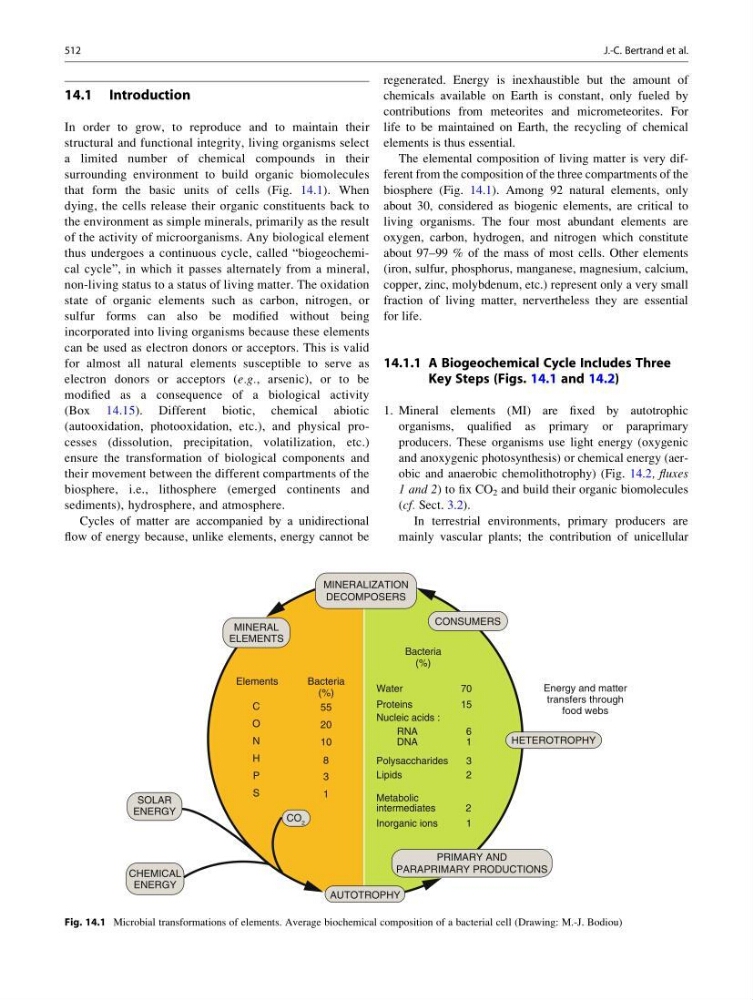
that form the basic units of cells (Fig. 14.1). When
dying, the cells release their organic constituents back to
the environment as simple minerals, primarily as the result
of the activity of microorganisms. Any biological element
thus undergoes a continuous cycle, called “biogeochemical cycle”, in which it passes alternately from a mineral,
non-living status to a status of living matter. The oxidation
state of organic elements such as carbon, nitrogen, or
sulfur forms can also be modified without being
incorporated into living organisms because these elements
can be used as electron donors or acceptors. This is valid
for almost all natural elements susceptible to serve as
electron donors or acceptors (e.g., arsenic), or to be
modified as a consequence of a biological activity
(Box 14.15). Different biotic, chemical abiotic
(autooxidation, photooxidation, etc.), and physical processes (dissolution, precipitation, volatilization, etc.)
ensure the transformation of biological components and
their movement between the different compartments of the
biosphere, i.e., lithosphere (emerged continents and
sediments), hydrosphere, and atmosphere.
Cycles of matter are accompanied by a unidirectional
flow of energy because, unlike elements, energy cannot be
regenerated. Energy is inexhaustible but the amount of
chemicals available on Earth is constant, only fueled by
contributions from meteorites and micrometeorites. For
life to be maintained on Earth, the recycling of chemical
elements is thus essential.
The elemental composition of living matter is very different from the composition of the three compartments of the
biosphere (Fig. 14.1). Among 92 natural elements, only
about 30, considered as biogenic elements, are critical to
living organisms. The four most abundant elements are
oxygen, carbon, hydrogen, and nitrogen which constitute
about 97–99 % of the mass of most cells. Other elements
(iron, sulfur, phosphorus, manganese, magnesium, calcium,
copper, zinc, molybdenum, etc.) represent only a very small
fraction of living matter, nervertheless they are essential
for life.
14.1.1 A Biogeochemical Cycle Includes Three
Key Steps (Figs. 14.1 and 14.2)
1. Mineral elements (MI) are fixed by autotrophic
organisms, qualified as primary or paraprimary
producers. These organisms use light energy (oxygenic
and anoxygenic photosynthesis) or chemical energy (aerobic and anaerobic chemolithotrophy) (Fig. 14.2, fluxes
1 and 2) to fix CO 2 and build their organic biomolecules
(cf. Sect. 3.2).
In terrestrial environments, primary producers are
mainly vascular plants; the contribution of unicellular
CO 2
Elements
C
O
N
H
P
S
Bacteria
(%)
Bacteria
(%)
55
20
10
8
3
1
Water
Proteins
Nucleic acids :
RNA
DNA
Polysaccharides
Lipids
Metabolic
intermediates
Inorganic ions
70
15
6
1
3
2
2
1
MINERALIZATION
DECOMPOSERS
MINERAL
ELEMENTS
CONSUMERS
AUTOTROPHY
PRIMARY AND
PARAPRIMARY PRODUCTIONS
SOLAR
ENERGY
CHEMICAL
ENERGY
Energy and matter
transfers through
food webs
HETEROTROPHY
Fig. 14.1 Microbial transformations of elements. Average biochemical composition of a bacterial cell (Drawing: M.-J. Bodiou)
512
J.-C. Bertrand et al.
In order to grow, to reproduce and to maintain their
structural and functional integrity, living organisms select
a limited number of chemical compounds in their
surrounding environment to build organic biomolecules
that form the basic units of cells (Fig. 14.1). When
dying, the cells release their organic constituents back to
the environment as simple minerals, primarily as the result
of the activity of microorganisms. Any biological element
thus undergoes a continuous cycle, called “biogeochemical cycle”, in which it passes alternately from a mineral,
non-living status to a status of living matter. The oxidation
state of organic elements such as carbon, nitrogen, or
sulfur forms can also be modified without being
incorporated into living organisms because these elements
can be used as electron donors or acceptors. This is valid
for almost all natural elements susceptible to serve as
electron donors or acceptors (e.g., arsenic), or to be
modified as a consequence of a biological activity
(Box 14.15). Different biotic, chemical abiotic
(autooxidation, photooxidation, etc.), and physical processes (dissolution, precipitation, volatilization, etc.)
ensure the transformation of biological components and
their movement between the different compartments of the
biosphere, i.e., lithosphere (emerged continents and
sediments), hydrosphere, and atmosphere.
Cycles of matter are accompanied by a unidirectional
flow of energy because, unlike elements, energy cannot be
regenerated. Energy is inexhaustible but the amount of
chemicals available on Earth is constant, only fueled by
contributions from meteorites and micrometeorites. For
life to be maintained on Earth, the recycling of chemical
elements is thus essential.
The elemental composition of living matter is very different from the composition of the three compartments of the
biosphere (Fig. 14.1). Among 92 natural elements, only
about 30, considered as biogenic elements, are critical to
living organisms. The four most abundant elements are
oxygen, carbon, hydrogen, and nitrogen which constitute
about 97–99 % of the mass of most cells. Other elements
(iron, sulfur, phosphorus, manganese, magnesium, calcium,
copper, zinc, molybdenum, etc.) represent only a very small
fraction of living matter, nervertheless they are essential
for life.
14.1.1 A Biogeochemical Cycle Includes Three
Key Steps (Figs. 14.1 and 14.2)
1. Mineral elements (MI) are fixed by autotrophic
organisms, qualified as primary or paraprimary
producers. These organisms use light energy (oxygenic
and anoxygenic photosynthesis) or chemical energy (aerobic and anaerobic chemolithotrophy) (Fig. 14.2, fluxes
1 and 2) to fix CO 2 and build their organic biomolecules
(cf. Sect. 3.2).
In terrestrial environments, primary producers are
mainly vascular plants; the contribution of unicellular
CO 2
Elements
C
O
N
H
P
S
Bacteria
(%)
Bacteria
(%)
55
20
10
8
3
1
Water
Proteins
Nucleic acids :
RNA
DNA
Polysaccharides
Lipids
Metabolic
intermediates
Inorganic ions
70
15
6
1
3
2
2
1
MINERALIZATION
DECOMPOSERS
MINERAL
ELEMENTS
CONSUMERS
AUTOTROPHY
PRIMARY AND
PARAPRIMARY PRODUCTIONS
SOLAR
ENERGY
CHEMICAL
ENERGY
Energy and matter
transfers through
food webs
HETEROTROPHY
Fig. 14.1 Microbial transformations of elements. Average biochemical composition of a bacterial cell (Drawing: M.-J. Bodiou)
512
J.-C. Bertrand et al.