

decoupling between growth and energy production is
described as energy decoupling. The excess energy can be
diverted to the production of glycogen and polyhydroxyalkanoates among microorganisms capable to accumulate
these substances in their cells as carbon reserve.
3.3
Energy Metabolism
3.3.1 General Principles
In all cases (respiration, fermentation, photosynthesis),
energy metabolism is based on redox processes between
electron donor couple at low redox potential and electron
acceptor couple at more high potential (Fig. 3.9).
During redox reactions that produce energy, the available
energy for microorganisms appears mainly in the form of highenergy phosphate bonds, mainly in the form of adenosine
triphosphate (ATP). ATP synthesis is an endergonic reaction
that requires input of energy from the catabolism (potential
phosphorylation: ΔGp
0
¼ +44 kJ.mol
À1
). The released
energy (ΔG
0 ) during the hydrolysis of ATP in ADP, which
is –32 kJ.mol
À1
, is used for biosynthesis and other cellular
functions. ATP is not the only energy-rich molecule. Other
molecules can be used such as phosphoenolpyruvate (PEP,
ΔG
0
¼ –52 kJ.mol
À1
), acetyl phosphate (ΔG
0
¼ –45 kJ.
mol
À1
), or acetyl-CoA (ΔG
0
¼ –36 kJ.mol
À1
).
In microorganisms, there are two types of mechanism for
the synthesis of ATP, the substrate-level phosphorylation*
and the phosphorylation during electron transfer by a
carrier chain (oxidative phosphorylation* and photophosphorylation*); these mechanisms involving the redox
reactions of catabolism are associated often to transfer
protons during dehydrogenation:
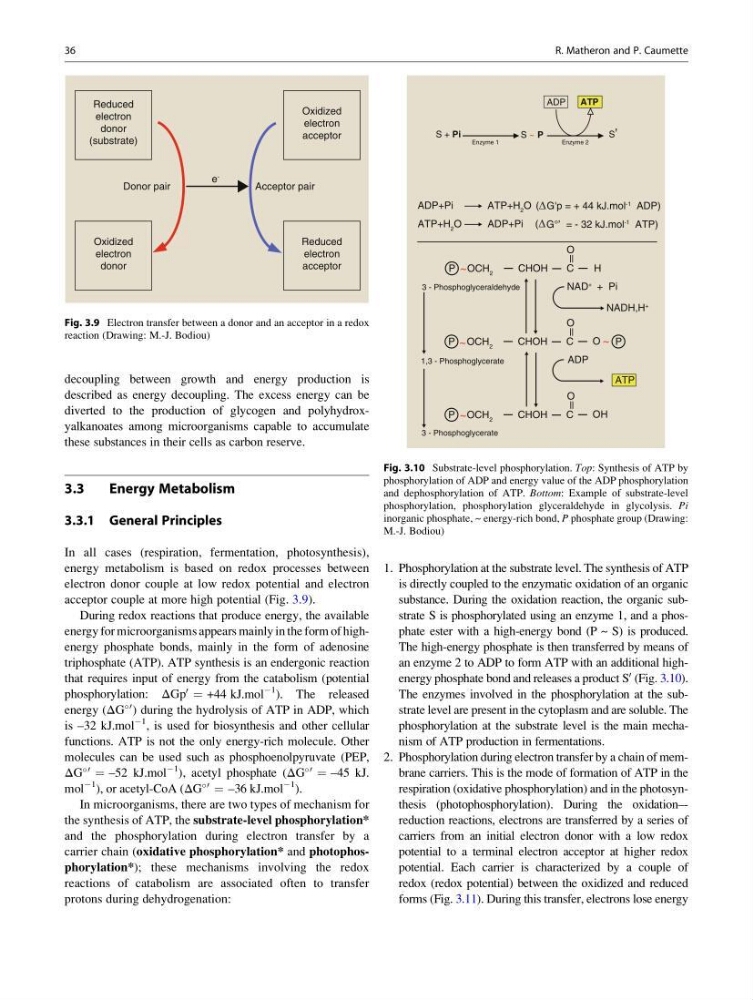
1. Phosphorylation at the substrate level. The synthesis of ATP
is directly coupled to the enzymatic oxidation of an organic
substance. During the oxidation reaction, the organic substrate S is phosphorylated using an enzyme 1, and a phosphate ester with a high-energy bond (P ~ S) is produced.
The high-energy phosphate is then transferred by means of
an enzyme 2 to ADP to form ATP with an additional highenergy phosphate bond and releases a product S
0 (Fig. 3.10).
The enzymes involved in the phosphorylation at the substrate level are present in the cytoplasm and are soluble. The
phosphorylation at the substrate level is the main mechanism of ATP production in fermentations.
2. Phosphorylation during electron transfer by a chain of membrane carriers. This is the mode of formation of ATP in the
respiration (oxidative phosphorylation) and in the photosynthesis (photophosphorylation). During the oxidation–reduction reactions, electrons are transferred by a series of
carriers from an initial electron donor with a low redox
potential to a terminal electron acceptor at higher redox
potential. Each carrier is characterized by a couple of
redox (redox potential) between the oxidized and reduced
forms (Fig. 3.11). During this transfer, electrons lose energy
Reduced
electron
donor
(substrate)
Donor pair
Acceptor pair
Oxidized
electron
donor
Oxidized
electron
acceptor
Reduced
electron
acceptor
e
-
Fig. 3.9 Electron transfer between a donor and an acceptor in a redox
reaction (Drawing: M.-J. Bodiou)
ADP
ATP
S + Pi
S’
P
S
Enzyme 1
Enzyme 2
ADP+Pi
ATP+H 2 O
ATP
G°’ = - 32 kJ.mol
-1 ATP)
( G'p = + 44 kJ.mol
-1 ADP)
ATP+H 2 O
ADP+Pi (
P OCH 2
CHOH
C
P
P
OCH 2
CHOH
C
H
3 - Phosphoglyceraldehyde
NAD
+ + Pi
NADH,H
+
O
=
O
=
O
=
O
P OCH 2
CHOH
C
OH
1,3 - Phosphoglycerate
ADP
3 - Phosphoglycerate
~
~
~
~
~
Fig. 3.10 Substrate-level phosphorylation. Top: Synthesis of ATP by
phosphorylation of ADP and energy value of the ADP phosphorylation
and dephosphorylation of ATP. Bottom: Example of substrate-level
phosphorylation, phosphorylation glyceraldehyde in glycolysis. Pi
inorganic phosphate, ~ energy-rich bond, P phosphate group (Drawing:
M.-J. Bodiou)
36
R. Matheron and P. Caumette
described as energy decoupling. The excess energy can be
diverted to the production of glycogen and polyhydroxyalkanoates among microorganisms capable to accumulate
these substances in their cells as carbon reserve.
3.3
Energy Metabolism
3.3.1 General Principles
In all cases (respiration, fermentation, photosynthesis),
energy metabolism is based on redox processes between
electron donor couple at low redox potential and electron
acceptor couple at more high potential (Fig. 3.9).
During redox reactions that produce energy, the available
energy for microorganisms appears mainly in the form of highenergy phosphate bonds, mainly in the form of adenosine
triphosphate (ATP). ATP synthesis is an endergonic reaction
that requires input of energy from the catabolism (potential
phosphorylation: ΔGp
0
¼ +44 kJ.mol
À1
). The released
energy (ΔG
0 ) during the hydrolysis of ATP in ADP, which
is –32 kJ.mol
À1
, is used for biosynthesis and other cellular
functions. ATP is not the only energy-rich molecule. Other
molecules can be used such as phosphoenolpyruvate (PEP,
ΔG
0
¼ –52 kJ.mol
À1
), acetyl phosphate (ΔG
0
¼ –45 kJ.
mol
À1
), or acetyl-CoA (ΔG
0
¼ –36 kJ.mol
À1
).
In microorganisms, there are two types of mechanism for
the synthesis of ATP, the substrate-level phosphorylation*
and the phosphorylation during electron transfer by a
carrier chain (oxidative phosphorylation* and photophosphorylation*); these mechanisms involving the redox
reactions of catabolism are associated often to transfer
protons during dehydrogenation:
1. Phosphorylation at the substrate level. The synthesis of ATP
is directly coupled to the enzymatic oxidation of an organic
substance. During the oxidation reaction, the organic substrate S is phosphorylated using an enzyme 1, and a phosphate ester with a high-energy bond (P ~ S) is produced.
The high-energy phosphate is then transferred by means of
an enzyme 2 to ADP to form ATP with an additional highenergy phosphate bond and releases a product S
0 (Fig. 3.10).
The enzymes involved in the phosphorylation at the substrate level are present in the cytoplasm and are soluble. The
phosphorylation at the substrate level is the main mechanism of ATP production in fermentations.
2. Phosphorylation during electron transfer by a chain of membrane carriers. This is the mode of formation of ATP in the
respiration (oxidative phosphorylation) and in the photosynthesis (photophosphorylation). During the oxidation–reduction reactions, electrons are transferred by a series of
carriers from an initial electron donor with a low redox
potential to a terminal electron acceptor at higher redox
potential. Each carrier is characterized by a couple of
redox (redox potential) between the oxidized and reduced
forms (Fig. 3.11). During this transfer, electrons lose energy
Reduced
electron
donor
(substrate)
Donor pair
Acceptor pair
Oxidized
electron
donor
Oxidized
electron
acceptor
Reduced
electron
acceptor
e
-
Fig. 3.9 Electron transfer between a donor and an acceptor in a redox
reaction (Drawing: M.-J. Bodiou)
ADP
ATP
S + Pi
S’
P
S
Enzyme 1
Enzyme 2
ADP+Pi
ATP+H 2 O
ATP
G°’ = - 32 kJ.mol
-1 ATP)
( G'p = + 44 kJ.mol
-1 ADP)
ATP+H 2 O
ADP+Pi (
P OCH 2
CHOH
C
P
P
OCH 2
CHOH
C
H
3 - Phosphoglyceraldehyde
NAD
+ + Pi
NADH,H
+
O
=
O
=
O
=
O
P OCH 2
CHOH
C
OH
1,3 - Phosphoglycerate
ADP
3 - Phosphoglycerate
~
~
~
~
~
Fig. 3.10 Substrate-level phosphorylation. Top: Synthesis of ATP by
phosphorylation of ADP and energy value of the ADP phosphorylation
and dephosphorylation of ATP. Bottom: Example of substrate-level
phosphorylation, phosphorylation glyceraldehyde in glycolysis. Pi
inorganic phosphate, ~ energy-rich bond, P phosphate group (Drawing:
M.-J. Bodiou)
36
R. Matheron and P. Caumette