

photonic redox reactions. Too important processes of internal super-oxidation (oxidative stress, cf. Sect. 9.6.2) cause
cell death.
For some microorganisms, all the needs of biosynthesis are
covered by a single carbon source; these microorganisms are
described as prototrophs*. Others require, in addition to the
main carbon source, organic compounds that cannot be
synthesized such as amino acids, fatty acids, vitamins, etc.
These compounds are considered essential for microorganisms
and are called growth factors; microorganisms are then defined
as auxotrophs* for a given essential compound.
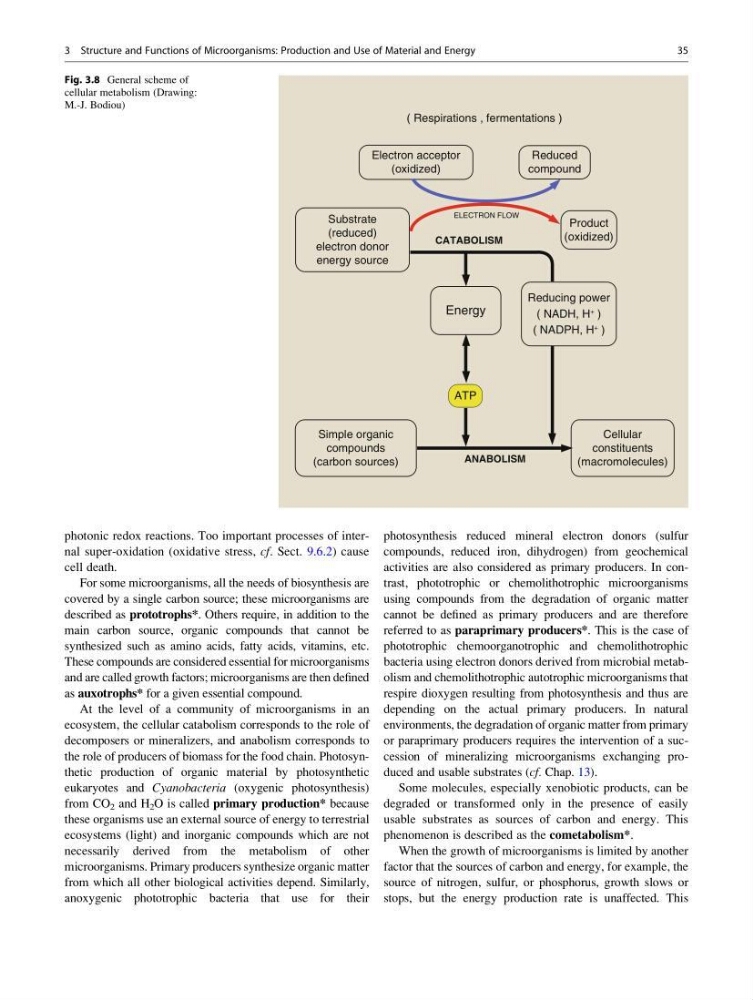
At the level of a community of microorganisms in an
ecosystem, the cellular catabolism corresponds to the role of
decomposers or mineralizers, and anabolism corresponds to
the role of producers of biomass for the food chain. Photosynthetic production of organic material by photosynthetic
eukaryotes and Cyanobacteria (oxygenic photosynthesis)
from CO 2 and H 2 O is called primary production* because
these organisms use an external source of energy to terrestrial
ecosystems (light) and inorganic compounds which are not
necessarily derived from the metabolism of other
microorganisms. Primary producers synthesize organic matter
from which all other biological activities depend. Similarly,
anoxygenic phototrophic bacteria that use for their
photosynthesis reduced mineral electron donors (sulfur
compounds, reduced iron, dihydrogen) from geochemical
activities are also considered as primary producers. In contrast, phototrophic or chemolithotrophic microorganisms
using compounds from the degradation of organic matter
cannot be defined as primary producers and are therefore
referred to as paraprimary producers*. This is the case of
phototrophic chemoorganotrophic and chemolithotrophic
bacteria using electron donors derived from microbial metabolism and chemolithotrophic autotrophic microorganisms that
respire dioxygen resulting from photosynthesis and thus are
depending on the actual primary producers. In natural
environments, the degradation of organic matter from primary
or paraprimary producers requires the intervention of a succession of mineralizing microorganisms exchanging produced and usable substrates (cf. Chap. 13).
Some molecules, especially xenobiotic products, can be
degraded or transformed only in the presence of easily
usable substrates as sources of carbon and energy. This
phenomenon is described as the cometabolism*.
When the growth of microorganisms is limited by another
factor that the sources of carbon and energy, for example, the
source of nitrogen, sulfur, or phosphorus, growth slows or
stops, but the energy production rate is unaffected. This
( Respirations , fermentations )
Electron acceptor
(oxidized)
Reduced
compound
Substrate
(reduced)
electron donor
energy source
ELECTRON FLOW
Product
(oxidized)
CATABOLISM
ANABOLISM
Energy
Reducing power
( NADH, H
+ )
( NADPH, H
+ )
ATP
Simple organic
compounds
(carbon sources)
Cellular
constituents
(macromolecules)
Fig. 3.8 General scheme of
cellular metabolism (Drawing:
M.-J. Bodiou)
3 Structure and Functions of Microorganisms: Production and Use of Material and Energy
35
cell death.
For some microorganisms, all the needs of biosynthesis are
covered by a single carbon source; these microorganisms are
described as prototrophs*. Others require, in addition to the
main carbon source, organic compounds that cannot be
synthesized such as amino acids, fatty acids, vitamins, etc.
These compounds are considered essential for microorganisms
and are called growth factors; microorganisms are then defined
as auxotrophs* for a given essential compound.
At the level of a community of microorganisms in an
ecosystem, the cellular catabolism corresponds to the role of
decomposers or mineralizers, and anabolism corresponds to
the role of producers of biomass for the food chain. Photosynthetic production of organic material by photosynthetic
eukaryotes and Cyanobacteria (oxygenic photosynthesis)
from CO 2 and H 2 O is called primary production* because
these organisms use an external source of energy to terrestrial
ecosystems (light) and inorganic compounds which are not
necessarily derived from the metabolism of other
microorganisms. Primary producers synthesize organic matter
from which all other biological activities depend. Similarly,
anoxygenic phototrophic bacteria that use for their
photosynthesis reduced mineral electron donors (sulfur
compounds, reduced iron, dihydrogen) from geochemical
activities are also considered as primary producers. In contrast, phototrophic or chemolithotrophic microorganisms
using compounds from the degradation of organic matter
cannot be defined as primary producers and are therefore
referred to as paraprimary producers*. This is the case of
phototrophic chemoorganotrophic and chemolithotrophic
bacteria using electron donors derived from microbial metabolism and chemolithotrophic autotrophic microorganisms that
respire dioxygen resulting from photosynthesis and thus are
depending on the actual primary producers. In natural
environments, the degradation of organic matter from primary
or paraprimary producers requires the intervention of a succession of mineralizing microorganisms exchanging produced and usable substrates (cf. Chap. 13).
Some molecules, especially xenobiotic products, can be
degraded or transformed only in the presence of easily
usable substrates as sources of carbon and energy. This
phenomenon is described as the cometabolism*.
When the growth of microorganisms is limited by another
factor that the sources of carbon and energy, for example, the
source of nitrogen, sulfur, or phosphorus, growth slows or
stops, but the energy production rate is unaffected. This
( Respirations , fermentations )
Electron acceptor
(oxidized)
Reduced
compound
Substrate
(reduced)
electron donor
energy source
ELECTRON FLOW
Product
(oxidized)
CATABOLISM
ANABOLISM
Energy
Reducing power
( NADH, H
+ )
( NADPH, H
+ )
ATP
Simple organic
compounds
(carbon sources)
Cellular
constituents
(macromolecules)
Fig. 3.8 General scheme of
cellular metabolism (Drawing:
M.-J. Bodiou)
3 Structure and Functions of Microorganisms: Production and Use of Material and Energy
35