

densities of 10
5 to 10
6 have been reported for these deep
sediment layers. With epifluorescence microscope
techniques it is equally possible to observe and count
virus-like particles and densities of about 10
11 have frequently been reported for sediments. Surprisingly, however,
the number of prokaryotes showing viral infections appears
often to be very low in sediments, and the role of viruses in
sediments still remains enigmatic (Filippini et al. 2006).
As it is the case for many other ecosystems, the use of the
concept of functional groups is particularly useful for the
analyses of the biogeochemistry of the benthic communities.
However, functional groups do often not correspond to phylogenetic groups. Therefore, the analysis of 16S rRNA gene
clone libraries is often not sufficient to infer the importance
of biogeochemical reactions. Rather, the amplification and
sequencing of functional groups is a better method to establish a link between biogeochemical activity and the phylogeny of the main responsible prokaryote actors.
The use of the concept of functional groups can also be
problematic for food web studies, as the main predators
select their prey according cell size and microhabitat, rather
than according to their biogeochemical functions. Moreover,
the concept of functional groups may also be problematic at
the level of the species and individual cells, because several
prokaryotes are generalists and highly versatile in their
metabolism and could, therefore, belong to several different
functional groups at the same time. This is particularly the
case for the mixotrophs that perform autotrophy and heterotrophy simultaneously.
During longtime, the methanogenic archaea were considered as the only archaea in most sediments where they
proliferate in the anoxic part. Other archaea were considered
as characteristic for extreme environments as hypersaline
and high-temperature environments. The sampling and
amplification of 16r RNA genes has shown, however, that
archaea are much more widespread and more diverse in
sediments, where they also may include the ammoniumoxidizing archaea.
13.2.3 Microorganisms of Terrestrial
Ecosystems
Studies on terrestrial environments mainly concern
organisms living on the soil (animals and higher plants),
and knowledge of soil biodiversity and its functional role
remains insufficient (Mittelbach et al. 2001). Numerous
microorganisms and telluric animals constitute the main
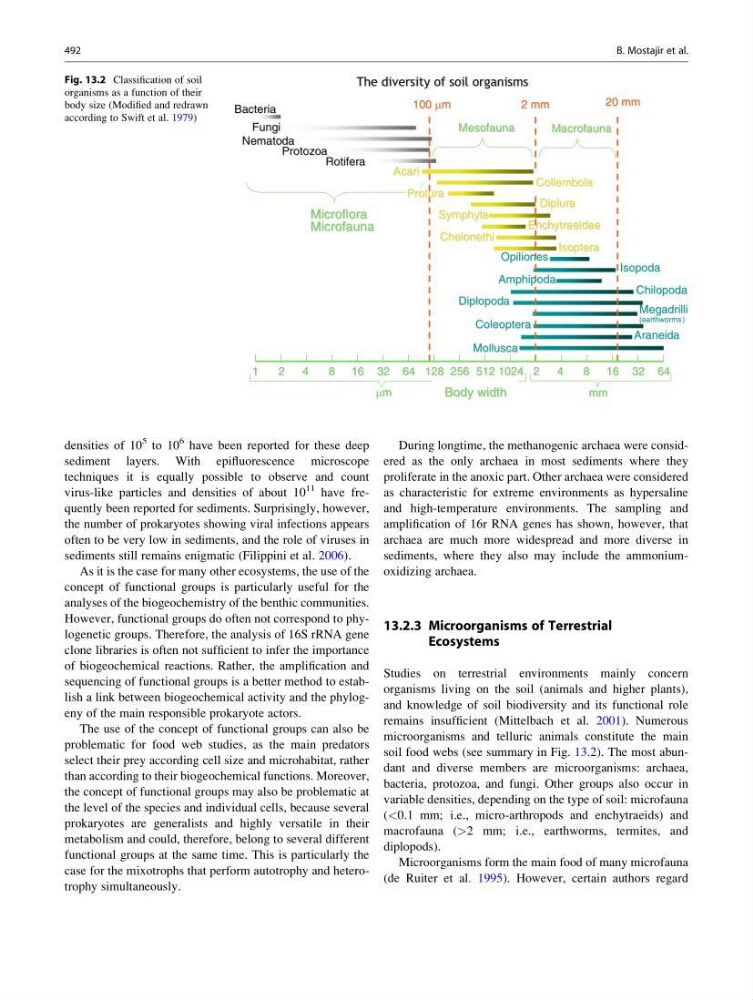
soil food webs (see summary in Fig. 13.2). The most abundant and diverse members are microorganisms: archaea,
bacteria, protozoa, and fungi. Other groups also occur in
variable densities, depending on the type of soil: microfauna
(<0.1 mm; i.e., micro-arthropods and enchytraeids) and
macrofauna (>2 mm; i.e., earthworms, termites, and
diplopods).
Microorganisms form the main food of many microfauna
(de Ruiter et al. 1995). However, certain authors regard
1
1
2
2
4
4
8
8
16
16 32
32 64
64 128
128 256
256 512
512 1024
1024 2
2
4
4
8
8
16
16 32
32 64
64
The diversity of soil organisms
The diversity of soil organisms
Bacteria
Bacteria
Fungi
Fungi
Nematoda
Nematoda
Protozoa
Protozoa
Rotifera
Rotifera
Acari
Acari
Collembola
Collembola
Protura
Protura
Diplura
Diplura
Symphyla
Symphyla
Enchytraeidae
Enchytraeidae
Chelonethi
Chelonethi
Isoptera
Isoptera
Opiliones
Opiliones
Isopoda
Isopoda
Amphipoda
Amphipoda
Chilopoda
Chilopoda
Diplopoda
Diplopoda
Megadrilli
Megadrilli
(
(earthworms earthworms )
)
Coleoptera
Coleoptera
Araneida
Araneida
Mollusca
Mollusca
Microflora
Microflora
Microfauna
Microfauna
Mesofauna
Mesofauna
Macrofauna
Macrofauna
100 μm
100 μm
2 mm
2 mm
20 mm
20 mm
Body
Body width
width
μm
μm
mm
mm
Fig. 13.2 Classification of soil
organisms as a function of their
body size (Modified and redrawn
according to Swift et al. 1979)
492
B. Mostajir et al.
5 to 10
6 have been reported for these deep
sediment layers. With epifluorescence microscope
techniques it is equally possible to observe and count
virus-like particles and densities of about 10
11 have frequently been reported for sediments. Surprisingly, however,
the number of prokaryotes showing viral infections appears
often to be very low in sediments, and the role of viruses in
sediments still remains enigmatic (Filippini et al. 2006).
As it is the case for many other ecosystems, the use of the
concept of functional groups is particularly useful for the
analyses of the biogeochemistry of the benthic communities.
However, functional groups do often not correspond to phylogenetic groups. Therefore, the analysis of 16S rRNA gene
clone libraries is often not sufficient to infer the importance
of biogeochemical reactions. Rather, the amplification and
sequencing of functional groups is a better method to establish a link between biogeochemical activity and the phylogeny of the main responsible prokaryote actors.
The use of the concept of functional groups can also be
problematic for food web studies, as the main predators
select their prey according cell size and microhabitat, rather
than according to their biogeochemical functions. Moreover,
the concept of functional groups may also be problematic at
the level of the species and individual cells, because several
prokaryotes are generalists and highly versatile in their
metabolism and could, therefore, belong to several different
functional groups at the same time. This is particularly the
case for the mixotrophs that perform autotrophy and heterotrophy simultaneously.
During longtime, the methanogenic archaea were considered as the only archaea in most sediments where they
proliferate in the anoxic part. Other archaea were considered
as characteristic for extreme environments as hypersaline
and high-temperature environments. The sampling and
amplification of 16r RNA genes has shown, however, that
archaea are much more widespread and more diverse in
sediments, where they also may include the ammoniumoxidizing archaea.
13.2.3 Microorganisms of Terrestrial
Ecosystems
Studies on terrestrial environments mainly concern
organisms living on the soil (animals and higher plants),
and knowledge of soil biodiversity and its functional role
remains insufficient (Mittelbach et al. 2001). Numerous
microorganisms and telluric animals constitute the main
soil food webs (see summary in Fig. 13.2). The most abundant and diverse members are microorganisms: archaea,
bacteria, protozoa, and fungi. Other groups also occur in
variable densities, depending on the type of soil: microfauna
(<0.1 mm; i.e., micro-arthropods and enchytraeids) and
macrofauna (>2 mm; i.e., earthworms, termites, and
diplopods).
Microorganisms form the main food of many microfauna
(de Ruiter et al. 1995). However, certain authors regard
1
1
2
2
4
4
8
8
16
16 32
32 64
64 128
128 256
256 512
512 1024
1024 2
2
4
4
8
8
16
16 32
32 64
64
The diversity of soil organisms
The diversity of soil organisms
Bacteria
Bacteria
Fungi
Fungi
Nematoda
Nematoda
Protozoa
Protozoa
Rotifera
Rotifera
Acari
Acari
Collembola
Collembola
Protura
Protura
Diplura
Diplura
Symphyla
Symphyla
Enchytraeidae
Enchytraeidae
Chelonethi
Chelonethi
Isoptera
Isoptera
Opiliones
Opiliones
Isopoda
Isopoda
Amphipoda
Amphipoda
Chilopoda
Chilopoda
Diplopoda
Diplopoda
Megadrilli
Megadrilli
(
(earthworms earthworms )
)
Coleoptera
Coleoptera
Araneida
Araneida
Mollusca
Mollusca
Microflora
Microflora
Microfauna
Microfauna
Mesofauna
Mesofauna
Macrofauna
Macrofauna
100 μm
100 μm
2 mm
2 mm
20 mm
20 mm
Body
Body width
width
μm
μm
mm
mm
Fig. 13.2 Classification of soil
organisms as a function of their
body size (Modified and redrawn
according to Swift et al. 1979)
492
B. Mostajir et al.