

rate of foreign DNA into cells is modulated by the presence
of endonucleases (e.g., NucA in B. subtilis) which create
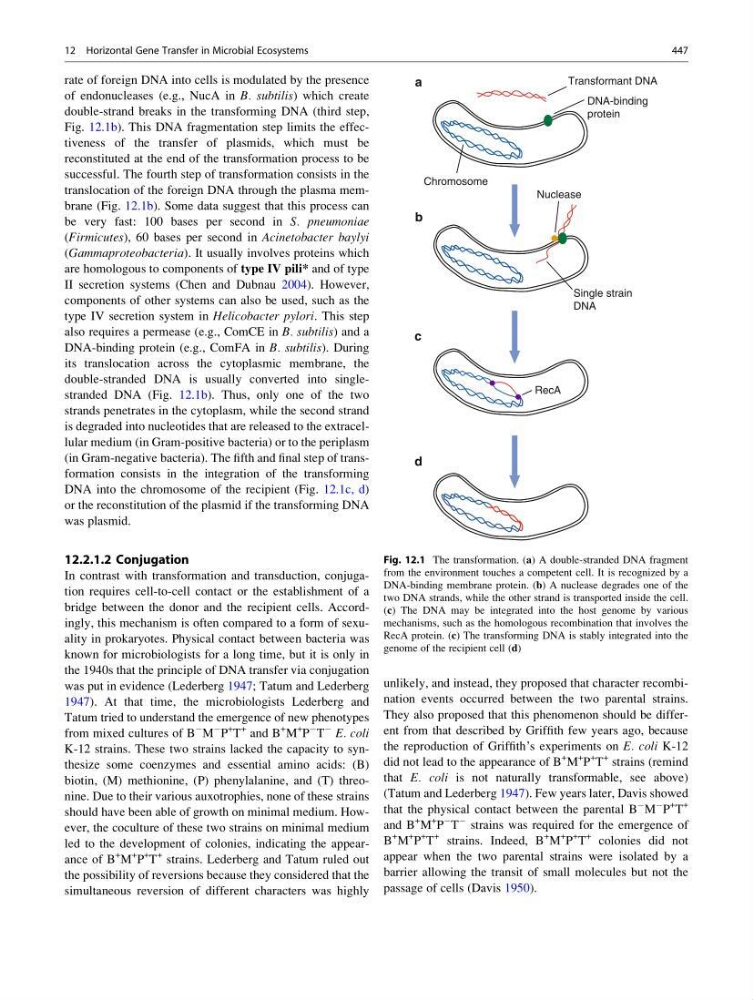
double-strand breaks in the transforming DNA (third step,
Fig. 12.1b). This DNA fragmentation step limits the effectiveness of the transfer of plasmids, which must be
reconstituted at the end of the transformation process to be
successful. The fourth step of transformation consists in the
translocation of the foreign DNA through the plasma membrane (Fig. 12.1b). Some data suggest that this process can
be very fast: 100 bases per second in S. pneumoniae
(Firmicutes), 60 bases per second in Acinetobacter baylyi
(Gammaproteobacteria). It usually involves proteins which
are homologous to components of type IV pili* and of type
II secretion systems (Chen and Dubnau 2004). However,
components of other systems can also be used, such as the
type IV secretion system in Helicobacter pylori. This step
also requires a permease (e.g., ComCE in B. subtilis) and a
DNA-binding protein (e.g., ComFA in B. subtilis). During
its translocation across the cytoplasmic membrane, the
double-stranded DNA is usually converted into singlestranded DNA (Fig. 12.1b). Thus, only one of the two
strands penetrates in the cytoplasm, while the second strand
is degraded into nucleotides that are released to the extracellular medium (in Gram-positive bacteria) or to the periplasm
(in Gram-negative bacteria). The fifth and final step of transformation consists in the integration of the transforming
DNA into the chromosome of the recipient (Fig. 12.1c, d)
or the reconstitution of the plasmid if the transforming DNA
was plasmid.
12.2.1.2 Conjugation
In contrast with transformation and transduction, conjugation requires cell-to-cell contact or the establishment of a
bridge between the donor and the recipient cells. Accordingly, this mechanism is often compared to a form of sexuality in prokaryotes. Physical contact between bacteria was
known for microbiologists for a long time, but it is only in
the 1940s that the principle of DNA transfer via conjugation
was put in evidence (Lederberg 1947; Tatum and Lederberg
1947). At that time, the microbiologists Lederberg and
Tatum tried to understand the emergence of new phenotypes
from mixed cultures of B
À M
À P
+ T
+ and B
+ M
+
P
À T
À E. coli
K-12 strains. These two strains lacked the capacity to synthesize some coenzymes and essential amino acids: (B)
biotin, (M) methionine, (P) phenylalanine, and (T) threonine. Due to their various auxotrophies, none of these strains
should have been able of growth on minimal medium. However, the coculture of these two strains on minimal medium
led to the development of colonies, indicating the appearance of B
+ M
+ P
+
T
+ strains. Lederberg and Tatum ruled out
the possibility of reversions because they considered that the
simultaneous reversion of different characters was highly
unlikely, and instead, they proposed that character recombination events occurred between the two parental strains.
They also proposed that this phenomenon should be different from that described by Griffith few years ago, because
the reproduction of Griffith’s experiments on E. coli K-12
did not lead to the appearance of B
+
M
+
P
+
T
+ strains (remind
that E. coli is not naturally transformable, see above)
(Tatum and Lederberg 1947). Few years later, Davis showed
that the physical contact between the parental B
À M
À P
+ T
+
and B
+
M
+
P
À T
À strains was required for the emergence of
B
+ M
+ P
+
T
+ strains. Indeed, B
+
M
+
P
+ T
+ colonies did not
appear when the two parental strains were isolated by a
barrier allowing the transit of small molecules but not the
passage of cells (Davis 1950).
Transformant DNA
DNA-binding
protein
Chromosome
Nuclease
RecA
Single strain
DNA
a
b
c
d
Fig. 12.1 The transformation. (a) A double-stranded DNA fragment
from the environment touches a competent cell. It is recognized by a
DNA-binding membrane protein. (b) A nuclease degrades one of the
two DNA strands, while the other strand is transported inside the cell.
(c) The DNA may be integrated into the host genome by various
mechanisms, such as the homologous recombination that involves the
RecA protein. (c) The transforming DNA is stably integrated into the
genome of the recipient cell (d)
12 Horizontal Gene Transfer in Microbial Ecosystems
447
of endonucleases (e.g., NucA in B. subtilis) which create
double-strand breaks in the transforming DNA (third step,
Fig. 12.1b). This DNA fragmentation step limits the effectiveness of the transfer of plasmids, which must be
reconstituted at the end of the transformation process to be
successful. The fourth step of transformation consists in the
translocation of the foreign DNA through the plasma membrane (Fig. 12.1b). Some data suggest that this process can
be very fast: 100 bases per second in S. pneumoniae
(Firmicutes), 60 bases per second in Acinetobacter baylyi
(Gammaproteobacteria). It usually involves proteins which
are homologous to components of type IV pili* and of type
II secretion systems (Chen and Dubnau 2004). However,
components of other systems can also be used, such as the
type IV secretion system in Helicobacter pylori. This step
also requires a permease (e.g., ComCE in B. subtilis) and a
DNA-binding protein (e.g., ComFA in B. subtilis). During
its translocation across the cytoplasmic membrane, the
double-stranded DNA is usually converted into singlestranded DNA (Fig. 12.1b). Thus, only one of the two
strands penetrates in the cytoplasm, while the second strand
is degraded into nucleotides that are released to the extracellular medium (in Gram-positive bacteria) or to the periplasm
(in Gram-negative bacteria). The fifth and final step of transformation consists in the integration of the transforming
DNA into the chromosome of the recipient (Fig. 12.1c, d)
or the reconstitution of the plasmid if the transforming DNA
was plasmid.
12.2.1.2 Conjugation
In contrast with transformation and transduction, conjugation requires cell-to-cell contact or the establishment of a
bridge between the donor and the recipient cells. Accordingly, this mechanism is often compared to a form of sexuality in prokaryotes. Physical contact between bacteria was
known for microbiologists for a long time, but it is only in
the 1940s that the principle of DNA transfer via conjugation
was put in evidence (Lederberg 1947; Tatum and Lederberg
1947). At that time, the microbiologists Lederberg and
Tatum tried to understand the emergence of new phenotypes
from mixed cultures of B
À M
À P
+ T
+ and B
+ M
+
P
À T
À E. coli
K-12 strains. These two strains lacked the capacity to synthesize some coenzymes and essential amino acids: (B)
biotin, (M) methionine, (P) phenylalanine, and (T) threonine. Due to their various auxotrophies, none of these strains
should have been able of growth on minimal medium. However, the coculture of these two strains on minimal medium
led to the development of colonies, indicating the appearance of B
+ M
+ P
+
T
+ strains. Lederberg and Tatum ruled out
the possibility of reversions because they considered that the
simultaneous reversion of different characters was highly
unlikely, and instead, they proposed that character recombination events occurred between the two parental strains.
They also proposed that this phenomenon should be different from that described by Griffith few years ago, because
the reproduction of Griffith’s experiments on E. coli K-12
did not lead to the appearance of B
+
M
+
P
+
T
+ strains (remind
that E. coli is not naturally transformable, see above)
(Tatum and Lederberg 1947). Few years later, Davis showed
that the physical contact between the parental B
À M
À P
+ T
+
and B
+
M
+
P
À T
À strains was required for the emergence of
B
+ M
+ P
+
T
+ strains. Indeed, B
+
M
+
P
+ T
+ colonies did not
appear when the two parental strains were isolated by a
barrier allowing the transit of small molecules but not the
passage of cells (Davis 1950).
Transformant DNA
DNA-binding
protein
Chromosome
Nuclease
RecA
Single strain
DNA
a
b
c
d
Fig. 12.1 The transformation. (a) A double-stranded DNA fragment
from the environment touches a competent cell. It is recognized by a
DNA-binding membrane protein. (b) A nuclease degrades one of the
two DNA strands, while the other strand is transported inside the cell.
(c) The DNA may be integrated into the host genome by various
mechanisms, such as the homologous recombination that involves the
RecA protein. (c) The transforming DNA is stably integrated into the
genome of the recipient cell (d)
12 Horizontal Gene Transfer in Microbial Ecosystems
447