

and Lindow 2001). Microorganisms colonizing aboveground plant surfaces are called epiphytes. Microbial numbers on leaves depend on the plant species, with densities in
the order of 10
5–7 bacteria per cm
2 (i.e., 10
5–8 per g fresh
weight) and 10
4 fungal propagules per cm
2 (Kinkel et al.
2000; Lindow and Brandl 2003). The stems can also be
colonized by microorganisms, but at lower levels. It is especially documented for nitrogen-fixing bacteria, such as photosynthetic Bradyrhizobium that induce stem nodules on
Aeschynomene (Wong et al. 1994) and Frankia on Casuarina equisetifolia (Prin et al. 1991).
In contrast, microorganisms present on the surface of
roots (i.e., at the rhizoplane) and in rhizosphere soil have
access to significant amounts of organic rhizodeposits
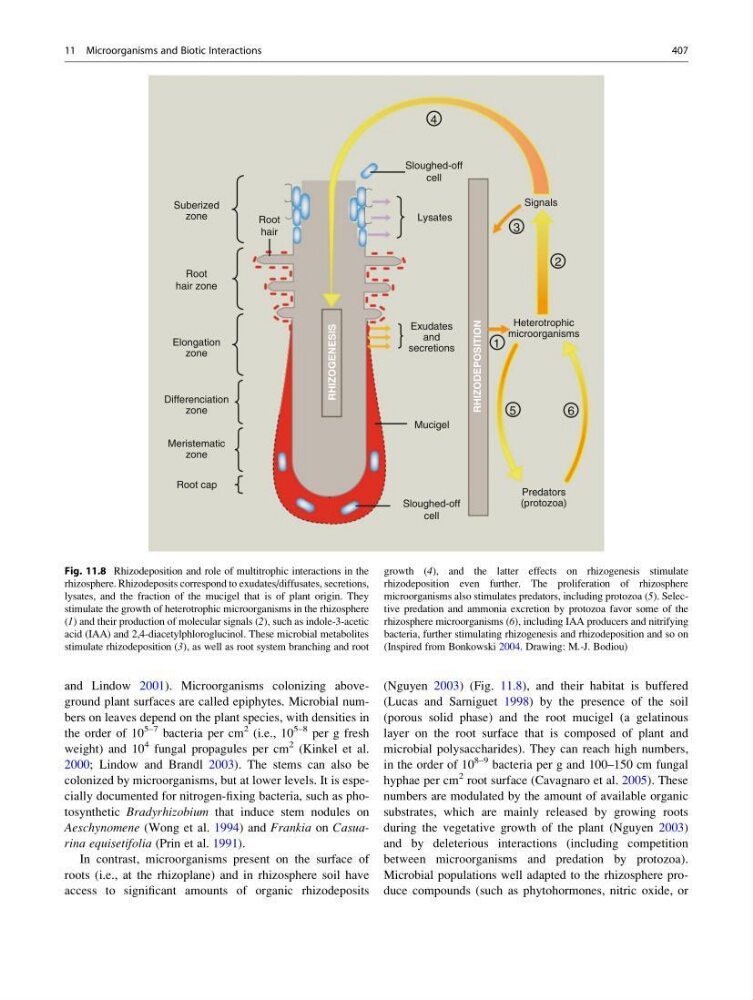
(Nguyen 2003) (Fig. 11.8), and their habitat is buffered
(Lucas and Sarniguet 1998) by the presence of the soil
(porous solid phase) and the root mucigel (a gelatinous
layer on the root surface that is composed of plant and
microbial polysaccharides). They can reach high numbers,
in the order of 10
8–9 bacteria per g and 100–150 cm fungal
hyphae per cm
2 root surface (Cavagnaro et al. 2005). These
numbers are modulated by the amount of available organic
substrates, which are mainly released by growing roots
during the vegetative growth of the plant (Nguyen 2003)
and by deleterious interactions (including competition
between microorganisms and predation by protozoa).
Microbial populations well adapted to the rhizosphere produce compounds (such as phytohormones, nitric oxide, or
Lysates
Exudates
and
secretions
Sloughed-off
cell
Sloughed-off
cell
Mucigel
Root cap
Suberized
zone
Root
hair zone
Elongation
zone
Differenciation
zone
Meristematic
zone
Heterotrophic
microorganisms
Predators
(protozoa)
1
2
3
4
RHIZOGENESIS
RHIZODEPOSITION
Root
hair
Signals
5
6
Fig. 11.8 Rhizodeposition and role of multitrophic interactions in the
rhizosphere. Rhizodeposits correspond to exudates/diffusates, secretions,
lysates, and the fraction of the mucigel that is of plant origin. They
stimulate the growth of heterotrophic microorganisms in the rhizosphere
(1) and their production of molecular signals (2), such as indole-3-acetic
acid (IAA) and 2,4-diacetylphloroglucinol. These microbial metabolites
stimulate rhizodeposition (3), as well as root system branching and root
growth (4), and the latter effects on rhizogenesis stimulate
rhizodeposition even further. The proliferation of rhizosphere
microorganisms also stimulates predators, including protozoa (5). Selective predation and ammonia excretion by protozoa favor some of the
rhizosphere microorganisms (6), including IAA producers and nitrifying
bacteria, further stimulating rhizogenesis and rhizodeposition and so on
(Inspired from Bonkowski 2004. Drawing: M.-J. Bodiou)
11 Microorganisms and Biotic Interactions
407
the order of 10
5–7 bacteria per cm
2 (i.e., 10
5–8 per g fresh
weight) and 10
4 fungal propagules per cm
2 (Kinkel et al.
2000; Lindow and Brandl 2003). The stems can also be
colonized by microorganisms, but at lower levels. It is especially documented for nitrogen-fixing bacteria, such as photosynthetic Bradyrhizobium that induce stem nodules on
Aeschynomene (Wong et al. 1994) and Frankia on Casuarina equisetifolia (Prin et al. 1991).
In contrast, microorganisms present on the surface of
roots (i.e., at the rhizoplane) and in rhizosphere soil have
access to significant amounts of organic rhizodeposits
(Nguyen 2003) (Fig. 11.8), and their habitat is buffered
(Lucas and Sarniguet 1998) by the presence of the soil
(porous solid phase) and the root mucigel (a gelatinous
layer on the root surface that is composed of plant and
microbial polysaccharides). They can reach high numbers,
in the order of 10
8–9 bacteria per g and 100–150 cm fungal
hyphae per cm
2 root surface (Cavagnaro et al. 2005). These
numbers are modulated by the amount of available organic
substrates, which are mainly released by growing roots
during the vegetative growth of the plant (Nguyen 2003)
and by deleterious interactions (including competition
between microorganisms and predation by protozoa).
Microbial populations well adapted to the rhizosphere produce compounds (such as phytohormones, nitric oxide, or
Lysates
Exudates
and
secretions
Sloughed-off
cell
Sloughed-off
cell
Mucigel
Root cap
Suberized
zone
Root
hair zone
Elongation
zone
Differenciation
zone
Meristematic
zone
Heterotrophic
microorganisms
Predators
(protozoa)
1
2
3
4
RHIZOGENESIS
RHIZODEPOSITION
Root
hair
Signals
5
6
Fig. 11.8 Rhizodeposition and role of multitrophic interactions in the
rhizosphere. Rhizodeposits correspond to exudates/diffusates, secretions,
lysates, and the fraction of the mucigel that is of plant origin. They
stimulate the growth of heterotrophic microorganisms in the rhizosphere
(1) and their production of molecular signals (2), such as indole-3-acetic
acid (IAA) and 2,4-diacetylphloroglucinol. These microbial metabolites
stimulate rhizodeposition (3), as well as root system branching and root
growth (4), and the latter effects on rhizogenesis stimulate
rhizodeposition even further. The proliferation of rhizosphere
microorganisms also stimulates predators, including protozoa (5). Selective predation and ammonia excretion by protozoa favor some of the
rhizosphere microorganisms (6), including IAA producers and nitrifying
bacteria, further stimulating rhizogenesis and rhizodeposition and so on
(Inspired from Bonkowski 2004. Drawing: M.-J. Bodiou)
11 Microorganisms and Biotic Interactions
407