

Box 10.1 (continued)
layer. Among Mediterranean DHABs, Discovery is
unique, as almost exclusively filled with a solution
of magnesium chloride that exhibits the highest
density ever found in aquatic environments. Numerous nodules of magnesium and carbonate are present
in the sediment, as well as hydrocarbon seeps.
Thetis. An elongated narrow depression of elliptical shape, with a surface area of about 11 km
2 and a
total volume of approximately 0.7 km
3 , filled by a
brine 157 m thick, almost nine times more saline
than seawater, one of the highest salinity reported for
DHABs. Hydrochemistry of Thetis brines seems quite
similar to L’Atalante and Bannock.
The Life in DHABs
Although deep hypersaline basins in the Mediterranean
Sea are extreme habitats, these basins are not biogeochemical dead ends but support prokaryotic activities,
including Discovery, in which chloride concentrations
(continued)
Box 10.1 (continued)
close to the saturation (Mg ~5 M) are considered anathema to life (van der Wielen et al. 2005).
Microbial activities (heterotrophy, sulfate reduction,
and methanogenesis) were evidenced in brines and
sediments of various basins, indicating the presence of
bacterial populations adapted to these extreme
biotopes. These results were corroborated with studies
by epifluorescence microscopy, fluorescent in situ
hybridization (FISH), and rRNA gene sequencing
(Daffonchio et al. 2006). These studies demonstrated
the presence of bacterial and archaeal communities,
with a higher diversity within the Bacteria. Some
microorganisms are similar to those previously
described, such as Proteobacteria and Sphingobacteria
within Bacteria and Halobacteria within Archaea;
other microorganisms correspond to a new division or
a new order of yet-to-be-cultivated Archaea (van der
Wielen et al. 2005; La Cono et al. 2011).
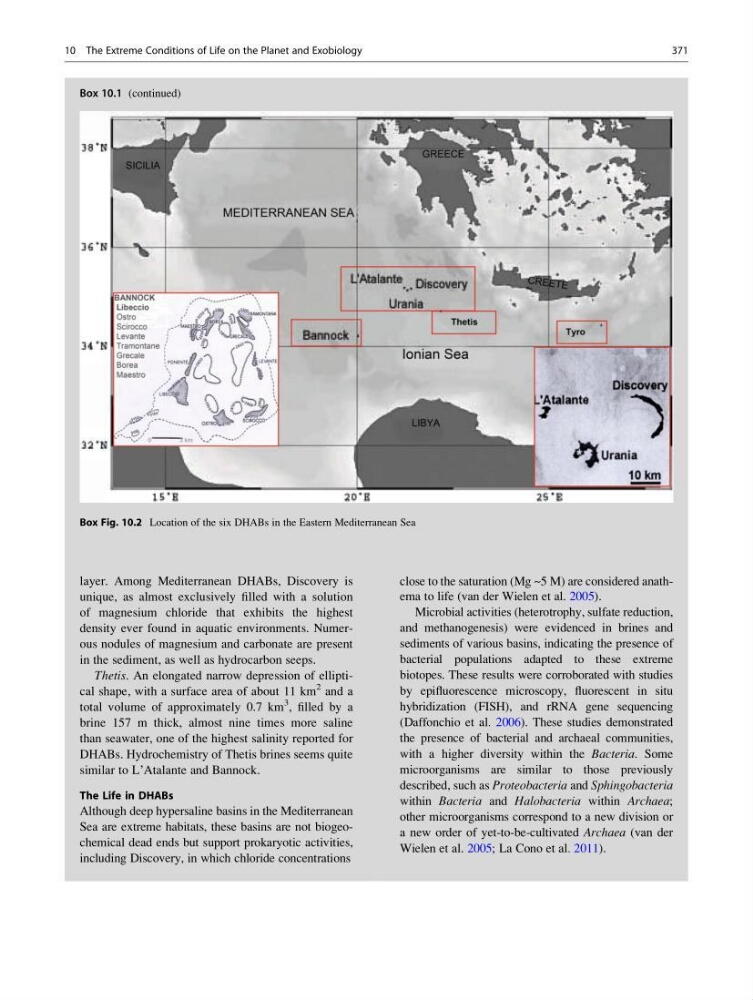
Box Fig. 10.2 Location of the six DHABs in the Eastern Mediterranean Sea
10 The Extreme Conditions of Life on the Planet and Exobiology
371
layer. Among Mediterranean DHABs, Discovery is
unique, as almost exclusively filled with a solution
of magnesium chloride that exhibits the highest
density ever found in aquatic environments. Numerous nodules of magnesium and carbonate are present
in the sediment, as well as hydrocarbon seeps.
Thetis. An elongated narrow depression of elliptical shape, with a surface area of about 11 km
2 and a
total volume of approximately 0.7 km
3 , filled by a
brine 157 m thick, almost nine times more saline
than seawater, one of the highest salinity reported for
DHABs. Hydrochemistry of Thetis brines seems quite
similar to L’Atalante and Bannock.
The Life in DHABs
Although deep hypersaline basins in the Mediterranean
Sea are extreme habitats, these basins are not biogeochemical dead ends but support prokaryotic activities,
including Discovery, in which chloride concentrations
(continued)
Box 10.1 (continued)
close to the saturation (Mg ~5 M) are considered anathema to life (van der Wielen et al. 2005).
Microbial activities (heterotrophy, sulfate reduction,
and methanogenesis) were evidenced in brines and
sediments of various basins, indicating the presence of
bacterial populations adapted to these extreme
biotopes. These results were corroborated with studies
by epifluorescence microscopy, fluorescent in situ
hybridization (FISH), and rRNA gene sequencing
(Daffonchio et al. 2006). These studies demonstrated
the presence of bacterial and archaeal communities,
with a higher diversity within the Bacteria. Some
microorganisms are similar to those previously
described, such as Proteobacteria and Sphingobacteria
within Bacteria and Halobacteria within Archaea;
other microorganisms correspond to a new division or
a new order of yet-to-be-cultivated Archaea (van der
Wielen et al. 2005; La Cono et al. 2011).
Box Fig. 10.2 Location of the six DHABs in the Eastern Mediterranean Sea
10 The Extreme Conditions of Life on the Planet and Exobiology
371