

Box 10.1 (continued)
homogeneous brine throughout the anoxic layer,
which thickness is limited, less than 60 m.
Bannock. A complex and irregular depression
about 15 km in diameter; with an area of 46.5 km
2
occupied by 4.1 km
3 of salt brine, it is the largest
Mediterranean anoxic basin. Within this area, nine
satellite basins have been identified and named after
various local winds: Libeccio, Sirocco, Ponante, Tramontane, Levante, etc. (Box Fig. 10.2). The Libeccio
sub-basin, the deepest and the most studied, is referred
(continued)
Box 10.1 (continued)
as the Bannock Basin: brines, constituted by seawater
concentrated 8–10 times, are enriched in potassium,
brome, and magnesium and saturated in gypsum and
dolomite, with formation of gypsum crystals within
sediments. Brines are stratified and consist of two
separate layers with different physical and chemical
properties: the upper layer is 150 m thick and the
lower layer is 300 m thick. Bannock brines would
have formed 150,000 years ago.
Urania. A horseshoe-shaped depression about
6 km width, filled with brines which thickness ranges
from 80 to 200 m, and stratified in two separated
layers, and the presence in the western arm, of a
deep hole fed with very fluid black mud (so called
the “mud pit”) at up to 65
C. Urania brines are
strongly H 2 S enriched, up to 10 mM, and so exhibiting
the highest concentration of sulfide among the Earth
aquatic environments; in addition, brines contain
10–100 times more dissolved methane than other
DHABs, as well as other hydrocarbons, such as ethane
and propane (Borin et al. 2008; Sass et al. 2001).
L’Atalante. The brine layer is homogeneous in
chemical composition; however, thermal stratification
is observed, with three layers: seawater 13.84
C, the
top 16-m thick layer 13.82
C, the middle 30-m thick
layer 13.91
C, and the bottom 40-m thick layer
14.06
C. Brines exhibited the highest sulfate
concentrations (397 mM) measured among Mediterranean DHABs and are also strongly enriched in potassium (up to 390 mM), suggesting a derivation from the
potassium chloride, which is a characteristic of the
uppermost levels of the evaporitic suite.
Discovery. An elongated basin in arc of a circle,
with a surface area of about 7.5 km
2 and a volume of
nearly 0.2 km
3 , contains a single homogeneous brine
(continued)
3500 m
80 - 500 m
SEAWATER
INTERFACE 1
UPPER BRINE
SEDIMENT
INTERFACE 2
LOWER BRINE
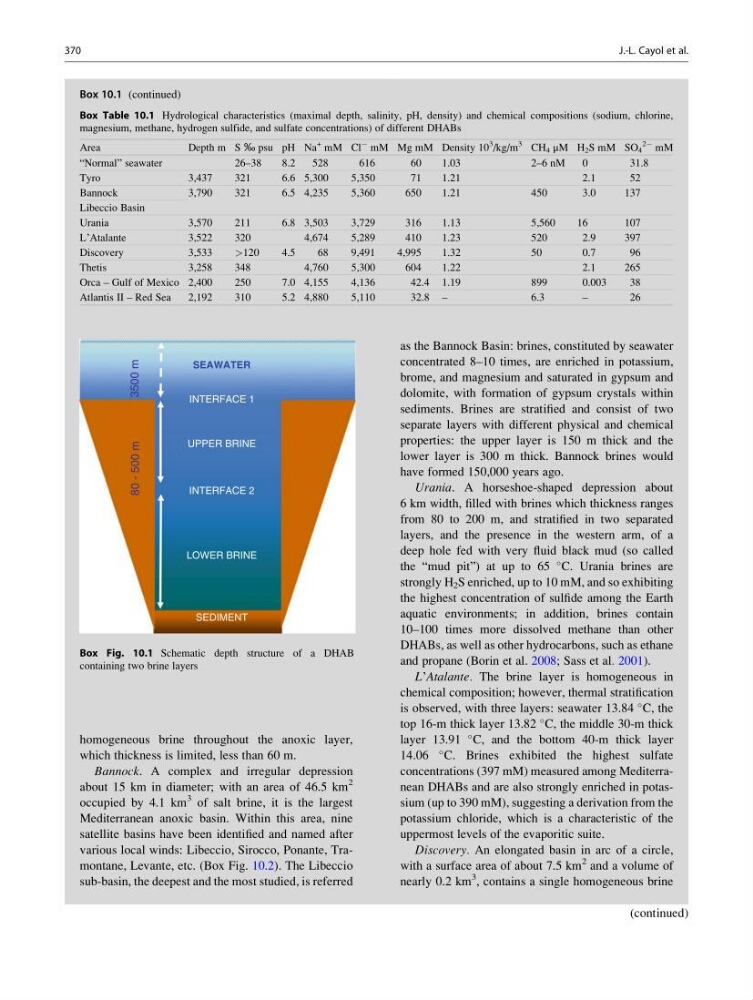
Box Fig. 10.1 Schematic depth structure of a DHAB
containing two brine layers
Box Table 10.1 Hydrological characteristics (maximal depth, salinity, pH, density) and chemical compositions (sodium, chlorine,
magnesium, methane, hydrogen sulfide, and sulfate concentrations) of different DHABs
Area
Depth m S ‰ psu pH Na
+ mM Cl
À mM Mg mM Density 10
3
/kg/m
3 CH 4 μM H 2 S mM SO 4
2À mM
“Normal” seawater
26–38
8.2
528
616
60
1.03
2–6 nM
0
31.8
Tyro
3,437
321
6.6 5,300
5,350
71
1.21
2.1
52
Bannock
3,790
321
6.5 4,235
5,360
650
1.21
450
3.0
137
Libeccio Basin
Urania
3,570
211
6.8 3,503
3,729
316
1.13
5,560
16
107
L’Atalante
3,522
320
4,674
5,289
410
1.23
520
2.9
397
Discovery
3,533
>120
4.5
68
9,491
4,995
1.32
50
0.7
96
Thetis
3,258
348
4,760
5,300
604
1.22
2.1
265
Orca – Gulf of Mexico 2,400
250
7.0 4,155
4,136
42.4 1.19
899
0.003
38
Atlantis II – Red Sea
2,192
310
5.2 4,880
5,110
32.8 –
6.3
–
26
370
J.-L. Cayol et al.
homogeneous brine throughout the anoxic layer,
which thickness is limited, less than 60 m.
Bannock. A complex and irregular depression
about 15 km in diameter; with an area of 46.5 km
2
occupied by 4.1 km
3 of salt brine, it is the largest
Mediterranean anoxic basin. Within this area, nine
satellite basins have been identified and named after
various local winds: Libeccio, Sirocco, Ponante, Tramontane, Levante, etc. (Box Fig. 10.2). The Libeccio
sub-basin, the deepest and the most studied, is referred
(continued)
Box 10.1 (continued)
as the Bannock Basin: brines, constituted by seawater
concentrated 8–10 times, are enriched in potassium,
brome, and magnesium and saturated in gypsum and
dolomite, with formation of gypsum crystals within
sediments. Brines are stratified and consist of two
separate layers with different physical and chemical
properties: the upper layer is 150 m thick and the
lower layer is 300 m thick. Bannock brines would
have formed 150,000 years ago.
Urania. A horseshoe-shaped depression about
6 km width, filled with brines which thickness ranges
from 80 to 200 m, and stratified in two separated
layers, and the presence in the western arm, of a
deep hole fed with very fluid black mud (so called
the “mud pit”) at up to 65
C. Urania brines are
strongly H 2 S enriched, up to 10 mM, and so exhibiting
the highest concentration of sulfide among the Earth
aquatic environments; in addition, brines contain
10–100 times more dissolved methane than other
DHABs, as well as other hydrocarbons, such as ethane
and propane (Borin et al. 2008; Sass et al. 2001).
L’Atalante. The brine layer is homogeneous in
chemical composition; however, thermal stratification
is observed, with three layers: seawater 13.84
C, the
top 16-m thick layer 13.82
C, the middle 30-m thick
layer 13.91
C, and the bottom 40-m thick layer
14.06
C. Brines exhibited the highest sulfate
concentrations (397 mM) measured among Mediterranean DHABs and are also strongly enriched in potassium (up to 390 mM), suggesting a derivation from the
potassium chloride, which is a characteristic of the
uppermost levels of the evaporitic suite.
Discovery. An elongated basin in arc of a circle,
with a surface area of about 7.5 km
2 and a volume of
nearly 0.2 km
3 , contains a single homogeneous brine
(continued)
3500 m
80 - 500 m
SEAWATER
INTERFACE 1
UPPER BRINE
SEDIMENT
INTERFACE 2
LOWER BRINE
Box Fig. 10.1 Schematic depth structure of a DHAB
containing two brine layers
Box Table 10.1 Hydrological characteristics (maximal depth, salinity, pH, density) and chemical compositions (sodium, chlorine,
magnesium, methane, hydrogen sulfide, and sulfate concentrations) of different DHABs
Area
Depth m S ‰ psu pH Na
+ mM Cl
À mM Mg mM Density 10
3
/kg/m
3 CH 4 μM H 2 S mM SO 4
2À mM
“Normal” seawater
26–38
8.2
528
616
60
1.03
2–6 nM
0
31.8
Tyro
3,437
321
6.6 5,300
5,350
71
1.21
2.1
52
Bannock
3,790
321
6.5 4,235
5,360
650
1.21
450
3.0
137
Libeccio Basin
Urania
3,570
211
6.8 3,503
3,729
316
1.13
5,560
16
107
L’Atalante
3,522
320
4,674
5,289
410
1.23
520
2.9
397
Discovery
3,533
>120
4.5
68
9,491
4,995
1.32
50
0.7
96
Thetis
3,258
348
4,760
5,300
604
1.22
2.1
265
Orca – Gulf of Mexico 2,400
250
7.0 4,155
4,136
42.4 1.19
899
0.003
38
Atlantis II – Red Sea
2,192
310
5.2 4,880
5,110
32.8 –
6.3
–
26
370
J.-L. Cayol et al.