

microorganisms have an optimum growth 15
C and a
maximum temperature for growth 20
C. They would
differ from psychrotolerant microorganisms with optimum
and maximum temperatures being 20
C and 35
C,
respectively. The psychrotrophic term also occurs and
corresponds more or less to the psychrotolerant term; these
terms are unnecessary and can be confusing. Indeed culture
experiments indicate for these microorganisms that:
1. There is a continuum in the adaptation to cold.
2. Any classification is restrictive.
3. The psychrophilic term is the only one correct as it unambiguously indicates that the bacterium is adapted to cold.
4. The psychrotolerant term is based on the misconception
that bacteria grow particularly well in what is called the
optimal growth temperature obtained from the growth
rate (Âh
À1 ) or doubling time (Âh) of the microorganism
measured according to the temperature of cultivation. In
fact, this temperature is a critical temperature resulting
from the crossing of two curves: one is the exponential
increase in the growth rate as a function of temperature
kinetic effect corresponding to the Arrhenius law and
the second decreasing corresponds to the deleterious
effect of temperature on cellular components such as
proteins (cf. Sect. 9.6.1). The real optimum temperature
for growth is often very different from those defined
above; it is probably close to the temperature of the
environment for endemic species. This can easily be
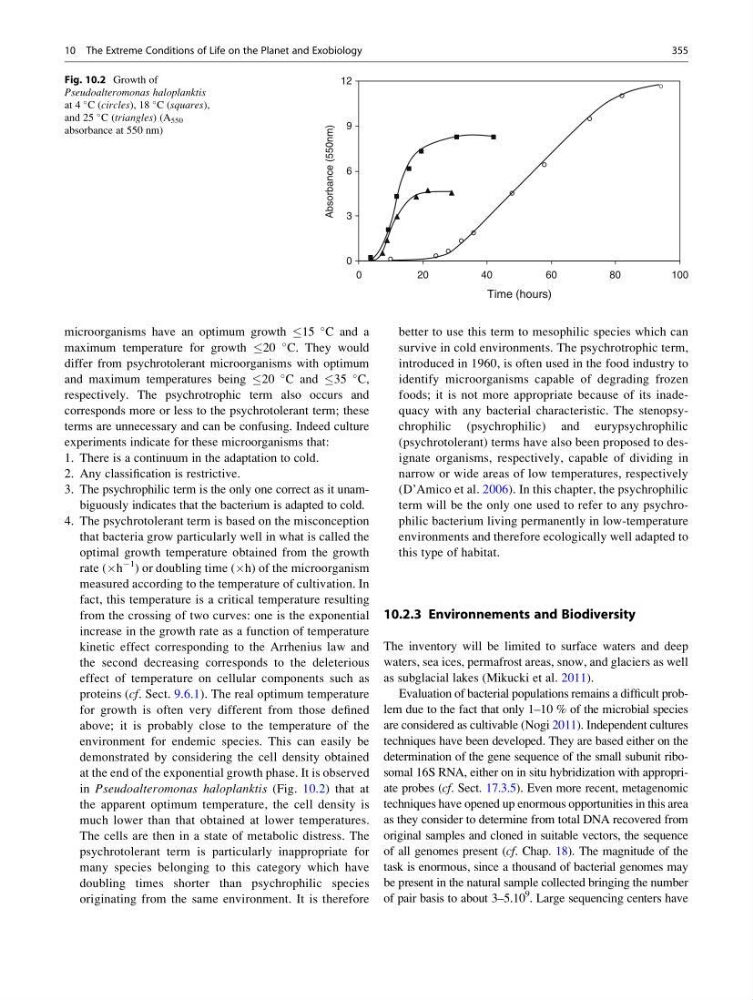
demonstrated by considering the cell density obtained
at the end of the exponential growth phase. It is observed
in Pseudoalteromonas haloplanktis (Fig. 10.2) that at
the apparent optimum temperature, the cell density is
much lower than that obtained at lower temperatures.
The cells are then in a state of metabolic distress. The
psychrotolerant term is particularly inappropriate for
many species belonging to this category which have
doubling times shorter than psychrophilic species
originating from the same environment. It is therefore
better to use this term to mesophilic species which can
survive in cold environments. The psychrotrophic term,
introduced in 1960, is often used in the food industry to
identify microorganisms capable of degrading frozen
foods; it is not more appropriate because of its inadequacy with any bacterial characteristic. The stenopsychrophilic (psychrophilic) and eurypsychrophilic
(psychrotolerant) terms have also been proposed to designate organisms, respectively, capable of dividing in
narrow or wide areas of low temperatures, respectively
(D’Amico et al. 2006). In this chapter, the psychrophilic
term will be the only one used to refer to any psychrophilic bacterium living permanently in low-temperature
environments and therefore ecologically well adapted to
this type of habitat.
10.2.3 Environnements and Biodiversity
The inventory will be limited to surface waters and deep
waters, sea ices, permafrost areas, snow, and glaciers as well
as subglacial lakes (Mikucki et al. 2011).
Evaluation of bacterial populations remains a difficult problem due to the fact that only 1–10 % of the microbial species
are considered as cultivable (Nogi 2011). Independent cultures
techniques have been developed. They are based either on the
determination of the gene sequence of the small subunit ribosomal 16S RNA, either on in situ hybridization with appropriate probes (cf. Sect. 17.3.5). Even more recent, metagenomic
techniques have opened up enormous opportunities in this area
as they consider to determine from total DNA recovered from
original samples and cloned in suitable vectors, the sequence
of all genomes present (cf. Chap. 18). The magnitude of the
task is enormous, since a thousand of bacterial genomes may
be present in the natural sample collected bringing the number
of pair basis to about 3–5.10
9
. Large sequencing centers have
0
3
6
9
12
0
2 0
4 0
6 0
8 0
1 0 0
Absorbance (550nm)
Time (hours)
Fig. 10.2 Growth of
Pseudoalteromonas haloplanktis
at 4
C (circles), 18
C (squares),
and 25
C (triangles) (A 550
absorbance at 550 nm)
10 The Extreme Conditions of Life on the Planet and Exobiology
355
C and a
maximum temperature for growth 20
C. They would
differ from psychrotolerant microorganisms with optimum
and maximum temperatures being 20
C and 35
C,
respectively. The psychrotrophic term also occurs and
corresponds more or less to the psychrotolerant term; these
terms are unnecessary and can be confusing. Indeed culture
experiments indicate for these microorganisms that:
1. There is a continuum in the adaptation to cold.
2. Any classification is restrictive.
3. The psychrophilic term is the only one correct as it unambiguously indicates that the bacterium is adapted to cold.
4. The psychrotolerant term is based on the misconception
that bacteria grow particularly well in what is called the
optimal growth temperature obtained from the growth
rate (Âh
À1 ) or doubling time (Âh) of the microorganism
measured according to the temperature of cultivation. In
fact, this temperature is a critical temperature resulting
from the crossing of two curves: one is the exponential
increase in the growth rate as a function of temperature
kinetic effect corresponding to the Arrhenius law and
the second decreasing corresponds to the deleterious
effect of temperature on cellular components such as
proteins (cf. Sect. 9.6.1). The real optimum temperature
for growth is often very different from those defined
above; it is probably close to the temperature of the
environment for endemic species. This can easily be
demonstrated by considering the cell density obtained
at the end of the exponential growth phase. It is observed
in Pseudoalteromonas haloplanktis (Fig. 10.2) that at
the apparent optimum temperature, the cell density is
much lower than that obtained at lower temperatures.
The cells are then in a state of metabolic distress. The
psychrotolerant term is particularly inappropriate for
many species belonging to this category which have
doubling times shorter than psychrophilic species
originating from the same environment. It is therefore
better to use this term to mesophilic species which can
survive in cold environments. The psychrotrophic term,
introduced in 1960, is often used in the food industry to
identify microorganisms capable of degrading frozen
foods; it is not more appropriate because of its inadequacy with any bacterial characteristic. The stenopsychrophilic (psychrophilic) and eurypsychrophilic
(psychrotolerant) terms have also been proposed to designate organisms, respectively, capable of dividing in
narrow or wide areas of low temperatures, respectively
(D’Amico et al. 2006). In this chapter, the psychrophilic
term will be the only one used to refer to any psychrophilic bacterium living permanently in low-temperature
environments and therefore ecologically well adapted to
this type of habitat.
10.2.3 Environnements and Biodiversity
The inventory will be limited to surface waters and deep
waters, sea ices, permafrost areas, snow, and glaciers as well
as subglacial lakes (Mikucki et al. 2011).
Evaluation of bacterial populations remains a difficult problem due to the fact that only 1–10 % of the microbial species
are considered as cultivable (Nogi 2011). Independent cultures
techniques have been developed. They are based either on the
determination of the gene sequence of the small subunit ribosomal 16S RNA, either on in situ hybridization with appropriate probes (cf. Sect. 17.3.5). Even more recent, metagenomic
techniques have opened up enormous opportunities in this area
as they consider to determine from total DNA recovered from
original samples and cloned in suitable vectors, the sequence
of all genomes present (cf. Chap. 18). The magnitude of the
task is enormous, since a thousand of bacterial genomes may
be present in the natural sample collected bringing the number
of pair basis to about 3–5.10
9
. Large sequencing centers have
0
3
6
9
12
0
2 0
4 0
6 0
8 0
1 0 0
Absorbance (550nm)
Time (hours)
Fig. 10.2 Growth of
Pseudoalteromonas haloplanktis
at 4
C (circles), 18
C (squares),
and 25
C (triangles) (A 550
absorbance at 550 nm)
10 The Extreme Conditions of Life on the Planet and Exobiology
355