

these lower or upper limits for life is named an extreme
environment: pH lower than 3, temperature above 80
C,
hydrostatic pressure above 20 MPa, etc. Deep-sea hydrothermal vents; cold deep-sea; acidic pools; salt marshes; and
permafrost are examples of extreme environments.
Regarding organisms that thrive in such environments,
one can distinguish several physiological categories.
When certain organisms are exposed to a given parameter
with value incompatible with their life cycle requirements, they
can face this aggression. For instance, some bacteria form
spores, which are resistant to heat, and can remain under
this almost inert stage for very long periods (a lifetime of
250 million years have been reported) (Vreeland et al. 2000).
Other organisms have developed diverse and complex
cellular and molecular mechanisms that allow them to resist,
for instance, to elevated concentrations of toxic heavy
metals or to repair their DNA damaged by ionizing
radiations. For both categories, extreme conditions are not
required for the accomplishment of the life cycle. But some
organisms have “learned” during evolution how to protect
themselves or to repair damages.
A third category of microorganisms can accomplish their
life cycles only if the environmental conditions are extreme.
This is the case of a hyperthermophile (cf. Sect. 10.3) which
cannot grow at temperature below 65
C, a temperature which
is lethal for psychrophiles (cf. Sect. 10.2). A piezophilic microorganism (cf. Sect. 10.5) will stop its growth when exposed to
atmospheric pressure. All of them are called extremophiles.
All these organisms really deserve the name of extremophile.
Despite some of them belonging to the Eukarya domain,
mostly belong to the Bacteria and Archaea domains. In all
cases, their study is in relation with microbial ecology, and this
is why they have been highlighted in this book.
10.2 Psychrophilic Bacteria
10.2.1 Presentation
Psychrophilic bacteria are microorganisms adapted to cold
(literally “cold loving” cf. Sect. 9.6.1). They represent a
considerable biomass since cold environments are the most
important part on Earth: indeed they comprise not only polar
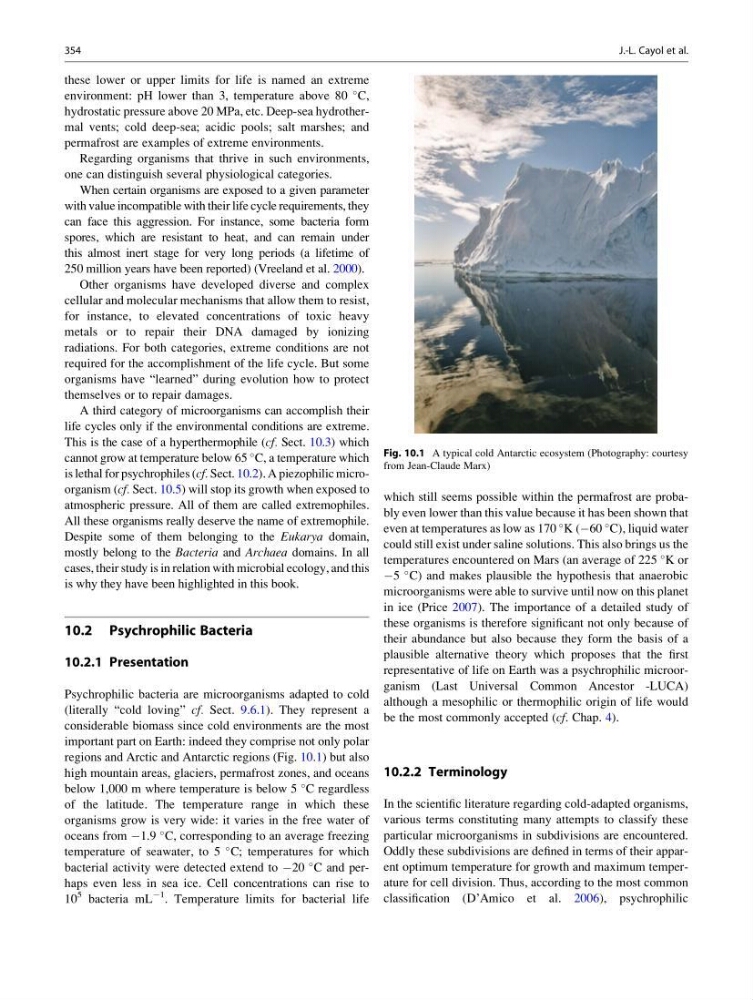
regions and Arctic and Antarctic regions (Fig. 10.1) but also
high mountain areas, glaciers, permafrost zones, and oceans
below 1,000 m where temperature is below 5
C regardless
of the latitude. The temperature range in which these
organisms grow is very wide: it varies in the free water of
oceans from À1.9
C, corresponding to an average freezing
temperature of seawater, to 5
C; temperatures for which
bacterial activity were detected extend to À20
C and perhaps even less in sea ice. Cell concentrations can rise to
10
5 bacteria mL
À1 . Temperature limits for bacterial life
which still seems possible within the permafrost are probably even lower than this value because it has been shown that
even at temperatures as low as 170
K (À60
C), liquid water
could still exist under saline solutions. This also brings us the
temperatures encountered on Mars (an average of 225
K or
À5
C) and makes plausible the hypothesis that anaerobic
microorganisms were able to survive until now on this planet
in ice (Price 2007). The importance of a detailed study of
these organisms is therefore significant not only because of
their abundance but also because they form the basis of a
plausible alternative theory which proposes that the first
representative of life on Earth was a psychrophilic microorganism (Last Universal Common Ancestor -LUCA)
although a mesophilic or thermophilic origin of life would
be the most commonly accepted (cf. Chap. 4).
10.2.2 Terminology
In the scientific literature regarding cold-adapted organisms,
various terms constituting many attempts to classify these
particular microorganisms in subdivisions are encountered.
Oddly these subdivisions are defined in terms of their apparent optimum temperature for growth and maximum temperature for cell division. Thus, according to the most common
classification (D’Amico et al. 2006), psychrophilic
Fig. 10.1 A typical cold Antarctic ecosystem (Photography: courtesy
from Jean-Claude Marx)
354
J.-L. Cayol et al.
environment: pH lower than 3, temperature above 80
C,
hydrostatic pressure above 20 MPa, etc. Deep-sea hydrothermal vents; cold deep-sea; acidic pools; salt marshes; and
permafrost are examples of extreme environments.
Regarding organisms that thrive in such environments,
one can distinguish several physiological categories.
When certain organisms are exposed to a given parameter
with value incompatible with their life cycle requirements, they
can face this aggression. For instance, some bacteria form
spores, which are resistant to heat, and can remain under
this almost inert stage for very long periods (a lifetime of
250 million years have been reported) (Vreeland et al. 2000).
Other organisms have developed diverse and complex
cellular and molecular mechanisms that allow them to resist,
for instance, to elevated concentrations of toxic heavy
metals or to repair their DNA damaged by ionizing
radiations. For both categories, extreme conditions are not
required for the accomplishment of the life cycle. But some
organisms have “learned” during evolution how to protect
themselves or to repair damages.
A third category of microorganisms can accomplish their
life cycles only if the environmental conditions are extreme.
This is the case of a hyperthermophile (cf. Sect. 10.3) which
cannot grow at temperature below 65
C, a temperature which
is lethal for psychrophiles (cf. Sect. 10.2). A piezophilic microorganism (cf. Sect. 10.5) will stop its growth when exposed to
atmospheric pressure. All of them are called extremophiles.
All these organisms really deserve the name of extremophile.
Despite some of them belonging to the Eukarya domain,
mostly belong to the Bacteria and Archaea domains. In all
cases, their study is in relation with microbial ecology, and this
is why they have been highlighted in this book.
10.2 Psychrophilic Bacteria
10.2.1 Presentation
Psychrophilic bacteria are microorganisms adapted to cold
(literally “cold loving” cf. Sect. 9.6.1). They represent a
considerable biomass since cold environments are the most
important part on Earth: indeed they comprise not only polar
regions and Arctic and Antarctic regions (Fig. 10.1) but also
high mountain areas, glaciers, permafrost zones, and oceans
below 1,000 m where temperature is below 5
C regardless
of the latitude. The temperature range in which these
organisms grow is very wide: it varies in the free water of
oceans from À1.9
C, corresponding to an average freezing
temperature of seawater, to 5
C; temperatures for which
bacterial activity were detected extend to À20
C and perhaps even less in sea ice. Cell concentrations can rise to
10
5 bacteria mL
À1 . Temperature limits for bacterial life
which still seems possible within the permafrost are probably even lower than this value because it has been shown that
even at temperatures as low as 170
K (À60
C), liquid water
could still exist under saline solutions. This also brings us the
temperatures encountered on Mars (an average of 225
K or
À5
C) and makes plausible the hypothesis that anaerobic
microorganisms were able to survive until now on this planet
in ice (Price 2007). The importance of a detailed study of
these organisms is therefore significant not only because of
their abundance but also because they form the basis of a
plausible alternative theory which proposes that the first
representative of life on Earth was a psychrophilic microorganism (Last Universal Common Ancestor -LUCA)
although a mesophilic or thermophilic origin of life would
be the most commonly accepted (cf. Chap. 4).
10.2.2 Terminology
In the scientific literature regarding cold-adapted organisms,
various terms constituting many attempts to classify these
particular microorganisms in subdivisions are encountered.
Oddly these subdivisions are defined in terms of their apparent optimum temperature for growth and maximum temperature for cell division. Thus, according to the most common
classification (D’Amico et al. 2006), psychrophilic
Fig. 10.1 A typical cold Antarctic ecosystem (Photography: courtesy
from Jean-Claude Marx)
354
J.-L. Cayol et al.