

allows activation of the basal body of the flagella through the
flow of sodium and the generation of ATP by sodium motive
force. The internal pH of alkaliphilic prokaryotes is generally maintained at two pH units below the pH optimum in
their environment. The Na
+ /H
+ anti-port allows an internal
accumulation of H
+ and a decreased pH.
Alkaline enzymes have been identified in alkaliphilic
bacteria. Alkaline proteases and amylases have been isolated
and characterized from alkalophilic Bacillus. These
enzymes have optimum activity at pH 10 to 10.5 and still
present 50 % of their maximum of activity at pH 9 or 11
(Hamamoto et al. 1994).
Maintenance of Homeostasis*
The bacteria and archaea regulate their internal pH through
the accumulation of weak acids (salicylic acid) or weak
bases (methylamines). Amino acids can also play the role
of cytoplasmic buffer (anions or cations). There may also
be an induced production of acids or bases. For example,
at alkaline pH, malic acid is synthesized from glucose, while
at acidic pH, it is converted into pyruvate by malate decarboxylase. Finally, active transports of H
+ or OH
À are
regulated by the internal pH: H
+ is replaced by K
+ or Na
+
,
and OH
À is replaced by Cl
À . In alkaliphilic bacteria, regulation of genes for alkaliphilicity was demonstrated based
on the presence of two DNA fragments, pALK11 and
pALK 2, that are present in alkaliphilic Bacillus and absent
in non alkaliphilic Bacillus and can confer alkaliphilicity
when they are transferred via the help of a plasmid.
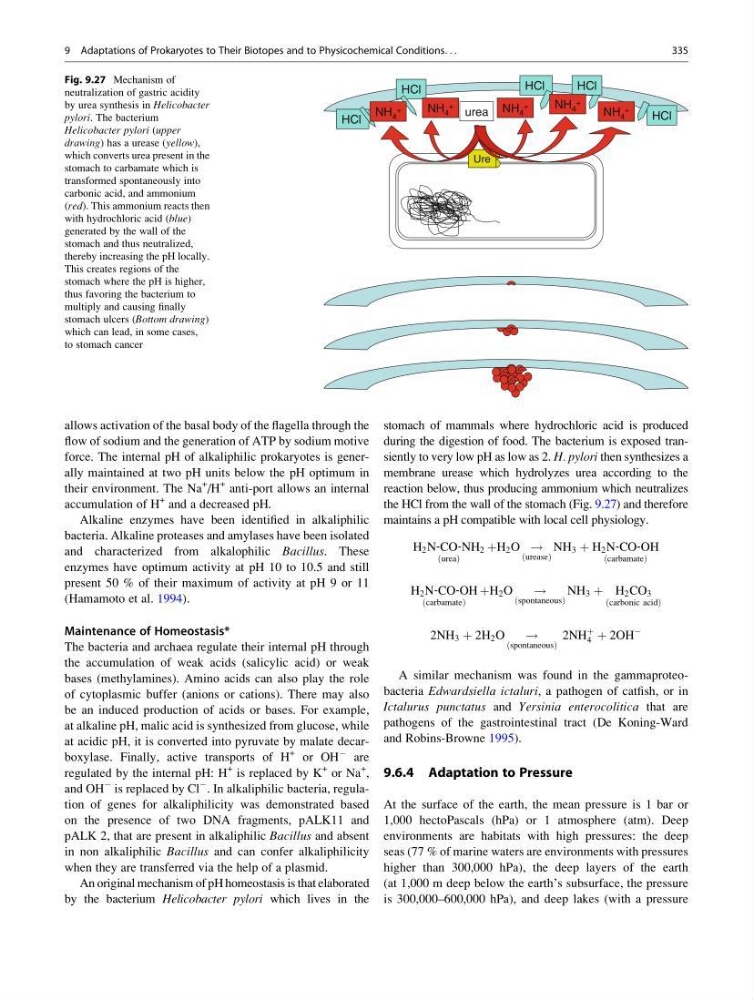
An original mechanism of pH homeostasis is that elaborated
by the bacterium Helicobacter pylori which lives in the
stomach of mammals where hydrochloric acid is produced
during the digestion of food. The bacterium is exposed transiently to very low pH as low as 2. H. pylori then synthesizes a
membrane urease which hydrolyzes urea according to the
reaction below, thus producing ammonium which neutralizes
the HCl from the wall of the stomach (Fig. 9.27) and therefore
maintains a pH compatible with local cell physiology.
H 2 N‐CO‐NH 2
urea
ð
Þ
þH 2 O !
urease
ð
Þ
NH 3 þ H 2 N‐CO‐OH
carbamate
ð
Þ
H 2 N‐CO‐OH
carbamate
ð
Þ
þH 2 O
!
spontaneous
ð
Þ
NH 3 þ H 2 CO 3
carbonic acid
ð
Þ
2NH 3 þ 2H 2 O
!
spontaneous
ð
Þ
2NH
þ
4 þ 2OH
À
A similar mechanism was found in the gammaproteobacteria Edwardsiella ictaluri, a pathogen of catfish, or in
Ictalurus punctatus and Yersinia enterocolitica that are
pathogens of the gastrointestinal tract (De Koning-Ward
and Robins-Browne 1995).
9.6.4 Adaptation to Pressure
At the surface of the earth, the mean pressure is 1 bar or
1,000 hectoPascals (hPa) or 1 atmosphere (atm). Deep
environments are habitats with high pressures: the deep
seas (77 % of marine waters are environments with pressures
higher than 300,000 hPa), the deep layers of the earth
(at 1,000 m deep below the earth’s subsurface, the pressure
is 300,000–600,000 hPa), and deep lakes (with a pressure
Ure
urea
HCl
HCl
HCl
NH 4
+
NH 4
+
NH 4
+
HCl
HCl
NH 4
+
NH 4
+
Fig. 9.27 Mechanism of
neutralization of gastric acidity
by urea synthesis in Helicobacter
pylori. The bacterium
Helicobacter pylori (upper
drawing) has a urease (yellow),
which converts urea present in the
stomach to carbamate which is
transformed spontaneously into
carbonic acid, and ammonium
(red). This ammonium reacts then
with hydrochloric acid (blue)
generated by the wall of the
stomach and thus neutralized,
thereby increasing the pH locally.
This creates regions of the
stomach where the pH is higher,
thus favoring the bacterium to
multiply and causing finally
stomach ulcers (Bottom drawing)
which can lead, in some cases,
to stomach cancer
9 Adaptations of Prokaryotes to Their Biotopes and to Physicochemical Conditions. . .
335
flow of sodium and the generation of ATP by sodium motive
force. The internal pH of alkaliphilic prokaryotes is generally maintained at two pH units below the pH optimum in
their environment. The Na
+ /H
+ anti-port allows an internal
accumulation of H
+ and a decreased pH.
Alkaline enzymes have been identified in alkaliphilic
bacteria. Alkaline proteases and amylases have been isolated
and characterized from alkalophilic Bacillus. These
enzymes have optimum activity at pH 10 to 10.5 and still
present 50 % of their maximum of activity at pH 9 or 11
(Hamamoto et al. 1994).
Maintenance of Homeostasis*
The bacteria and archaea regulate their internal pH through
the accumulation of weak acids (salicylic acid) or weak
bases (methylamines). Amino acids can also play the role
of cytoplasmic buffer (anions or cations). There may also
be an induced production of acids or bases. For example,
at alkaline pH, malic acid is synthesized from glucose, while
at acidic pH, it is converted into pyruvate by malate decarboxylase. Finally, active transports of H
+ or OH
À are
regulated by the internal pH: H
+ is replaced by K
+ or Na
+
,
and OH
À is replaced by Cl
À . In alkaliphilic bacteria, regulation of genes for alkaliphilicity was demonstrated based
on the presence of two DNA fragments, pALK11 and
pALK 2, that are present in alkaliphilic Bacillus and absent
in non alkaliphilic Bacillus and can confer alkaliphilicity
when they are transferred via the help of a plasmid.
An original mechanism of pH homeostasis is that elaborated
by the bacterium Helicobacter pylori which lives in the
stomach of mammals where hydrochloric acid is produced
during the digestion of food. The bacterium is exposed transiently to very low pH as low as 2. H. pylori then synthesizes a
membrane urease which hydrolyzes urea according to the
reaction below, thus producing ammonium which neutralizes
the HCl from the wall of the stomach (Fig. 9.27) and therefore
maintains a pH compatible with local cell physiology.
H 2 N‐CO‐NH 2
urea
ð
Þ
þH 2 O !
urease
ð
Þ
NH 3 þ H 2 N‐CO‐OH
carbamate
ð
Þ
H 2 N‐CO‐OH
carbamate
ð
Þ
þH 2 O
!
spontaneous
ð
Þ
NH 3 þ H 2 CO 3
carbonic acid
ð
Þ
2NH 3 þ 2H 2 O
!
spontaneous
ð
Þ
2NH
þ
4 þ 2OH
À
A similar mechanism was found in the gammaproteobacteria Edwardsiella ictaluri, a pathogen of catfish, or in
Ictalurus punctatus and Yersinia enterocolitica that are
pathogens of the gastrointestinal tract (De Koning-Ward
and Robins-Browne 1995).
9.6.4 Adaptation to Pressure
At the surface of the earth, the mean pressure is 1 bar or
1,000 hectoPascals (hPa) or 1 atmosphere (atm). Deep
environments are habitats with high pressures: the deep
seas (77 % of marine waters are environments with pressures
higher than 300,000 hPa), the deep layers of the earth
(at 1,000 m deep below the earth’s subsurface, the pressure
is 300,000–600,000 hPa), and deep lakes (with a pressure
Ure
urea
HCl
HCl
HCl
NH 4
+
NH 4
+
NH 4
+
HCl
HCl
NH 4
+
NH 4
+
Fig. 9.27 Mechanism of
neutralization of gastric acidity
by urea synthesis in Helicobacter
pylori. The bacterium
Helicobacter pylori (upper
drawing) has a urease (yellow),
which converts urea present in the
stomach to carbamate which is
transformed spontaneously into
carbonic acid, and ammonium
(red). This ammonium reacts then
with hydrochloric acid (blue)
generated by the wall of the
stomach and thus neutralized,
thereby increasing the pH locally.
This creates regions of the
stomach where the pH is higher,
thus favoring the bacterium to
multiply and causing finally
stomach ulcers (Bottom drawing)
which can lead, in some cases,
to stomach cancer
9 Adaptations of Prokaryotes to Their Biotopes and to Physicochemical Conditions. . .
335